Google Lost Four Senior AI Researchers to Anthropic and OpenAI in Six Days
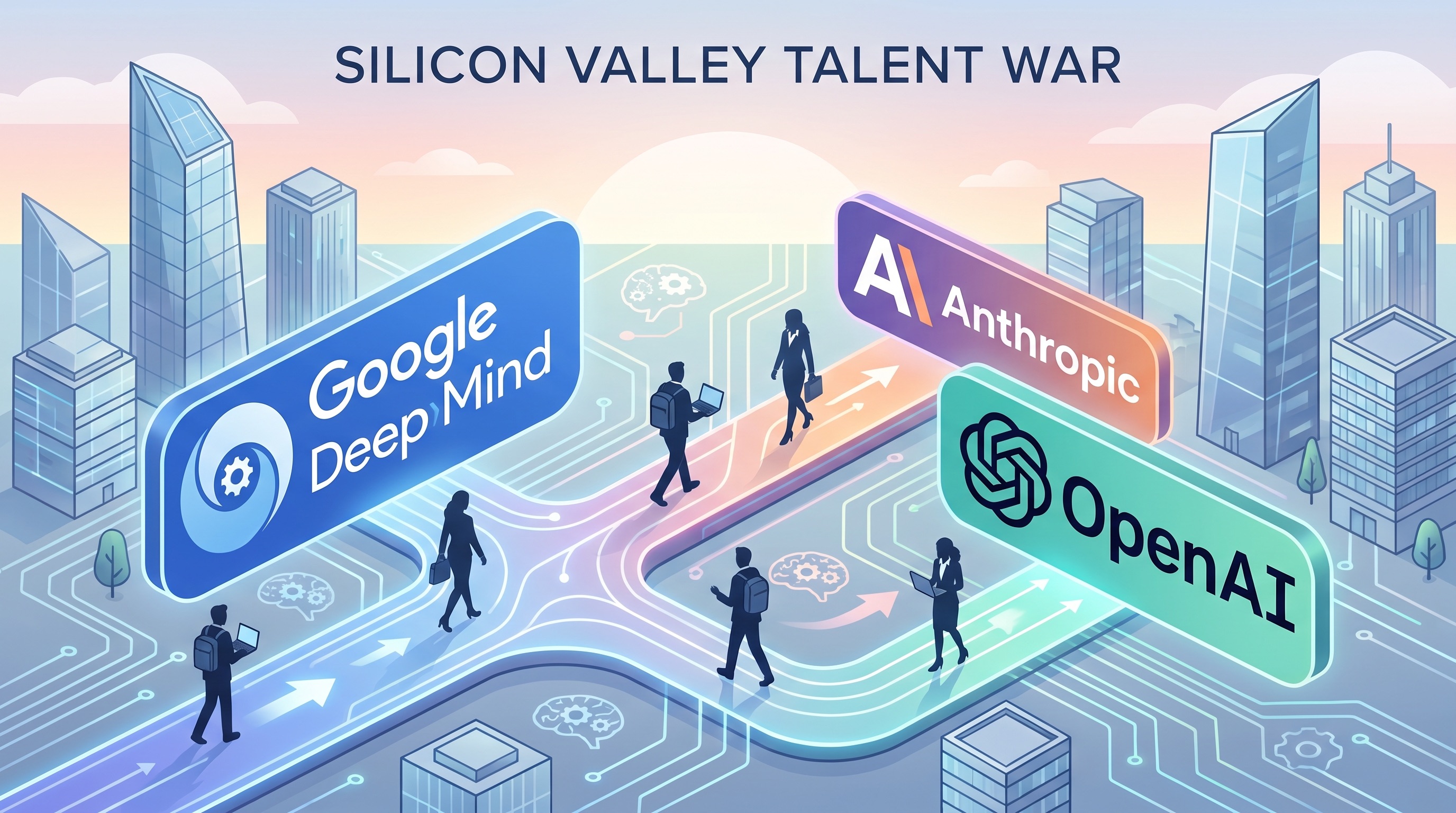
Google has lost four of its most senior AI researchers to rivals in a span of six days, a concentrated talent departure that marks a new intensity in the industry's ongoing war for AI expertise, as reported by TechCrunch and Bloomberg.
The most prominent departure is John Jumper, a director at Google DeepMind, who announced he is leaving to join Anthropic after nearly nine years at the company. Jumper won the 2024 Nobel Prize in Chemistry alongside DeepMind CEO Demis Hassabis for their work on AlphaFold, the AI system that predicts 3D protein structures from amino acid sequences. His announcement, posted on June 19, confirmed he would take time to recharge before starting at Anthropic.
Two More Gemini Contributors Follow
Bloomberg reported on June 24 that Jonas Adler and Alexander Pritzel — both described as key contributors to Google's Gemini AI model — are also heading to Anthropic. Adler worked on Google's AI coding efforts, the same area where Anthropic's Claude Code has achieved significant commercial traction. Pritzel was involved in pretraining, the foundational phase in which models learn from large volumes of data. Neither departure has been publicly confirmed by Google.
Shazeer Goes to OpenAI
The parallel departure of Noam Shazeer adds a separate dimension. Shazeer, who has been at Google for most of his career since 2000 (except three years building Character.AI, which Google acquired for $2.7 billion partly to bring him back), announced he is leaving for IPO-bound OpenAI. His loss is particularly significant: Shazeer co-led Google's Gemini model development and is widely regarded as one of the most influential researchers in transformer architecture.
Why This Is Happening Now
The timing tracks with a well-documented IPO premium. As Anthropic and OpenAI prepare to go public, both companies can recruit with equity packages that have clear, near-term liquidity. For researchers who joined Google years ago and whose equity has largely vested, the math has shifted. Anthropic in particular has been aggressive — the company is tracking toward $559 million in operating profit in Q2 2026, and its fundraising has given it the capital to compete on compensation.
There is also a structural factor. Bloomberg reported that GPU resources at Google were recently reassigned from active research projects to a London-based team, creating friction among researchers who found their work suddenly deprioritized. For researchers already weighing offers, that kind of organizational disruption can tip the decision.
Google's Position
Google has not commented on the departures. The company retains an enormous research base and continues to release frontier models — Gemini 3.5 Pro, though delayed from June to July, remains a leading benchmark performer. But the loss of four visible senior researchers in quick succession is a reputational hit that goes beyond the individuals involved. It signals, accurately or not, that Google is no longer the default destination for top AI talent.
Originally reported by TechCrunch. Read the original article for additional details.
View original source