Apple enters the smart display market with HomeView, a $299 face-recognizing screen for the home
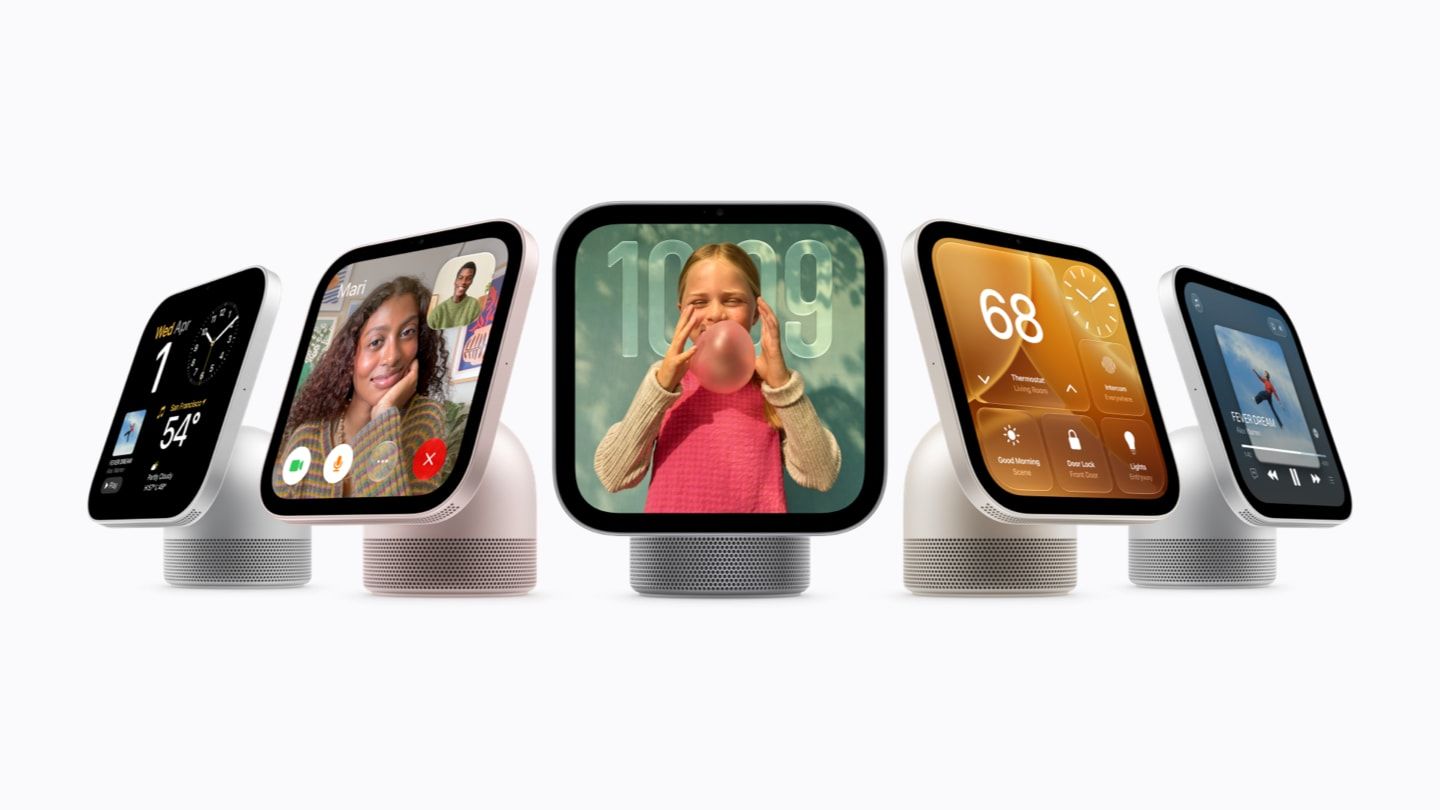
Apple unveiled its long-rumored smart home push on October 13, 2026 at a “Welcome home” event in Tribeca, introducing a new product category called HomeView alongside refreshed Apple TV 4K and HomePod mini hardware. It is Apple’s first new device category launch in years and its most direct answer yet to Amazon’s Echo Show and Google’s Nest Hub lineups — nearly two decades after the smart-display category first emerged.
HomeView: a shared screen that knows who’s looking at it
HomeView is a 7-inch square Liquid Retina display with True Tone, peak brightness of 500 nits, and the ability to dim down to 0.3 nits for use as a bedside display. It ships in two physical forms: a tabletop version that sits on a domed speaker base with a tilting stainless steel hinge, and a wall-mounted version that attaches via Schneider Home mounts (sold separately starting at $59.95 for the USB-C wall connector mount). Both versions cost $299 and are available to pre-order now, shipping November 13. Apple says HomeView will not be sold in the European Union.
The device’s signature feature is face recognition for up to six household members, each getting a personalized home screen with their own apps and widgets, while shared content like family photo albums and music stays visible to everyone. Apple’s SVP of Worldwide Marketing, Greg Joswiak, described it as a device designed to be “a shared household device that still feels personal to each member” — switching automatically from a family-facing screen to an individual’s own experience based on who it recognizes.
HomeView runs through five distinct “Faces”, or home-screen modes: a Photos face with portrait-style depth effects, a Flow face that reacts to presence and movement, a Snoopy-themed face with time-of-day and weather animations, a Home Modular face for quick smart-home accessory access, and a Home Camera face that can livestream up to nine video feeds simultaneously. A built-in Center Stage camera handles FaceTime calls, and the audio system packs two full-range drivers, a down-firing woofer, and two force-canceling passive radiators.
Siri AI is central to the pitch: paired with an Apple Intelligence-capable iPhone or iPad, HomeView can draw on personal context — calendar, messages, reminders — while Apple says that information stays private to the recognized user. Without a paired Apple Intelligence device, it still offers general world knowledge and music discovery.
Apple TV 4K gets its first update in four years
The new Apple TV 4K is built around an A19 chip, which Apple says delivers up to 50% faster CPU performance and 2x faster GPU performance than the outgoing model. It ships with 128GB of storage and Gigabit Ethernet, priced at $299, available to pre-order now and shipping November 13 — the same day as HomeView.
The redesigned Siri Remote, also sold separately for $59 and compatible with older Apple TV 4K and Apple TV HD models, adds a built-in speaker for Find My and Precision Finding location assistance. Far-field microphones built into the Apple TV box itself let users summon Siri AI hands-free. Paired with two HomePod mini 2 units and two full-size HomePod 2 speakers, the system can form a calibrated four-speaker surround setup.
HomePod mini 2: a modest but overdue refresh
The HomePod mini 2 keeps the original’s design but swaps in Apple’s S10 chip (up from the S5) and adds “Sound Glow” — a lighting effect where the top of the speaker pulses in sync with music, with album artwork setting a color-matched display per song. It launches in five colors — green, pink, blue, midnight, and white — priced at $149, up from the original’s $99 launch price (and $129 after an earlier 2026 price increase). Pre-orders opened today; general availability is October 30. Siri AI support is promised but will arrive via a later software update rather than at launch.
A platform bet, not just hardware
Apple also introduced the Apple Home Collection, a line of third-party smart home accessories — cameras, thermostats, and a smart lock — developed in partnership with LG and Schneider, signaling that Apple wants HomeView to anchor an entire accessory ecosystem rather than exist as a standalone gadget.
The timing matters. Reports describing HomeView’s development trace a nearly two-year delay: Apple reportedly planned a smart home hub launch as early as March 2025 before shelving it when the AI-upgraded Siri it depended on slipped. The version shipping now arrives well after Amazon and Google have spent years iterating on their own smart-display lines — Apple is entering a mature category rather than defining a new one, and its $299 price sits well above entry-level competitors from both companies. Whether Apple’s privacy-centric, no-App-Store approach and tighter hardware integration can win over a market already comfortable with cheaper alternatives will be the real test over the next several months.
As announced by Apple and first detailed in Apple’s official newsroom.
Originally reported by Apple Newsroom. Read the original article for additional details.
View original source