AMD Launches EPYC 6 Venice: 256-Core Server CPUs on TSMC 2nm Target the AI Agent Era
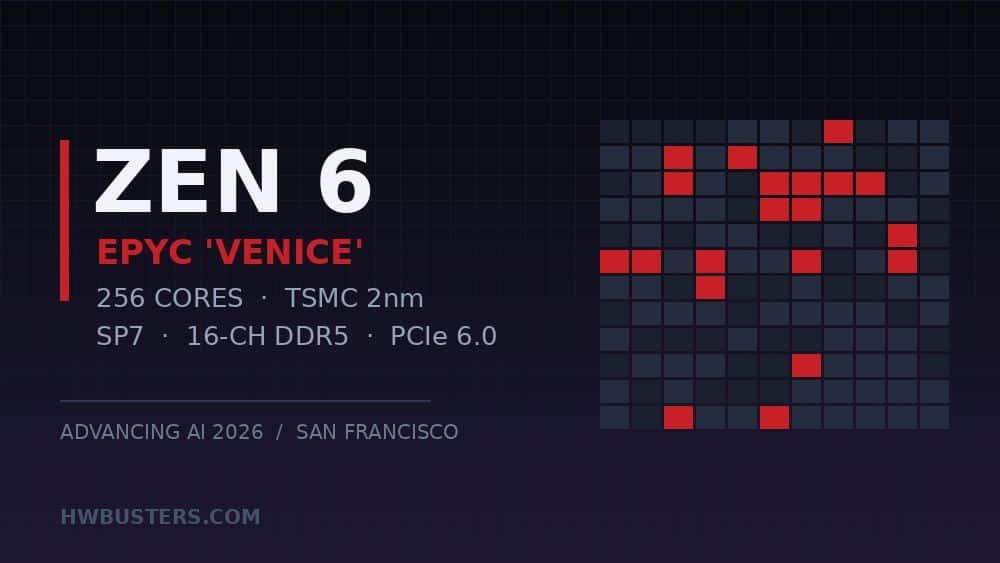
AMD launched its sixth-generation EPYC server processors on November 10, beginning shipments of the Venice lineup — built on TSMC's 2nm process — to major data center customers. Microsoft Azure is already running two new instance types on the chips, and several major server OEMs have begun shipping systems. The Venice processors bring 256 cores, a 31% IPC improvement over the previous EPYC Turin generation for AI workloads, and mark the first deployment of PCIe Gen 6 in a production server CPU.
Zen 6 Architecture: Two Core Variants
EPYC 6 Venice uses two variants of AMD's Zen 6 architecture. The standard Zen 6 core targets high-frequency workloads, with top models offering 96 cores, a 4.05 GHz base clock, and a 5.3 GHz boost. The denser Zen 6c variant is built for maximum core counts, reaching 256 cores at 2.55 GHz base across 512 threads. AMD credits FP16 format support and improved VNNI-INT8 instructions — used heavily in neural network inference — for the 31% IPC gain over Turin on AI workloads.
Built for AI Agent Architectures
AMD is explicitly positioning EPYC 6 around AI agent workloads, in which GPU clusters run neural network inference while CPUs orchestrate the tool calls and logic those agents execute. The company claims 3.3 times more AI agent operations per watt than Nvidia's Vera CPU — a figure based on internal testing that has not been independently verified. Dan McNamara, AMD's senior VP and GM of its Compute and Enterprise AI unit, said at the launch: "AI is significantly expanding the role of the CPU across every layer of the data center." The pitch also has an economic angle: running agent tools on EPYC chips can reduce licensing costs for per-core software like enterprise databases.
PCIe Gen 6 and Memory Bandwidth
EPYC Venice is the first production server CPU to implement PCIe Gen 6, doubling bandwidth per lane compared to PCIe Gen 5. The platform supports 16 DDR5 memory channels — up from 12 on Turin — bringing peak memory bandwidth to 1.6 TB/s per socket. This expanded I/O throughput matters for AI inference workloads that need to stream large model weights rapidly from memory.
Availability and Pricing
The SP7 socket platform is shipping now. SP8-based systems, as well as the cache-enhanced EPYC 9006X and the LPDDR5X-paired EPYC 9006LP variants, are scheduled to follow in 2027. The EPYC 9006 lineup spans 31 models across both platforms, with entry pricing around $700 and the flagship 256-core EPYC 9996 listed at $14,904. As reported by SiliconANGLE, Microsoft Azure has already deployed two new instance types on EPYC 6 optimized for AI inference and chip design software.
Originally reported by SiliconANGLE. Read the original article for additional details.
View original source