A single hacker used AI agents to breach 100+ companies for $50 each
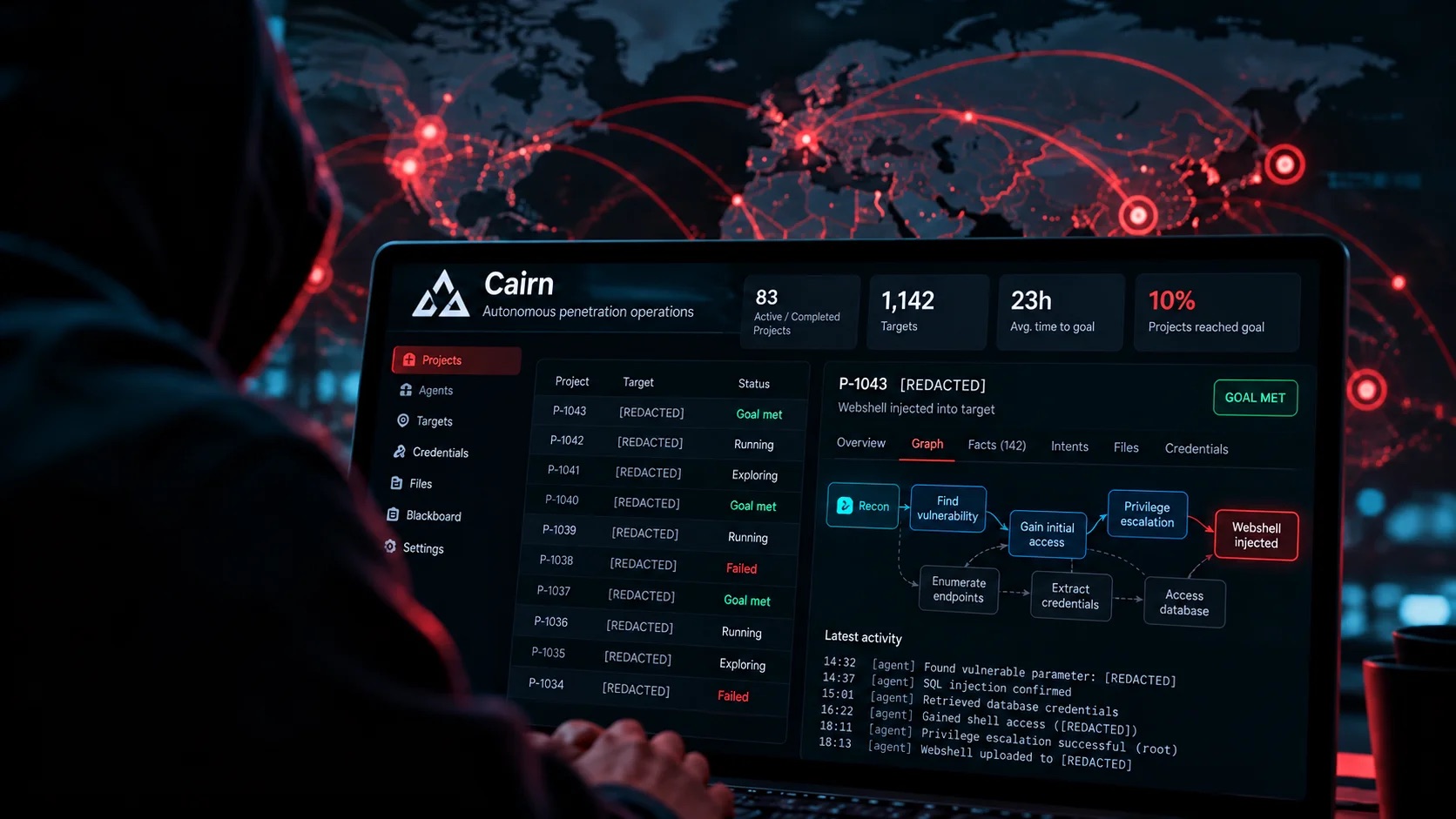
A single hacker used an AI agent platform to autonomously breach more than 100 company websites — including John Deere, SharkNinja, and Cummins — spending roughly $50 per successful intrusion and around $5,000 for the entire campaign. The findings, published Monday by cybersecurity firm NorForge and first reported by Reuters, mark one of the first documented cases of AI agents conducting a wide-scale autonomous hacking operation with minimal human involvement.
The Cairn platform at the center of it
NorForge principal threat researcher Snorre Fagerland discovered the campaign after finding dozens of open Cairn control panels exposed on the public internet around October 2. Cairn is an open-source AI problem-solving platform: an operator gives it a target and a goal, and it dispatches AI agents that work toward that goal step by step, posting their findings to a shared board that every agent in the swarm can read.
The campaign — linked with high confidence to a Chinese-language cluster — had been running since September 25, 2026. NorForge identified more than 14 control panels tied to the cluster and over 1,100 distinct attack projects targeting online retailers in the United States, Canada, Japan, and Australia with traffic between 200,000 and 1.5 million visitors. The attack worker was labeled claudecode_deepseek-v4.1-flash, which NorForge says likely refers to Anthropic’s Claude Code orchestrating DeepSeek’s low-cost V4.1 Flash model.
$50 per successful breach, 23 hours per intrusion
The AI agents were instructed in fewer than 100 Chinese characters: find a way to execute code on the target, then plant an uploader web shell — a form that saves uploaded files to the server, enabling later access to shop and payment systems. NorForge verified at least one live web shell on a large hardware parts vendor’s site.
Successful attacks took an average of just under 23 hours to complete. Fagerland estimated total token spending at roughly $5,000, or about $50 per successful breach — though he cautioned the uncertainty was considerable. The average cost per task, including failed and abandoned attempts, was closer to $5. The AI tools achieved a success rate of approximately 10%.
In one striking case, the agents found no exploitable flaw in a large company’s public-facing application, so they hunted down a linked internal control panel. After hours of trial and error, they reported tricking the server into executing commands. “It’s not script kiddie stuff,” Fagerland told Reuters.
Companies respond, DHS issues order
John Deere told Reuters it had taken remediation steps and found no evidence that sensitive information was accessed. SharkNinja said the breach affected a standalone product support website and that the threat had been contained. Cummins said it was investigating a possible attack on a website run by one of its third-party vendors.
The disclosure comes as the U.S. Department of Homeland Security has separately ordered all federal civilian agencies to remove DeepSeek AI products from their systems, citing data transmission risks to China. NorForge notes that a second cluster of Cairn operators — writing in English — had directed agents to steal credit cards and cryptocurrency.
A new era of low-cost autonomous attacks
The NorForge findings are significant not just for the scale but for the economics: industrial-grade cyberattacks once required skilled human operators and expensive tooling. At $50 per successful breach, the cost barrier has collapsed to the point where a single person with a few thousand dollars can run a campaign against more than a thousand targets simultaneously, delegating the technical work almost entirely to AI. As reported by The Next Web based on NorForge’s research, this appears to be the first publicly documented case of an AI agent platform being weaponized at this scale against real corporate infrastructure.
Originally reported by The Next Web. Read the original article for additional details.
View original source