Zero Trust Is No Longer Optional: How Enterprise Security Architecture Changed in 2026
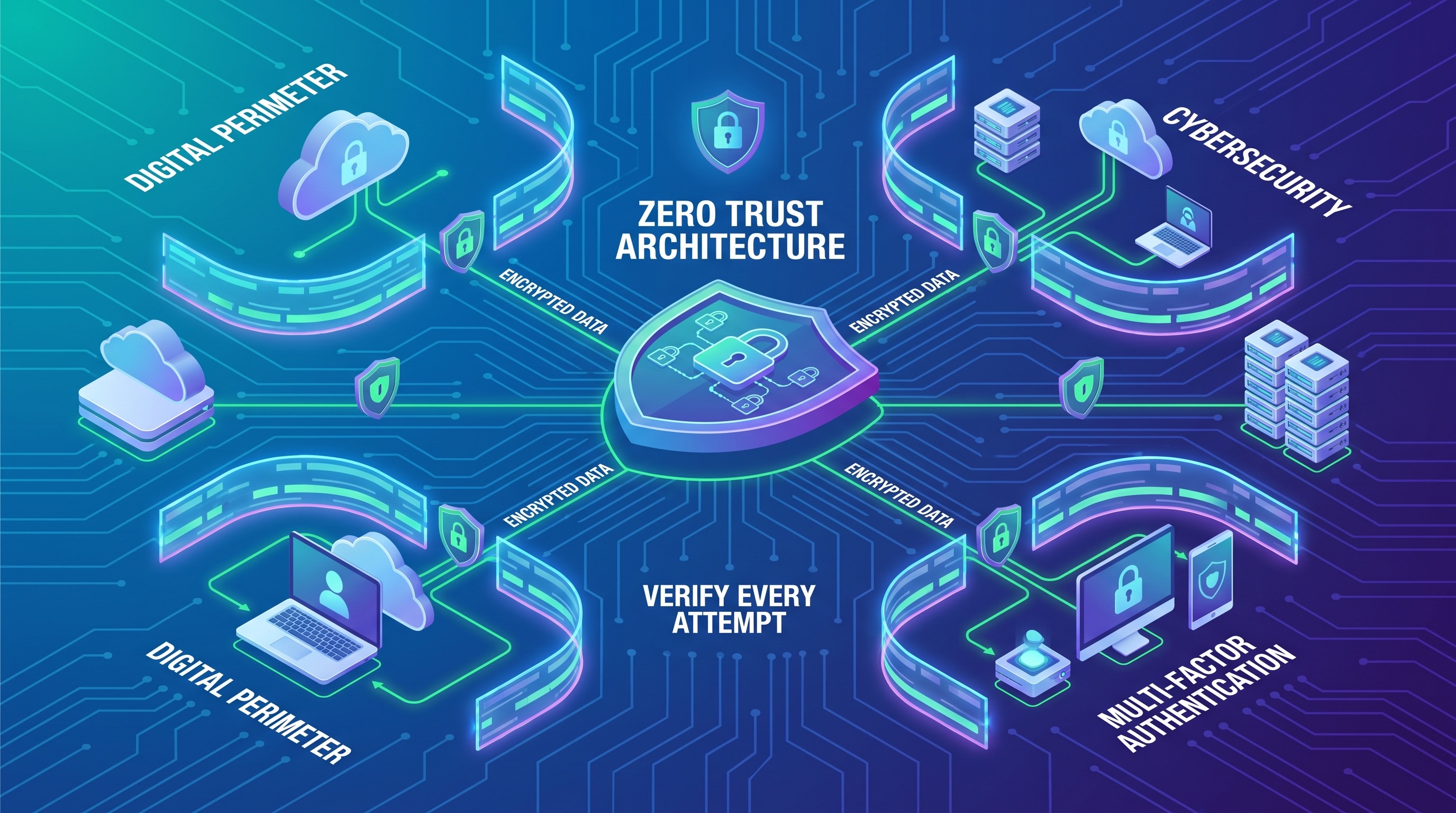
For most of the 2010s, Zero Trust was a framework that security vendors used to sell products and consultants used to justify engagements. The core idea — never trust a request just because it comes from inside the network perimeter — was sound, but the implementation guidance was vague enough that organizations could claim compliance without meaningfully changing anything.
That era is over. A combination of regulatory mandates, high-profile breaches that exploited exactly the assumptions Zero Trust was designed to eliminate, and maturing tooling has turned Zero Trust from an architectural philosophy into a minimum viable security posture. If your organization is still relying primarily on VPNs and network perimeter trust in 2026, you are not just behind — you are measurably more exposed.
What Zero Trust Actually Means
Zero Trust is not a product you buy. It is a set of principles applied across your infrastructure. The National Institute of Standards and Technology (NIST) defines it as a security model where no implicit trust is granted to assets or users based solely on their physical or network location. Every access request — from every user, device, and application — is authenticated, authorized, and continuously validated before being granted.
In practice, this collapses to five pillars that organizations implement progressively:
- Identity: Who is this? Multi-factor authentication for every access request, with phishing-resistant methods (FIDO2, hardware keys, or passkeys) replacing SMS codes.
- Devices: Is this device healthy? Device posture checks verify that a laptop or phone is patched, encrypted, and compliant before allowing access to sensitive resources.
- Networks: What does this device actually need to reach? Microsegmentation limits lateral movement so that a compromised endpoint cannot reach the entire network.
- Applications: Application-layer access control rather than network-layer trust. Users are granted access to specific applications, not placed onto a network where they can discover everything.
- Data: Data classification and access controls that follow the data regardless of where it lives — on-premises, in cloud storage, or in SaaS applications.
What Drove Adoption From Philosophy to Requirement
Three forces converged to make Zero Trust non-optional between 2021 and 2026.
The first was regulatory pressure. The Biden administration's 2021 Executive Order on cybersecurity mandated that US federal agencies implement Zero Trust architecture by 2024, with CISA publishing detailed implementation guidance. The EU's NIS2 Directive, which took effect in October 2024, extended similar requirements to critical infrastructure operators across member states. Healthcare-specific regulations (HIPAA updates) and financial services rules added sector-specific mandates on top of general frameworks.
The second was a string of high-profile breaches that were, in retrospect, textbook illustrations of what Zero Trust prevents. Attackers who compromised a single endpoint or obtained a single set of credentials were able to move laterally through networks because implicit trust was granted to anything inside the perimeter. The SolarWinds breach, the Microsoft Exchange server attacks, and a cluster of ransomware campaigns in healthcare and critical infrastructure all shared this pattern.
The third force was tooling maturity. By 2024, every major enterprise vendor had a credible Zero Trust offering — and they had become coherent enough to actually implement without a multi-year custom integration project. Microsoft's Entra suite, Zscaler's Zero Trust Exchange, Cloudflare's Zero Trust platform, Okta for identity, and CrowdStrike Falcon for device posture are the most common building blocks enterprises are assembling today.
VPNs Are Being Replaced by ZTNA
The most visible operational change in enterprise security over the past three years has been the shift from VPNs to Zero Trust Network Access (ZTNA). VPNs were designed for a world where employees occasionally needed remote access to a network. They grant broad network-level access and are notoriously difficult to segment. A user connected over VPN can typically reach far more than they need to for any specific task.
ZTNA reverses this model. Instead of connecting a user to the network, ZTNA connects a user to a specific application — and only after verifying identity and device health. The user never has direct network visibility to anything beyond what they are explicitly authorized to access. This eliminates the lateral movement vector that VPN-based architectures expose.
Gartner projected that ZTNA would replace VPN for remote access for more than 70% of new deployments by 2025. The enterprise market has broadly hit that trajectory. ZTNA is now the default architecture for new remote access deployments; VPNs are increasingly legacy infrastructure being phased out rather than extended.
The MFA Reality Check
Multi-factor authentication is a foundational Zero Trust control, but not all MFA is equal. SMS-based one-time passwords, once considered a meaningful security improvement, are now trivially bypassed by adversary-in-the-middle phishing attacks. Attackers intercept the user's login session in real-time and forward credentials — including the SMS code — to the real service before the code expires.
The industry has largely acknowledged this. CISA, NIST, and major cloud providers now recommend phishing-resistant MFA as the minimum for sensitive access. The options are FIDO2 hardware security keys (like YubiKey), platform passkeys built into modern operating systems, or certificate-based authentication. Each of these is tied to the specific origin of the login request and cannot be replayed against a different site — which eliminates the interception attack.
Passkeys, in particular, have become the consumer-facing implementation of FIDO2. Apple, Google, and Microsoft all support passkeys natively, and adoption among major consumer services accelerated significantly through 2025. For enterprise, hardware security keys remain the gold standard for privileged access.
Common Implementation Mistakes
Organizations that have started Zero Trust journeys consistently encounter a handful of recurring problems:
- Treating Zero Trust as a product purchase rather than an architectural shift. Buying a ZTNA product and deploying it for remote access is a good first step, but it does not make you Zero Trust. The principles need to be applied across identity, devices, applications, and data.
- Starting with the wrong pillar. Identity is almost always the right starting point — it delivers immediate risk reduction and forms the foundation for every other control. Organizations that start with network microsegmentation often stall because the complexity is high and the identity foundation is weak.
- Ignoring service-to-service authentication. Human user access is the obvious target, but machine-to-machine communication — APIs calling APIs, services accessing databases — is often left on implicit trust long after human access is locked down.
- Underestimating change management. Zero Trust changes the user experience of accessing applications. Without communication and training, friction increases and users find workarounds that defeat the security controls.
Actionable Starting Points
If your organization is early in its Zero Trust journey, the sequence that consistently delivers the most risk reduction per dollar spent is:
- Deploy phishing-resistant MFA for all users, starting with administrators and privileged accounts. This single control prevents a disproportionate share of successful attacks.
- Implement device health checks before granting access to sensitive applications. Most identity providers support device compliance as a conditional access policy.
- Replace VPN with a ZTNA solution for remote application access. Pilot with a single application before rolling out broadly.
- Audit and microsegment your most sensitive internal systems. Map which services actually need to talk to each other and enforce that with network policy.
- Implement data classification and enforce access controls that follow data regardless of location.
Zero Trust is not a destination you arrive at and then stop. It is an ongoing posture that requires continuous improvement as your infrastructure, threat landscape, and regulatory environment evolve. But the organizations that treat it as a checkbox will find out the hard way that attackers are not checking the same boxes.