Wi-Fi 7 Is Winning the Indoor Enterprise Network Fight Against Private 5G
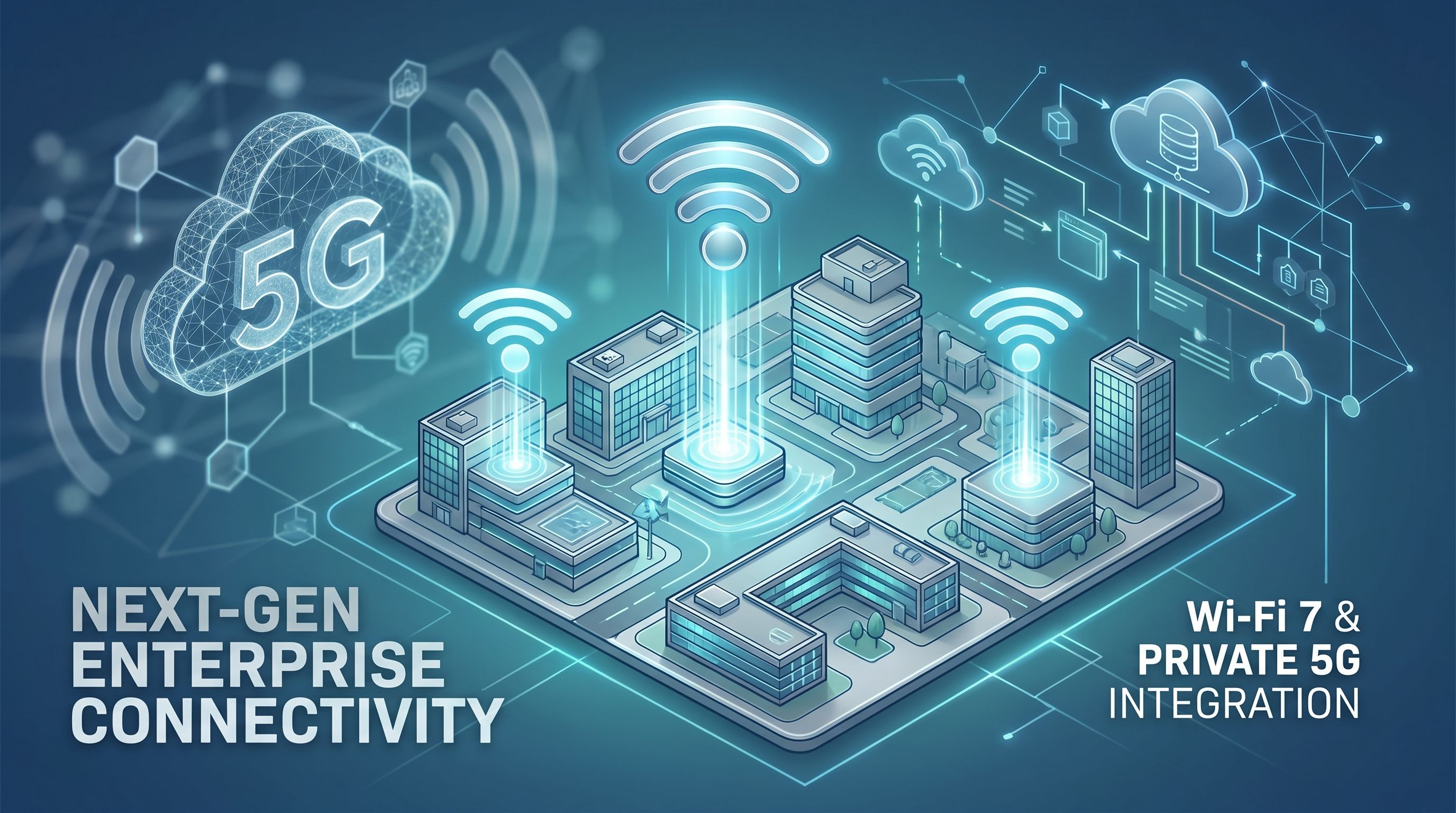
Indoor enterprise networking has turned into a much more practical contest than the marketing suggests. In offices, hospitals, universities, and mixed-use campuses, buyers are not asking which wireless standard sounds more advanced on a slide. They are asking which option gets thousands of employees and devices online quickly, works with existing laptops and phones, fits current IT operations, and stays affordable over a full refresh cycle. On that score, Wi-Fi 7 is starting to win far more often than private 5G.
That does not mean private 5G is irrelevant. It remains valuable in environments that need deterministic mobility, tightly controlled radio behavior, or industrial-grade segmentation. But for mainstream indoor enterprise demand, Wi-Fi 7 aligns better with the installed device base, the skill set of enterprise IT teams, and the economics of incremental upgrades. The result is simple: when the job is modernizing indoor connectivity rather than building a specialized operational network, Wi-Fi 7 increasingly looks like the default choice.
Why indoor buyers are leaning toward Wi-Fi 7
The biggest advantage Wi-Fi 7 has is not theoretical peak speed. It is fit. Most enterprises already run Wi-Fi, monitor Wi-Fi, secure Wi-Fi, and troubleshoot Wi-Fi. Their users arrive with Wi-Fi-capable devices, their buildings are already planned around access point density, and their procurement motions assume a familiar WLAN vendor ecosystem. Wi-Fi 7 improves that existing model with wider channels, more efficient spectrum use, multi-link operation, better handling of dense environments, and lower effective latency when networks are designed well.
For buyers, that means the upgrade path is understandable. They can replace access points floor by floor, keep existing management frameworks, and deliver an immediate improvement to devices that already expect Wi-Fi first indoors. Private 5G often asks the organization to adopt a new operating model at the same time it is trying to solve a coverage or capacity problem. That extra complexity is not always justified in a conventional enterprise building.
Compatibility matters more than slogans
Device compatibility is where the indoor argument usually becomes decisive. In office environments, the dominant clients are laptops, smartphones, tablets, collaboration endpoints, printers, and a long tail of peripherals. Nearly all of them are built to use Wi-Fi indoors as the primary data path. Even where cellular radios are present, enterprises do not typically control every SIM, modem profile, or hardware variation across the fleet.
Private 5G can look elegant in an architecture diagram, but the client story is often messier than the brochure implies. A network is only as useful as the endpoints that can use it with minimal friction. Wi-Fi 7 inherits an enormous advantage from the fact that enterprise client behavior is already centered on Wi-Fi associations, onboarding methods, and policy controls. For many IT leaders, that is more important than whether private 5G can deliver superior behavior in edge cases.
Operational simplicity is a strategic feature
Indoor networking decisions are heavily influenced by who will run the system after launch. Wi-Fi 7 usually fits the skills already inside the enterprise. Security teams understand certificate-based onboarding, network engineers understand access point placement, and help desks know how to diagnose most client-side failures. That familiarity lowers the hidden cost of ownership.
Private 5G can absolutely be run well, especially with experienced integrators or telecom partners, but it often introduces new dependencies. Spectrum licensing or local regulatory choices, core network architecture, SIM or eSIM lifecycle management, and cellular-specific troubleshooting all add work. In some sectors, those tradeoffs are justified. In a typical headquarters, classroom building, or clinical wing, they can feel like a heavy solution to a problem that better Wi-Fi already addresses.
Performance comparisons are becoming more nuanced
There was a period when private 5G advocates could rely on a simple message: cellular is more controlled, therefore better for enterprise-critical traffic. That framing now feels incomplete. Wi-Fi 7 is improving capacity, scheduling efficiency, and latency consistency in dense indoor spaces, especially when paired with modern switching, better policy engines, and careful RF design. It is not just faster Wi-Fi. It is more capable infrastructure for environments where many users, many applications, and many device types compete at once.
That does not erase private 5G's strengths. Cellular still has a compelling case when uninterrupted mobility across large facilities is essential, when a business wants stricter separation from guest or consumer traffic, or when devices must behave predictably in motion. Warehouses, factories, ports, and highly controlled operational environments may still prefer private 5G for good reasons. But those are narrower scenarios than the broad indoor enterprise market that includes desk-based knowledge work, education, and general-purpose clinical collaboration.
Budget reality is shaping the outcome
Many organizations entered the decade assuming they would eventually adopt some form of private cellular indoors. Then budgets tightened, hardware refresh cycles lengthened, and buyers became more demanding about measurable return. Under those conditions, Wi-Fi 7 benefits from being an upgrade rather than a reinvention. Enterprises can often preserve cabling plans, management contracts, authentication patterns, and user expectations. They spend money on better wireless outcomes without funding a parallel networking culture.
That financial difference goes beyond capex. It shows up in training, support, vendor coordination, and rollout speed. Indoor projects are frequently approved not because they are visionary, but because they are low-risk and easy to operationalize. Wi-Fi 7 meets that test more often. Private 5G has to prove not only that it works, but that its extra complexity creates value the enterprise can actually feel.
Where private 5G still deserves serious consideration
None of this means enterprises should dismiss private 5G. They should narrow the question. If the environment involves autonomous vehicles, persistent handheld mobility across long paths, machine connectivity that benefits from cellular behavior, or a need for tighter control over coverage and traffic engineering, private 5G remains a strong candidate. It can also matter where organizations want an operational network separated from employee IT, with different resiliency and lifecycle requirements.
The mistake is treating those conditions as universal. They are not. Many indoor spaces mainly need reliable collaboration, video meetings, SaaS access, roaming that is good enough rather than deterministic, and support for a huge diversity of personal and corporate devices. In those environments, Wi-Fi 7 usually solves the problem more directly.
How enterprise teams should evaluate the decision
Buyers should resist ideology and run a use-case-first evaluation. Start with the client mix. If most critical endpoints are already optimized for Wi-Fi, that matters. Then assess mobility requirements honestly. Does the business truly need cellular-style continuity, or does it need stronger indoor wireless in busy spaces? Next, examine the operating model. Can the current team deploy and support the chosen network without creating a permanent dependency on outside specialists?
It is also worth testing application behavior instead of staring at peak throughput. Measure how voice, video, collaboration suites, identity workflows, and device onboarding perform under load. Evaluate time to deploy, not just steady-state behavior. Indoor enterprise networks succeed when users stop noticing them, not when architects admire the diagram.
The likely market outcome
Wi-Fi 7 is winning the indoor enterprise fight because it matches the center of the market. It improves a wireless model enterprises already understand, supports the devices people actually carry, and reaches strong enough performance without importing unnecessary complexity. Private 5G remains real, but increasingly specialized indoors. The more buyers focus on day-two operations, endpoint reality, and budget discipline, the more Wi-Fi 7 benefits.
For enterprise decision-makers, the practical takeaway is clear. Use private 5G where mobility, determinism, or operational isolation genuinely justify it. For the majority of indoor office and campus upgrades, treat Wi-Fi 7 as the lead candidate and force alternatives to beat it on real business outcomes, not aspiration alone.