Wi-Fi 7 in 2025: What Multi-Link Operation Actually Changes
The Standard That Changes How Radios Work
The IEEE 802.11be standard, finalized in 2024 and marketed as Wi-Fi 7, is the first Wi-Fi generation to rethink the connection model rather than just raise the speed ceiling. Every previous Wi-Fi version—including Wi-Fi 6E with its 6 GHz band—required a device to pick one band and stick with it. If you were on 5 GHz, you were on 5 GHz. The router couldn't simultaneously use your 2.4 GHz radio as a backup or a supplement.
Wi-Fi 7 breaks that constraint entirely with Multi-Link Operation (MLO), and it matters more than any throughput statistic.
Multi-Link Operation: Using All Three Bands at Once
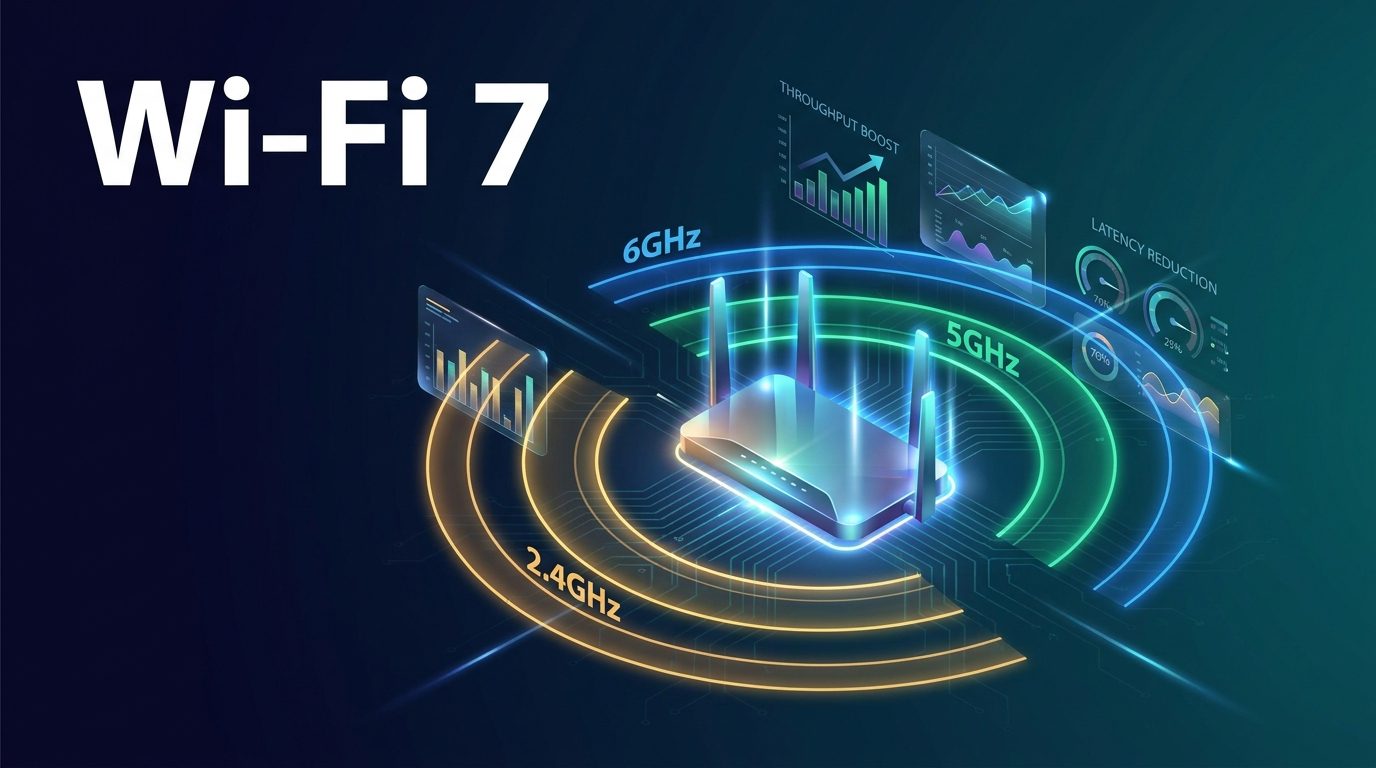
MLO allows a Wi-Fi 7 device to maintain active simultaneous connections on the 2.4 GHz, 5 GHz, and 6 GHz bands at the same time. The device and router coordinate across all three links as a single logical connection. In practice, this does three things:
- Aggregated throughput: traffic is split across bands, so you're not limited to what any single band can deliver.
- Automatic failover: if one band is congested or experiences interference, traffic shifts to the other active links instantly—no reconnect, no dropped packets.
- Lower latency: time-sensitive packets (a game state update, a VR frame) can be routed down the least-congested link at that moment instead of waiting in a queue behind bulk traffic on a single band.
The latency impact is the most underappreciated benefit. Wi-Fi 7 targets under 5ms for real-time applications. For cloud gaming and VR, where 20-30ms of wireless jitter is the difference between smooth and nauseous, MLO's ability to pick the cleanest path per packet is a genuine leap. Prior generations could prioritize traffic classes (Wi-Fi 6's OFDMA did this), but they couldn't escape interference on the chosen band. MLO sidesteps the band entirely.
The Other Technical Advances
Beyond MLO, Wi-Fi 7 raises the ceiling across the board. The maximum theoretical throughput is 46 Gbps, compared to 9.6 Gbps on Wi-Fi 6E—a nearly 5x increase. The practical contributors to that number:
- 320 MHz channel width in the 6 GHz band, double the 160 MHz maximum in Wi-Fi 6E. Wider channels carry more data per transmission.
- 4096-QAM modulation versus 1024-QAM in Wi-Fi 6 and 6E. QAM determines how much data is encoded per signal cycle; 4096-QAM packs 20% more bits per cycle under ideal conditions.
- 16 spatial streams through improved OFDMA, up from 8 in Wi-Fi 6. More streams mean more simultaneous data paths.
- Multi-Resource Units (MRU): the router can assign multiple resource units to a single client for bursty traffic, instead of rigidly dividing spectrum into fixed slices.
Under ideal lab conditions, Wi-Fi 7 routers are delivering 5–10 Gbps to compatible clients. That's real throughput, not marketing math—though it requires close proximity, minimal interference, and a Wi-Fi 7 client device.
The Hardware That Exists Right Now
Wi-Fi 7 is no longer enthusiast-only. As of 2024, several mainstream devices include Wi-Fi 7 radios:
- Phones: Samsung Galaxy S24 series, iPhone 16 series, and any device running Qualcomm's Snapdragon 8 Gen 3 or later chips.
- Routers: TP-Link Archer BE900, ASUS RT-BE96U, and Netgear Orbi 970 are the headline options, priced in the $300–600 range. That puts them in the premium-but-accessible tier for home networking.
Wi-Fi 7 is fully backward compatible with Wi-Fi 4, 5, and 6 devices, and WPA3 security is mandatory—an improvement over WPA2 that prior generations only offered optionally.
The Honest Catch: You Need the Internet Connection to Match
Wi-Fi 7's full throughput capability requires a multi-gigabit internet connection—2.5 Gbps or faster—to actually saturate. The majority of home broadband plans in 2025 top out at 1 Gbps. This means most users upgrading to Wi-Fi 7 today are buying headroom for a future internet tier, not extracting its maximum potential right now.
That said, the wireless throughput matters even without a multi-gig WAN connection. Local network transfers—NAS access, PC-to-PC file moves, local video streaming—benefit immediately from 5–10 Gbps wireless speeds regardless of what the ISP delivers. And MLO's latency improvements apply to any traffic, including a standard 1 Gbps connection that previously suffered wireless jitter.
Who Should Upgrade Now, and Who Should Wait
The case for upgrading to Wi-Fi 7 now is strongest if you meet two or more of these conditions:
- You own a Wi-Fi 7 client device (iPhone 16, Galaxy S24, or a recent Snapdragon laptop) and want to use it to its capability.
- You have or are planning to subscribe to a 2.5 Gbps+ internet plan.
- Cloud gaming, VR, or low-latency remote work is a daily use case in your home.
- You have a dense device environment—many clients competing for spectrum—where MLO's congestion avoidance reduces interference across the whole network.
The case for waiting is equally clear if your current router handles your household without complaints, your devices are all Wi-Fi 6 or older, and your ISP tops out at 1 Gbps. Wi-Fi 6 remains the dominant installed standard in 2025, and for a single-family home with average usage patterns, a good Wi-Fi 6E router is not a bottleneck. The router upgrade cycle is roughly 4–6 years for most households; if you bought a Wi-Fi 6 router in 2021–2022, you are not leaving meaningful performance on the table by waiting until 2026–2027.
The Bigger Picture
Wi-Fi 7's mainstream adoption in 2025–2026 is being driven primarily by the phone upgrade cycle, not by router purchases. Hundreds of millions of Wi-Fi 7 phones will ship over the next two years, creating the client base that makes the technology consequential at scale. Router adoption will follow as those clients seek the full benefit of the hardware they're already carrying.
The number that matters most is not 46 Gbps. It's the sub-5ms latency target enabled by MLO—a change in how wireless works, not just how fast it runs. That is why Wi-Fi 7 is a meaningful generational shift rather than an incremental speed bump, and why it will look more important in 2027 than it does today.