Why Spatial Transcriptomics Could Become Drug Discovery’s Map Layer
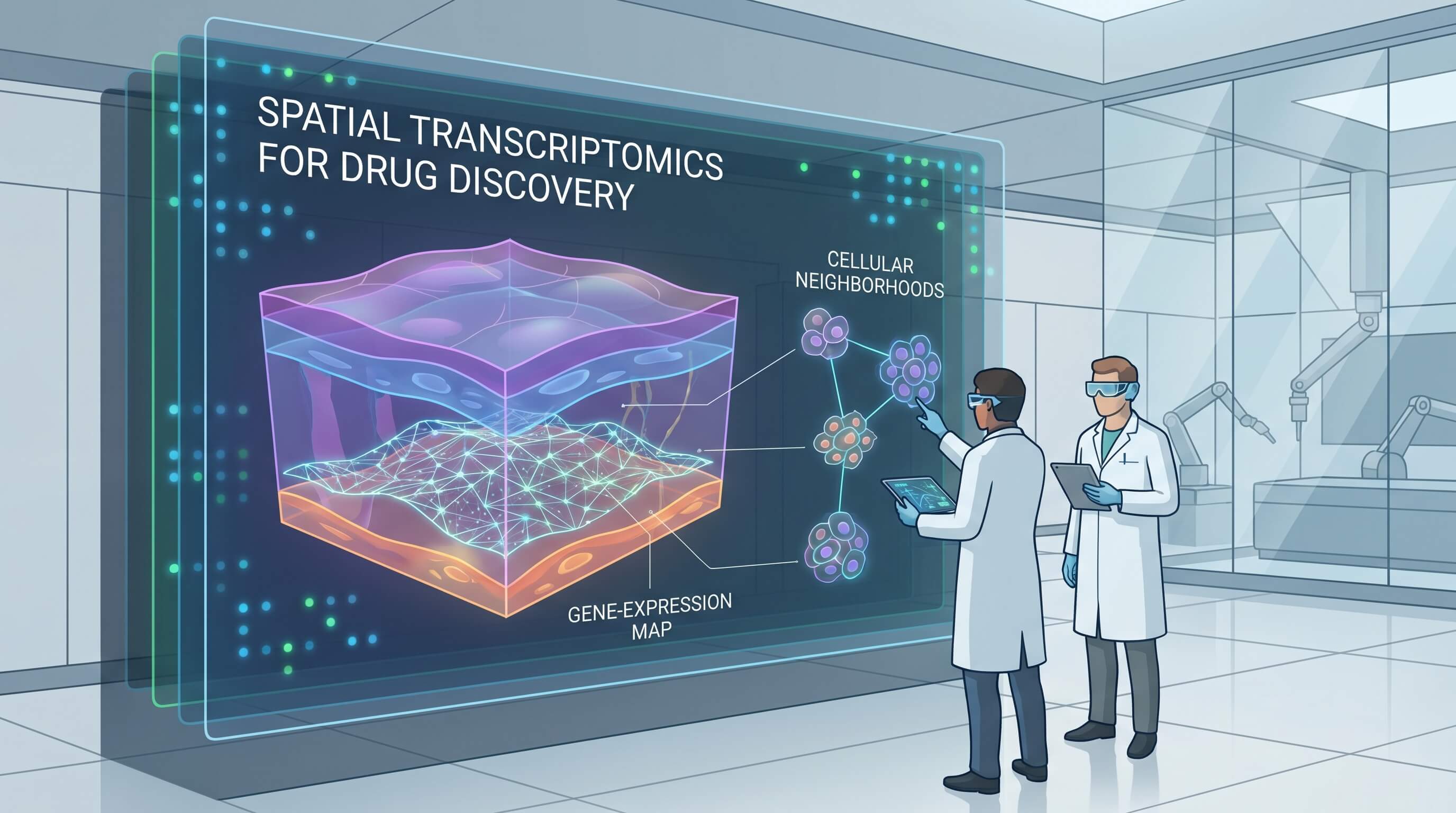
Drug discovery has no shortage of data. Labs can sequence genomes, profile RNA, screen compounds and simulate proteins faster than ever. What they still struggle with is context. A diseased tissue is not just a list of cells and genes. It is a living neighborhood, where location changes meaning. The same immune cell can be helpful in one region of a tumor and ineffective a few microns away. That is why spatial transcriptomics is drawing so much attention. It does not merely ask which genes are active. It asks where they are active inside real tissue.
The idea sounds almost obvious once you hear it. Traditional RNA sequencing often breaks tissue apart before analysis. That produces a useful inventory of molecules, but it can erase the architecture that makes biology behave the way it does. Spatial transcriptomics keeps the map attached to the measurement. Researchers can see which genes switch on near inflamed tissue, how cancer cells interact with nearby stromal cells, and where signals that drive treatment resistance begin.
Why location changes the quality of evidence
In practical terms, spatial transcriptomics helps researchers move from averages to neighborhoods. Many diseases are driven by microenvironments, not just by a single rogue cell type. Cancer is the clearest example. Tumors can contain immune cells, blood-vessel cells, fibroblasts and malignant cells that all influence one another. If a promising target appears in bulk analysis, that is helpful. But if scientists cannot tell whether the target sits at the invasive edge of a tumor, deep in a hypoxic core or in healthy tissue nearby, they still do not fully understand what they are aiming at.
This is the reason the technique is increasingly discussed as a bridge between discovery biology and translational medicine. The Northwestern team behind the SOAR platform described it as a kind of molecular GPS, and that is a useful metaphor. Their open resource aggregates hundreds of spatial transcriptomics datasets across thousands of tissue samples, giving researchers a way to compare how gene activity changes across tissue types and disease states. That kind of shared reference layer can shorten early target-selection work, which is often where drug programs lose time and money.
The value is not limited to oncology. In inflammatory bowel disease, autoimmune conditions and neurodegeneration, the central question is often not just which pathways are active but where damaging interactions occur. A signaling pathway that looks broadly important in aggregate data may turn out to be highly localized. That matters for drug design, patient stratification and biomarker development.
Why this is arriving at the right moment
Spatial biology has existed as a research ambition for years, but it is now benefiting from convergence. Sequencing platforms have improved, imaging methods are better, cloud-scale analysis is more practical, and AI tools are becoming useful for pattern detection across complex tissue images. The result is that spatial transcriptomics is moving from a beautiful demo to an operational layer in research workflows.
That shift matters because drug discovery increasingly depends on combining multiple types of evidence. A company may have genetics pointing to a disease mechanism, cell assays showing functional effects and pathology images revealing tissue damage. Spatial transcriptomics can connect those dots. It gives teams a way to ask whether a molecular target is active in the exact cellular neighborhood that seems to matter clinically. When the answer is yes, confidence improves. When the answer is no, a company can stop a weak hypothesis earlier.
That is a big economic argument, not just a scientific one. Early-stage attrition is expensive. Pushing the wrong target toward preclinical work burns years. Better biological maps can improve prioritization long before a candidate reaches patients.
What the technology still has to prove
There is still a gap between excitement and routine use. Spatial transcriptomics datasets are large, noisy and technically demanding. Different platforms make different tradeoffs between resolution, throughput and cost. Sample preparation remains difficult. Clinical adoption will also require standardization, reproducibility and workflows that fit outside elite research centers.
Interpretation is another challenge. A rich map is not the same thing as a clear answer. Teams still need strong computational methods and biological judgment to avoid over-reading patterns. This is where AI can help, but only if it is tied to careful experimental design. The field will win not by producing the prettiest tissue heatmaps, but by showing repeated improvements in target selection, biomarker discovery and trial design.
Why pharma will care even if patients never hear the term
Most breakthrough technologies in drug development never become household names. Patients do not usually ask whether a medicine was enabled by better protein modeling or cleaner screening libraries. Spatial transcriptomics may fit that pattern. Its biggest effect could be invisible to the public but obvious to R&D teams: fewer blind spots, better disease models and a stronger link between tissue biology and therapeutic decisions.
If that happens, the technology will become less of a specialist method and more of an infrastructure layer, something closer to a map service for modern biology. And that may be the right way to think about it. Drug discovery is already full of powerful tools. What it often lacks is orientation. Spatial transcriptomics is becoming interesting not because it replaces existing methods, but because it tells researchers where to look next.