Why Software Supply Chain Provenance Is Becoming a Default Build Requirement
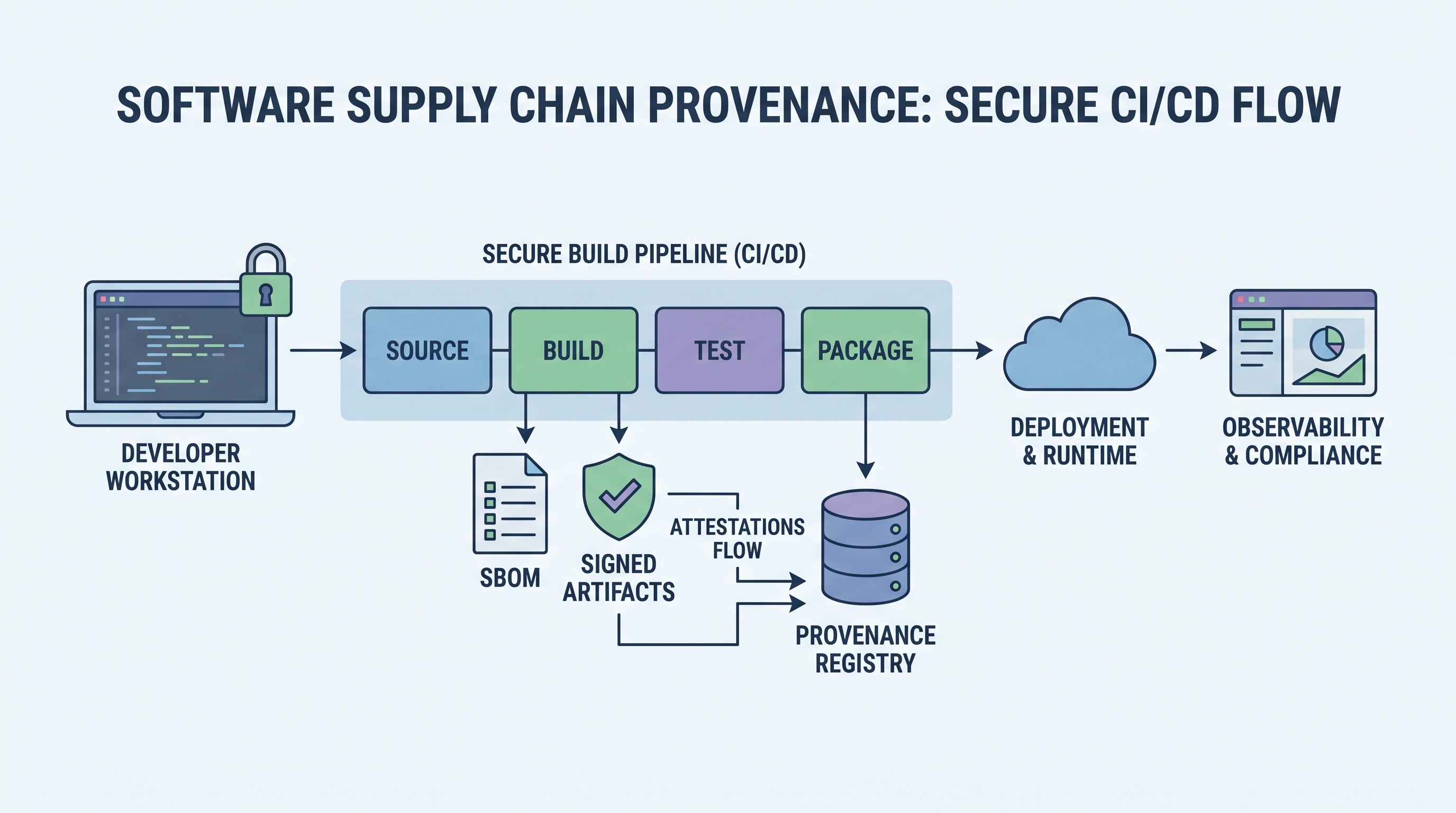
For years, software supply chain security was treated like a specialist concern. Security teams worried about dependency confusion, compromised packages, tampered build systems, and opaque release pipelines, while many developers saw the topic as a compliance layer that lived somewhere after the real work. That separation is breaking down. Supply chain provenance is starting to move directly into the build process itself, and it is increasingly hard to imagine modern delivery without it.
The shift is not only about reacting to headline incidents. It is about the basic mechanics of trust in software systems that now depend on thousands of components, automated CI/CD pipelines, generated artifacts, container images, AI-assisted code, and increasingly complex deployment paths. When software is assembled from so many moving parts, it is no longer enough to know what was shipped. Teams increasingly need evidence of how it was built, where it came from, what dependencies were involved, and whether the build environment can be trusted. That evidence is what provenance provides.
Why provenance matters beyond buzzwords
In practical terms, provenance is a signed trail describing how an artifact was produced. It can include the source repository, commit, build workflow, dependencies, identity of the builder, and the conditions under which the artifact was created. Combined with SBOMs, code-signing, and frameworks such as SLSA, provenance turns software delivery from a chain of assumptions into a chain of verifiable statements.
That matters because modern attacks increasingly target the spaces between development and deployment. Compromising a dependency, poisoning a build job, or swapping an artifact late in the pipeline can be far more efficient for an attacker than finding a memory corruption bug in production. If teams cannot verify that an artifact came from the workflow they intended, then release automation becomes a trust gap rather than a force multiplier.
Why this is becoming a developer-tools story
Five years ago, provenance often appeared as a policy discussion. Today it is becoming a tooling discussion. Build platforms, package registries, cloud providers, and open source projects are adding native support for signatures, attestations, and verifiable workflows. Sigstore made keyless signing more practical. SLSA gave teams a maturity model that maps cleanly onto CI/CD design. GitHub, GitLab, Google, Microsoft, Chainguard, and many others have pushed the ecosystem toward better defaults. The result is that provenance is no longer something only elite security teams can implement.
This is an important change because security controls stick when they become part of the normal developer path. A control that requires manual ceremony is usually fragile. A control that appears automatically in the build system, links to the commit history, and can be verified downstream by deployment tooling has a better chance of surviving real production pressure. Provenance is becoming valuable not because every developer wants another checkbox, but because good tooling can make trust evidence almost invisible until it is needed.
Compliance pressure is part of the story, but not the whole story
Regulation and procurement requirements are clearly accelerating adoption. Governments and large enterprises increasingly want stronger SBOM practices, artifact integrity guarantees, and verifiable release processes from vendors. But treating provenance as a paperwork exercise misses the larger point. Teams benefit operationally when they can answer simple questions quickly: Which workflow produced this image? Which dependency graph was involved? Was the release built in the hardened runner or on a local machine? Is this binary traceable to the reviewed source?
Those questions matter during incident response, vendor review, and everyday debugging. They also matter when organizations are trying to introduce AI-assisted development without losing control of what reaches production. As generated code, agentic tooling, and autonomous build steps become more common, the value of trustworthy build metadata increases. Provenance is one of the few mechanisms that can scale trust across more automation instead of less.
The next maturity step for build systems
The likely destination is that provenance becomes part of the default definition of a successful build. Not an optional export. Not a security-team sidecar. A normal artifact will increasingly be expected to ship with verifiable metadata, signatures, and policy-friendly attestations. Downstream tools will use that information to decide whether deployments proceed, whether registries accept packages, and whether production environments trust a release.
That does not mean the problem is solved. Tooling remains fragmented, terminology still confuses teams, and many organizations are early in the journey. SBOM quality varies. Policy engines can be brittle. Developer education is uneven. But the direction is clear. The software industry is slowly moving from implicit trust in builds toward explicit evidence.
That is a meaningful change in how developer tools work. The build pipeline is no longer just a machine for producing artifacts quickly. It is becoming a machine for producing artifacts that can be trusted. Once that expectation hardens, provenance stops looking like extra security paperwork and starts looking like standard engineering hygiene.