Why Logical Qubits Are Becoming the Real Quantum Race
For years, the quantum computing headlines were dominated by a single metric: qubit count. Each announcement of a new quantum processor seemed to boast more physical qubits than the last, fueling a perception that the race to build a powerful quantum computer was simply a numbers game. However, a significant and far more nuanced shift is now underway, moving the core competitive story from raw qubit totals to the intricate engineering required to create reliable, "logical" qubits. This evolution marks the true inflection point in the journey from noisy laboratory experiments to genuinely useful quantum systems.
The Fundamental Challenge: From Fragile Physical Qubits to Resilient Logical Qubits
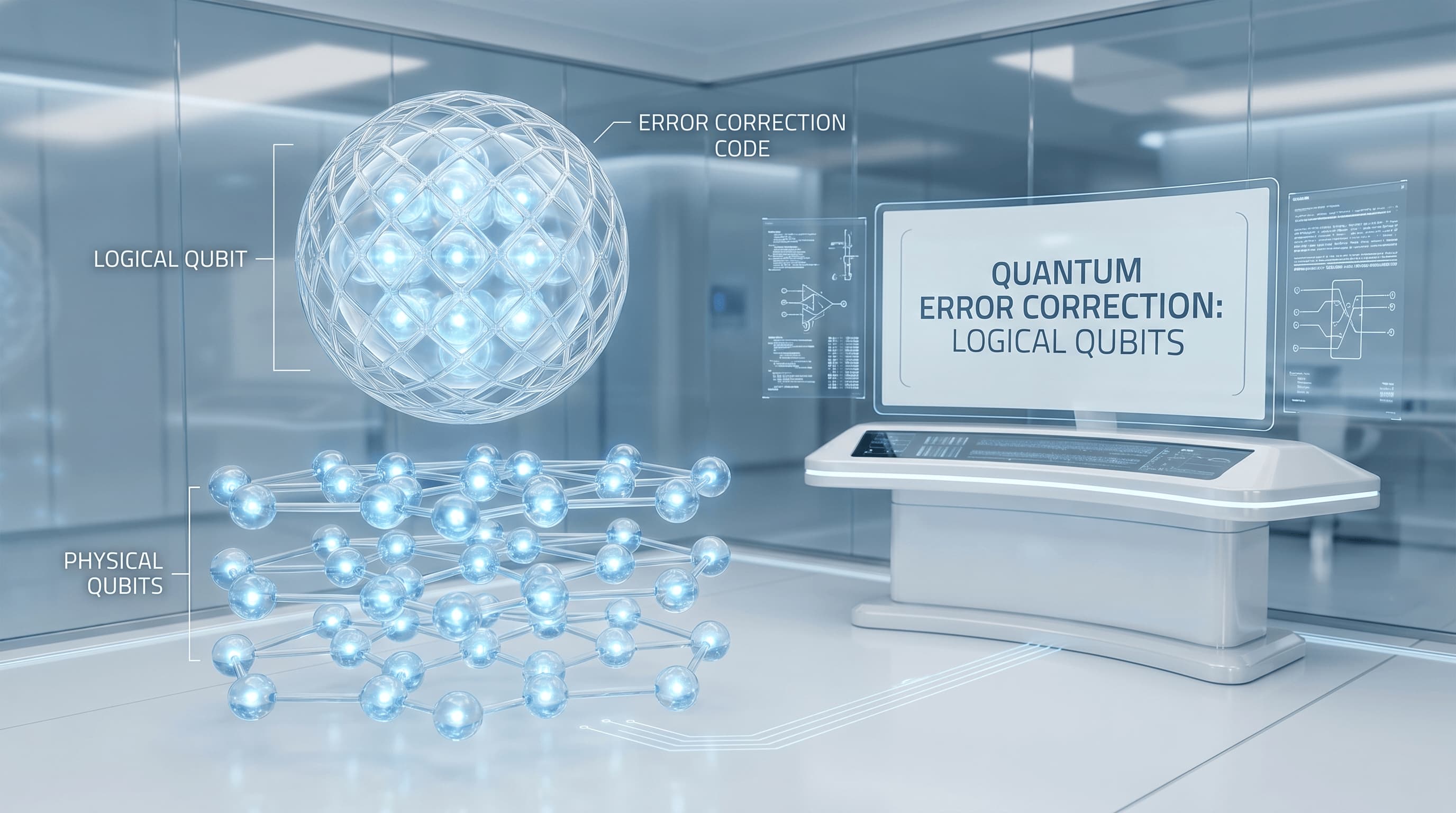
To understand this shift, it's crucial to grasp the difference between physical and logical qubits. A physical qubit is the actual hardware unit that stores quantum information – be it a trapped ion, a superconducting circuit, or a topological defect. These physical qubits are incredibly delicate. Their quantum states are highly susceptible to environmental noise, temperature fluctuations, and electromagnetic interference. This fragility leads to errors, causing the stored quantum information to decohere or flip incorrectly, rendering computations unreliable.
Imagine trying to perform a complex calculation on a calculator where the numbers randomly change during the process. That's the challenge with raw physical qubits. Even with the best isolation, errors are inevitable. This is where logical qubits come into play. A logical qubit isn't a single physical qubit; it's an abstract, error-corrected unit of quantum information encoded across multiple physical qubits. By distributing the quantum information redundantly across several physical qubits, and continuously monitoring and correcting errors without disturbing the fragile quantum state, a logical qubit aims to be far more stable and reliable than any single physical qubit.
Why Error Correction Isn't Optional, It's Everything
The concept of quantum error correction (QEC) is the bedrock upon which logical qubits are built. In classical computing, error correction is relatively straightforward: if a bit flips, you can simply read its value again and correct it. In quantum mechanics, however, measuring a qubit's state collapses its superposition, destroying the very information you're trying to protect. Quantum error correction schemes are ingenious methods that detect and correct errors indirectly, inferring the presence of an error without directly measuring the data qubits themselves. This allows the quantum computation to proceed while maintaining the integrity of the quantum state.
Without effective quantum error correction, even the largest quantum computers would be limited to short, simple calculations before errors accumulate and corrupt the results. Fault tolerance – the ability of a quantum computer to perform arbitrary computations reliably despite errors in its underlying physical components – is the ultimate goal. It's the path from "noisy intermediate-scale quantum" (NISQ) devices, which are useful for exploring quantum phenomena but not yet for solving practical problems, to truly universal, error-corrected quantum computers.
The New Front in the Quantum Race: Engineering for Resilience
Major players in the quantum computing landscape are increasingly aligning their roadmaps around this vision of logical qubits and fault tolerance. The competitive narrative is no longer just about who can build the most physical qubits, but who can engineer the most robust and scalable architecture for logical qubits, with the lowest overhead and highest fidelity.
IBM, for instance, has clearly articulated its long-term strategy. In June 2025, they announced plans to deliver IBM Quantum Starling by 2029, targeting a system with 200 logical qubits and capable of executing 100 million quantum gates. This ambitious goal explicitly frames fault tolerance as the necessary bridge from today's experimental systems to future useful ones. It's a commitment not just to scale, but to reliable scale.
Google has also made significant strides in this direction. Their Willow processor demonstrated below-threshold quantum error correction, a critical milestone. This means that as larger encoded qubit arrays were used, the error rates actually dropped – a meaningful signal that scaling up the number of physical qubits dedicated to a logical qubit can indeed improve reliability rather than making it worse. This result directly challenges the intuition that more components always mean more problems and instead points to the power of robust error correction.
Microsoft, too, continues to frame its roadmap around a clear progression: moving from noisy physical qubits to reliable logical qubits, and then onward to utility-scale systems. They emphasize that building resilience – the ability to maintain quantum coherence and perform computations accurately despite noise – is the "hard middle layer" of quantum computing development. Their focus is on developing the full stack, from hardware to control systems and software, all optimized for the creation and manipulation of stable logical qubits.
Beyond Headline Qubit Totals: Decoding the Engineering Challenge
This shift means that the real innovation and competitive edge are now found in areas far more complex than just raw qubit counts. The focus is on:
- Decoding Algorithms: The sophisticated software and hardware required to quickly and accurately identify and correct errors within the logical qubit structure.
- Overhead Reduction: Minimizing the number of physical qubits required to construct a single logical qubit. While current estimates suggest hundreds or even thousands of physical qubits might be needed for one reliable logical qubit, reducing this overhead is crucial for practical scalability.
- Architecture and Connectivity: Designing quantum processors with optimal connectivity between physical qubits to efficiently implement error correction codes and complex quantum circuits.
- Control Systems: Developing precise and scalable control electronics that can manage the vast number of physical qubits and their interactions required for logical operations.
These are the deep engineering challenges that will define the next decade of quantum computing. The race isn't just about building bigger machines; it's about building smarter, more resilient ones.
An Early Field, A Long Road Ahead
It's important to keep in mind that despite these exciting developments, the field of quantum computing is still very much in its early stages. While companies are outlining ambitious roadmaps and achieving impressive scientific milestones, these are not the same as delivered commercial utility. The journey from demonstrating a single logical qubit to building a fault-tolerant quantum computer capable of solving real-world problems remains long and arduous.
There is no clear winner in this race yet, and different approaches to quantum hardware and error correction continue to be explored. However, the consensus is clear: the future of practical quantum computing hinges on our ability to tame the inherent fragility of quantum mechanics through the sophisticated engineering of logical qubits. This is where the real quantum race is being run, promising to unlock the full potential of this transformative technology.