Why Local-First Software Is Going Mainstream
The Cloud's Promise and Its Hidden Costs
Remember the early days of cloud computing? It promised seamless collaboration, access from anywhere, and never losing your data again. And for a long time, it delivered. We embraced web apps that ran entirely in the browser, syncing our lives across devices with magical ease. But over time, the cracks began to show. The spinning loader when your internet connection falters, the frustrating lag when typing into a document hosted thousands of miles away, the nagging feeling that your data isn't truly yours but merely rented from a giant corporation – these are the hidden costs of an exclusively cloud-first world.
Users have grown accustomed to these inconveniences, but a new wave of software design is challenging the status quo. It’s called local-first software, and it’s rapidly moving from an intriguing academic concept to a practical, mainstream product strategy.
What Exactly Is Local-First Software?
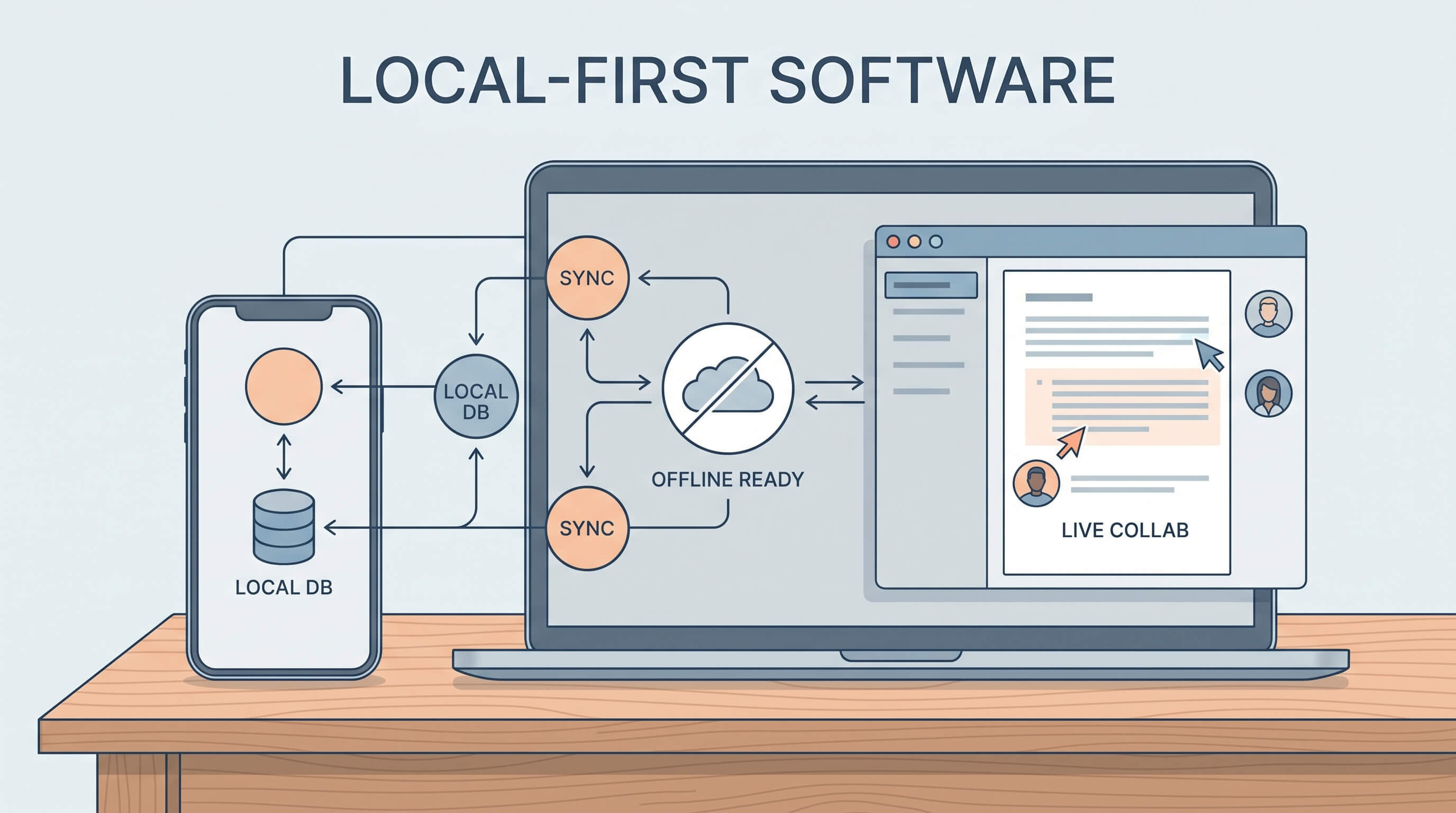
At its core, local-first software flips the traditional cloud-first model on its head. Instead of treating the server as the primary, authoritative source of your data and your local device as a mere cache, local-first design prioritizes the copy on your device. Your local copy is the primary source of truth, and the server holds secondary copies, primarily for syncing your data across multiple devices and for collaboration with others.
This isn't just about saving files locally; it’s a fundamental shift in how applications are architected. It’s about getting the best of both worlds: the instant responsiveness and data ownership of traditional desktop software, combined with the collaborative power and cross-device access of modern cloud applications. Think of it as having a personal, super-fast database on your device that intelligently and silently syncs with the cloud in the background.
The Tangible Benefits: Speed, Resilience, and Ownership
The advantages of this approach are compelling and directly address the frustrations of cloud-only experiences:
- Instant Interactions: Because all reads and writes happen against your local data store, operations are virtually instantaneous. No more waiting for network round-trips for every keystroke or click. The app feels snappy and responsive, always.
- Offline Capability: A flaky Wi-Fi connection or a complete lack of internet doesn't stop you. You can continue working uninterrupted, and your changes will sync automatically once connectivity is restored. This is a game-changer for field workers, travelers, or anyone in areas with unreliable networks.
- Resilience to Connectivity Issues: Beyond full offline mode, local-first apps are inherently more robust. They gracefully handle intermittent network drops, ensuring your work is never lost and your productivity isn't derailed.
- Stronger Data Ownership and Agency: Your data resides on your device, under your control. This fosters a stronger sense of ownership and reduces reliance on a single vendor for data access. It aligns with a growing desire for digital sovereignty.
How Local-First Works in Practice Today
While the theoretical underpinnings of local-first software have been discussed for years, practical implementations are now becoming widely accessible. Modern local-first systems often involve a local database, such as SQLite, embedded directly within the client application or browser. All application interactions—reading, writing, editing—occur against this local database first.
In the background, a sophisticated sync engine works tirelessly to reconcile changes between your local database and a backend server. This automatic, bidirectional synchronization ensures that your data is consistent across all your devices and shared with collaborators. Technologies like Conflict-free Replicated Data Types (CRDTs) play a crucial role here, providing robust mechanisms for merging concurrent changes from multiple sources without data loss, even in complex collaborative scenarios.
This pragmatic form of local-first, where a local client database automatically syncs with a backend database, is proving to be a powerful pattern for building resilient, high-performance applications.
Why Now? The Perfect Storm for Local-First
The timing for local-first software's ascent isn't accidental; it's the result of several converging trends:
- Rising User Expectations: Users no longer tolerate slow, unreliable applications. They expect instant feedback and seamless operation, regardless of network conditions. Local-first delivers on this expectation.
- Maturity of Sync Technologies: The development and refinement of CRDTs and other sophisticated sync algorithms have made building robust, conflict-resolving synchronization much more feasible for developers.
- Ubiquity of Local Storage: Powerful local databases like SQLite are now readily available and performant across virtually all platforms, from desktops and mobile devices to modern web browsers via WebAssembly.
- Frustration with Cloud-Only Brittle Experiences: The collective experience of offline warnings, lost work due to server outages, and performance bottlenecks has created a strong demand for more resilient alternatives.
This confluence of user demand and technological readiness is transforming local-first from a manifesto into a viable, competitive product strategy.
The Road Ahead: Challenges and Considerations
It's important to be candid: local-first software is not a magic bullet. While it solves many problems, it introduces its own set of complexities that developers must address:
- Sync Conflicts: While CRDTs are powerful, designing the right data structures and conflict resolution strategies for complex application logic remains a significant challenge.
- Permissions and Access Control: Managing who can access and modify which parts of the data in a distributed, local-first system requires careful thought and robust security implementations.
- Encryption: Ensuring data is securely encrypted both locally on the device and in transit to the server is paramount.
- Collaboration Semantics: Building truly seamless real-time collaboration that feels intuitive and robust in a local-first context is still a hard problem.
- Storage Migration: As applications evolve, managing schema changes and migrating local data stores across different versions can be complex.
- Developer Complexity: Building local-first applications often involves more moving parts and a deeper understanding of distributed systems than traditional client-server models.
These challenges are significant, but the increasing availability of tools and frameworks designed to simplify local-first development is helping to mitigate them.
A Balanced Future for Software
Local-first software represents a powerful paradigm shift, offering a compelling blend of performance, reliability, and user agency that cloud-only solutions often struggle to provide. It’s not about abandoning the cloud entirely, but rather intelligently leveraging its strengths for collaboration and ubiquitous access while prioritizing the user's local experience.
Not every application needs to be local-first. A simple website displaying static information, for example, probably doesn't benefit much. However, for a vast array of productivity tools, creative applications, field service software, and collaborative platforms where instant feedback, offline capability, and data ownership are critical, local-first design is becoming an increasingly attractive and necessary approach. As users continue to demand more from their digital tools, the local-first philosophy will undoubtedly shape the next generation of software experiences, empowering us with apps that are truly ours, fast, and always ready to work.