Why Local-First Software Is Finally Growing Up
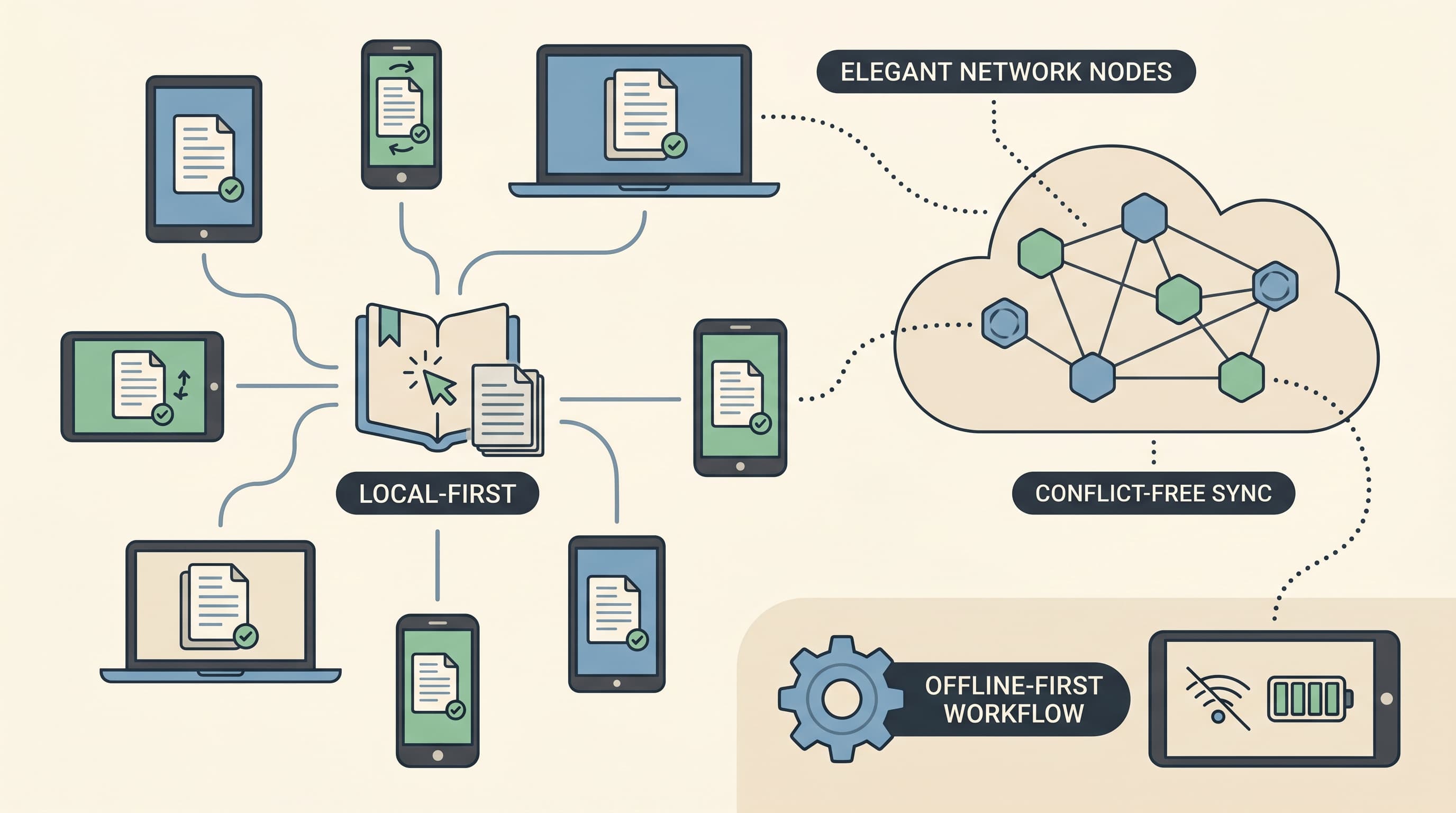
The internet has fundamentally reshaped how we build and use software. Cloud services offer unparalleled convenience, scalability, and collaboration. Yet, beneath the surface of this interconnected world, a quiet revolution has been brewing: local-first software. For years, it felt like an idealistic manifesto, a whispered promise of a better way. But today, local-first is finally growing up, transitioning from a research curiosity to a credible, robust architectural pattern for modern applications.
What Does "Local-First" Truly Mean?
At its heart, local-first software embodies a philosophy articulated brilliantly by Ink and Switch: 'you own your data in spite of the cloud.' This isn't just about having a local copy; it's about making the local copy the primary source of truth. Ink and Switch defines six key ideals: responsiveness (local operations are instant), offline access (full functionality without internet), cross-device use (seamless data flow between all your devices), collaboration (multi-user editing without central server bottlenecks), ownership (users truly control their data), and data permanence (data persists independent of service providers). Imagine an application that feels as fast and reliable as a desktop app from the 90s, but also offers the collaborative power and sync capabilities of a modern cloud service. That's the local-first dream.
The Maturation of an Ecosystem
For a long time, implementing local-first principles was largely the domain of academic research or highly specialized teams. The challenges of data synchronization, conflict resolution, and distributed state management were formidable. However, recent years have seen a significant shift. The emergence of initiatives like Open Local First and the dedicated FOSDEM 2026 devroom for local-first technologies are clear indicators that the ecosystem is maturing rapidly. This isn't just a niche conversation anymore; it's a vibrant community actively building standards, tools, and shared knowledge around sync engines, CRDTs (Conflict-Free Replicated Data Types), and other foundational components. This collective effort is what's propelling local-first from an idealistic vision to a practical product architecture.
The Core Thesis: From Manifesto to Product Architecture
Our core thesis is this: local-first software is moving beyond its initial role as an idealistic manifesto and is becoming a credible product architecture for applications that demand speed, resilience, and better data ownership. As users increasingly expect applications to work seamlessly offline, across multiple devices, and in collaborative environments, the limitations of purely cloud-dependent models become apparent. Local-first offers a compelling alternative, putting the user and their data at the center, rather than the server.
The Engines Behind Local-First: CRDTs and Sync Engines
Understanding CRDTs
At the technical core of many modern local-first applications are Conflict-Free Replicated Data Types, or CRDTs. Think of CRDTs as special data structures designed to be merged automatically and deterministically, even when changes are made concurrently on different devices without immediate communication. Unlike traditional data structures where concurrent edits might lead to messy conflicts that require manual resolution (like when two people edit the same line in a document and the server asks who wins), CRDTs are designed so that all valid concurrent operations commute. This means that no matter the order in which changes arrive or are applied, all replicas will eventually converge to the same correct state without any external intervention. This elegant mathematical property is what makes seamless offline collaboration possible.
The Role of Sync Engines
While CRDTs handle the merging logic, sync engines are the workhorses that manage the flow of data. A sync engine is responsible for efficiently transmitting changes between local storage, other devices, and potentially a cloud backup or coordination service. It tracks what changes have been made locally, what changes have been received from other sources, and orchestrates the application of these changes using CRDTs to maintain consistency. It ensures that your data is always up-to-date across all your devices, whether you're online or offline, without you ever having to think about 'saving' or 'syncing' manually. It's the invisible glue that makes the local-first experience feel magical.
Why the Promise is So Attractive
The allure of local-first software is multifaceted. Firstly, responsiveness is unparalleled; operations happen instantly because they are performed on local data, eliminating network latency. Secondly, true offline access means you can work without an internet connection, a critical feature for many professionals and anyone on the go. Thirdly, it fosters genuine data ownership, giving users more control and reducing reliance on a single vendor's cloud infrastructure. Finally, for collaboration, local-first models enable a fluid, real-time experience where multiple users can edit simultaneously, with changes propagating efficiently without constant server roundtrips, thanks to the robust conflict resolution capabilities of CRDTs.
Where We Already See Its Influence
Even if you haven't heard the term 'local-first,' you've likely experienced its benefits. Many popular note-taking applications, code editors, and even some design tools already exhibit local-first characteristics, allowing you to work offline and syncing seamlessly when a connection is restored. Users now expect this level of resilience and responsiveness. The frustration of losing work due to a dropped internet connection or waiting for a server roundtrip for every keystroke is becoming increasingly unacceptable. These user expectations are subtly pushing the industry towards architectures that prioritize local data.
The Hard Realities: What Still Makes Implementation Challenging
Despite its growing maturity, building local-first software is not without its significant hurdles. It's crucial to be balanced about the challenges:
Cost and Complexity
Implementing CRDTs and robust sync engines from scratch is a highly specialized and complex undertaking. It requires deep expertise in distributed systems, data structures, and concurrency. While libraries and frameworks are emerging, the learning curve and development effort can still be substantial, translating into higher development costs.
Permissions and Access Control
Managing fine-grained permissions and access control in a distributed, local-first model is significantly more complex than in a centralized client-server system. How do you ensure only authorized users can modify certain parts of a shared document when changes can originate from any device, offline? This often requires sophisticated cryptographic techniques and careful architectural design.
Handling Large Files
While CRDTs excel with textual data, efficiently syncing and merging large binary files (images, videos, CAD files) remains a challenge. Merging binary data is often not as straightforward as merging text, and distributing large files efficiently across many peer-to-peer connections requires careful consideration of bandwidth and storage.
Schema Migration
Evolving data schemas across many distributed local databases can be a nightmare. In a centralized system, you update the server schema, and clients adapt. In a local-first world, every local replica might have a different schema version, and coordinating migrations without data loss or corruption is a non-trivial problem.
Not Every App Needs It
Perhaps the most important caveat: local-first is not a silver bullet. Many applications, especially those that are inherently server-centric (e.g., streaming services, complex financial trading platforms, or apps with massive shared datasets that don't fit locally), are perfectly well-served by traditional client-server architectures. Rebuilding every application with a local-first approach would be an unnecessary and often counterproductive effort. It's about choosing the right architecture for the specific problem at hand.
Conclusion: A Future of Resilient, User-Centric Applications
The journey of local-first software from an idealistic vision to a practical architectural choice is a testament to the persistent pursuit of better software. While challenges remain, the growing ecosystem, the maturation of foundational technologies like CRDTs and sync engines, and the increasing user demand for resilient, responsive, and ownership-centric applications all point to a future where local-first principles play a much larger role. It's an exciting time to watch software finally grow up, putting users truly in control of their data, in spite of the cloud.