Why CXL Memory Pooling Could Reshape the AI Data Center
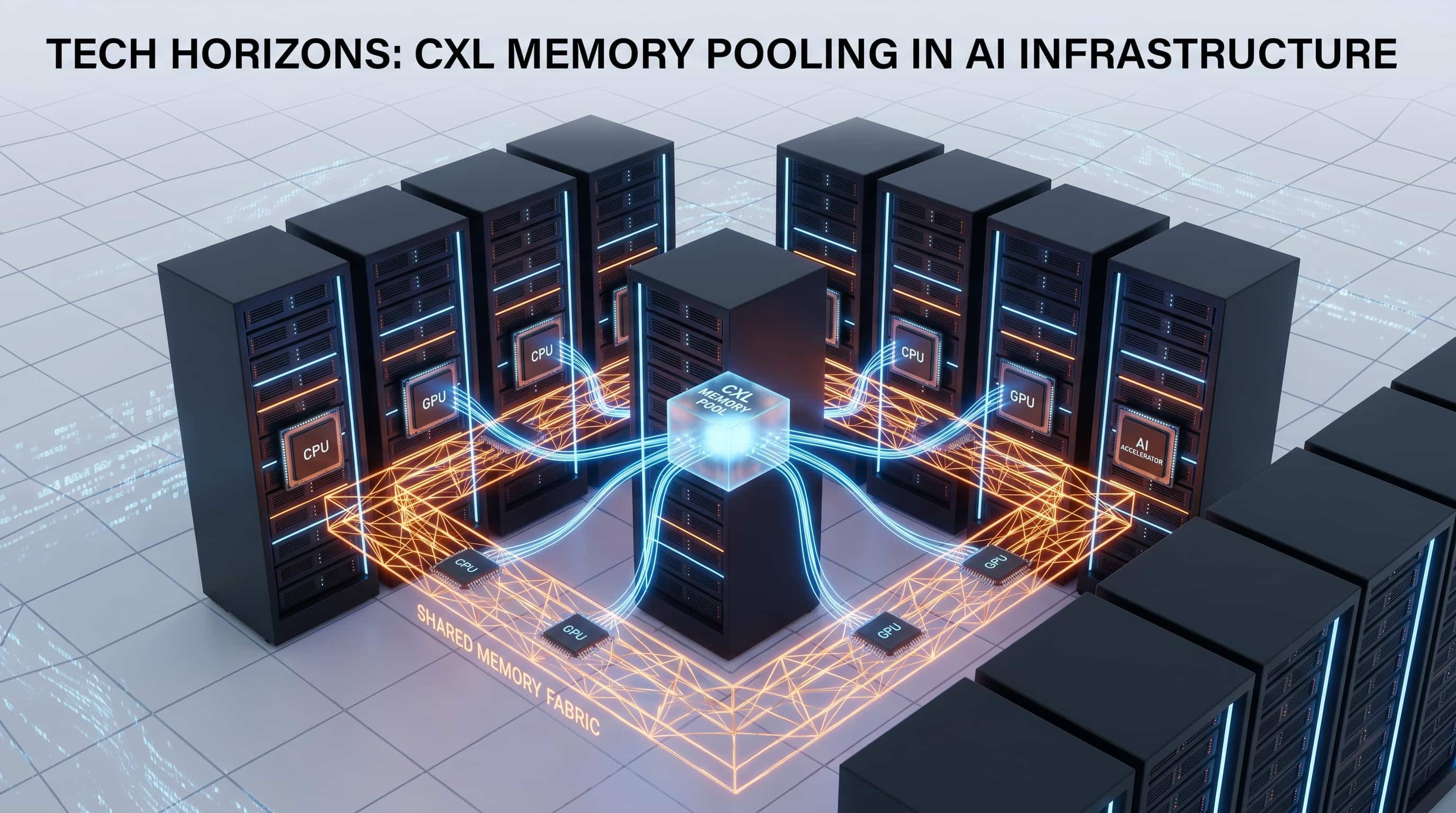
The artificial intelligence revolution is fundamentally reshaping how we design and operate data centers. From massive language models to complex recommendation engines, AI workloads are not just compute-intensive; they are profoundly memory-hungry. Traditional server architectures, where each CPU or accelerator comes with a fixed amount of directly attached memory, are increasingly hitting a wall. This often leads to overprovisioning, wasted resources, and significant cost inefficiencies. But what if memory could be treated as a flexible, dynamically allocatable resource, shared across an entire rack or even a cluster? Enter Compute Express Link (CXL) and its promise of memory pooling.
Understanding Compute Express Link (CXL)
At its heart, CXL is a high-speed interconnect technology designed to enable CPUs, accelerators (like GPUs and AI ASICs), and memory to communicate more efficiently. Built on top of the ubiquitous PCIe (Peripheral Component Interconnect Express) physical and electrical interface, CXL is more than just a faster bus. It introduces a cache-coherent fabric that allows different components to share memory seamlessly, reducing data duplication and improving overall system performance.
Think of PCIe as a highway for data. CXL adds specialized lanes and traffic rules to that highway, specifically designed for memory and compute devices to interact much more intelligently. This coherence is crucial because it means that all devices connected via CXL see a consistent view of memory, eliminating the need for complex software mechanisms to synchronize data across different memory domains.
The AI Memory Bottleneck: Why Current Architectures Fall Short
Today's AI models, especially those pushing the boundaries of scale, demand vast amounts of memory. Training a large language model might require hundreds of gigabytes, if not terabytes, of RAM. Inference, while often less demanding, can still benefit immensely from larger memory capacities, particularly for batch processing or serving multiple complex models simultaneously.
The problem is that memory is typically bundled with compute. When you buy a server with a powerful CPU or GPU, it comes with a certain amount of DDR DRAM directly attached. If your workload needs more memory than a single node offers, you often have to scale out by adding more nodes, even if the existing nodes still have ample compute capacity. Conversely, if a node has more memory than a specific workload requires, that excess memory sits idle, representing a significant capital expenditure that isn't being fully utilized.
This "stranded memory" problem is particularly acute in AI data centers, where workloads are highly dynamic. A server might run a memory-intensive training job one hour, and a compute-intensive but memory-light inference job the next. The fixed memory allocation of traditional servers struggles to adapt to these fluctuating demands, leading to either underutilization or the need for constant, costly hardware upgrades.
Shared vs. Pooled Memory: CXL's Transformative Distinction
The CXL Consortium materials often highlight a critical distinction between "shared memory" and "pooled memory." While both involve multiple devices accessing the same memory, their implications for data center architecture are profound.
Shared Memory (CXL Type 1 and Type 2 Devices)
In a shared memory model, typically seen with CXL Type 1 (accelerators without their own memory, like smart NICs) and Type 2 (accelerators with their own memory, like GPUs), devices can coherently access the host CPU's memory and vice-versa. This is an improvement, allowing accelerators to operate on larger datasets than their local memory might permit, or to access data directly from the CPU's memory without copying. It's about tighter integration and more efficient data movement within a single system.
Pooled Memory (CXL Type 3 Devices)
This is where CXL truly shines for the future of AI data centers. CXL Type 3 devices are essentially memory expanders or disaggregated memory modules. With memory pooling, multiple host CPUs or accelerators can dynamically access a common pool of memory that is physically separate from any single host. Imagine a rack of servers, each with its own CPU(s), but instead of each server having its own fixed set of DIMMs, they all draw memory from a central, shared pool of CXL-attached DRAM or even emerging memory technologies.
This disaggregation fundamentally changes the economics and flexibility of data center design. Instead of buying servers with fixed memory configurations, you can provision compute and memory independently. Need more memory for a specific AI training job? Dynamically allocate it from the pool. Is another server idle? Its allocated memory can be returned to the pool for another workload. This is akin to how virtual machines dynamically allocate CPU and RAM, but now at the hardware level for physical memory.
The Game-Changing Benefits of CXL Memory Pooling for AI
The shift to CXL memory pooling offers several compelling advantages for AI infrastructure:
- Dynamic Memory Allocation and Flexibility: Workloads can request and release memory on demand from a shared pool. This eliminates the need to overprovision individual servers, as memory can be reallocated based on real-time needs. For highly variable AI workloads, this is a game-changer.
- Improved Memory Utilization: By reducing stranded memory, data centers can achieve significantly higher overall memory utilization rates. This translates directly into cost savings by making better use of expensive DRAM modules.
- More Flexible Scaling: Compute and memory can be scaled independently. If you need more compute, add more CPUs/GPUs. If you need more memory, add more CXL memory modules to the pool. This modularity simplifies upgrades and allows for more granular resource management.
- Enabling Larger Workloads: With access to a vast, shared memory pool, AI models that currently struggle to fit into single-node memory limits can now be more easily deployed and trained. This opens doors for even larger, more complex AI architectures.
- Potential Power Savings: Higher utilization means fewer idle servers or memory modules. While CXL itself consumes power, the overall data center efficiency gains from reduced overprovisioning and improved utilization could lead to net power savings. Furthermore, CXL can enable memory tiers, potentially allowing for the use of lower-power, higher-latency memory for less critical data.
- Future-Proofing: CXL's open standard nature and support for various memory types (DDR, HBM, persistent memory) make it a robust foundation for future memory and compute innovations.
The Road Ahead: Tradeoffs and Challenges
While the promise of CXL memory pooling is immense, it's important to acknowledge the journey ahead. This is not a magic bullet without considerations:
- Latency Still Matters: While CXL is designed for low latency, accessing memory from a disaggregated pool will inherently involve slightly higher latency compared to directly attached, local DRAM. For extremely latency-sensitive AI operations, this might require careful architectural considerations. However, for many large-scale AI training and inference tasks, the benefits of capacity and utilization will likely outweigh this minor latency increase.
- Software Ecosystem Maturity: To fully leverage CXL memory pooling, the entire software stack needs to evolve. Operating systems, hypervisors, orchestration layers, and even application frameworks need to be CXL-aware to dynamically allocate and manage pooled memory effectively. This ecosystem is still maturing.
- Hardware Availability and Cost: CXL-enabled CPUs, accelerators, and memory pooling devices are becoming available, but broad deployment will depend on economies of scale and competitive pricing. Initial deployments might focus on high-value AI and in-memory database workloads.
- Management Complexity: Disaggregating resources can introduce new management challenges. Tools and practices for monitoring, allocating, and troubleshooting a dynamic pool of memory across many servers will need to mature.
Conclusion
CXL memory pooling represents a pivotal shift in data center architecture, particularly for the demanding world of artificial intelligence. By decoupling memory from compute and enabling dynamic allocation from a shared pool, CXL promises to address the critical memory capacity and utilization constraints that currently plague AI infrastructure. While the journey to widespread adoption involves overcoming challenges related to latency, software maturity, and ecosystem development, the potential for greater efficiency, flexibility, and the ability to tackle even larger, more complex AI problems makes CXL a technology that IRCNF will be watching very closely. It's not just about faster connections; it's about smarter resource utilization that could truly reshape the AI data center as we know it.