Why AI NPCs Are Becoming a Live-Operations Problem, Not Just a Design Demo
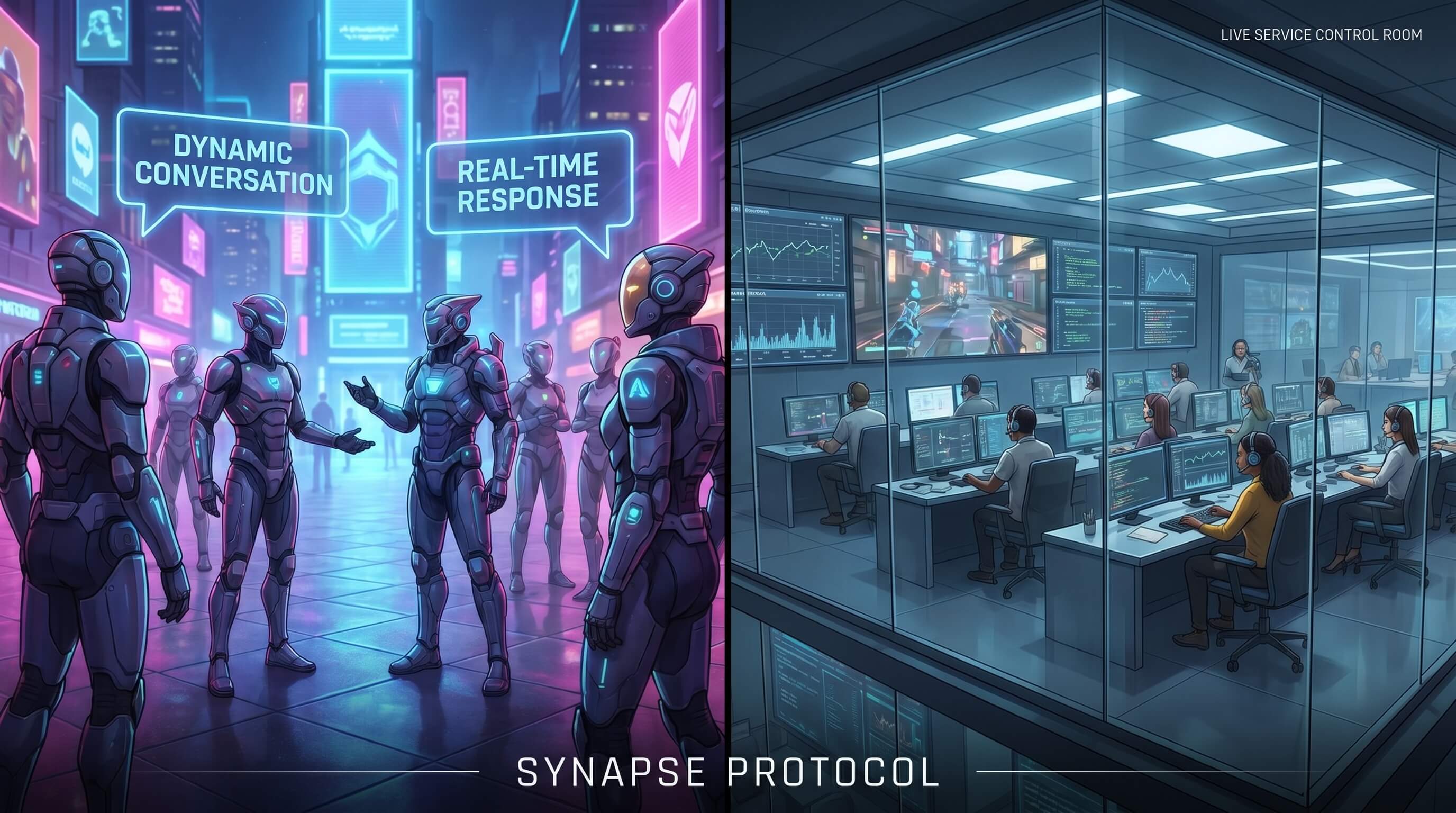
Whenever the games industry talks about AI NPCs, the first conversation is usually about immersion. Can a non-player character speak naturally? Can it remember a player? Can it react without a dialogue tree? Those are valid questions, and recent demos from Ubisoft, Nvidia, Inworld and Microsoft suggest the answer is increasingly yes, at least in controlled settings. But the industry’s more difficult problem is emerging somewhere else. The challenge is not just character design. It is operations.
An AI NPC that works in a stage demo is impressive. An AI NPC that survives millions of messy player interactions in a live game is a very different product. It has to respond quickly, stay in character, respect the rules of the game world, avoid breaking safety standards and remain affordable to run. That turns AI NPCs into a live-ops problem as much as a creative one.
From authored dialogue to operated behavior
Traditional NPC systems are expensive to write, but relatively stable to ship. Designers define branches, writers control tone and QA can inspect most possible outcomes. Generative systems change that model. Once a character can improvise, the studio is no longer shipping only content. It is shipping a behavior stack. That stack has prompts, moderation, retrieval layers, latency budgets, voice systems, fallback logic and telemetry. In other words, it starts to look less like a script and more like a service.
This is why the most credible companies in the space are talking about toolchains and infrastructure, not only about magical conversations. Ubisoft’s experiments have focused on keeping characters authentic to writer-defined personalities. Microsoft and Inworld have emphasized design copilots, runtime engines and responsible AI. Nvidia’s ACE push is as much about deployment, rendering and performance as it is about character intelligence. All of that points to the same truth: AI NPCs only become real products when studios can operate them reliably.
Why live games make the problem harder
Live-service games raise the stakes because they never stand still. New content arrives weekly, balance changes alter context, community slang evolves and players immediately test the edges of any system. A static NPC script can be patched. An AI-driven companion or quest-giver has to adapt without drifting off tone or inventing lore. That means studios need memory systems, retrieval boundaries and curated knowledge layers so characters know enough to be useful without becoming unpredictable.
Latency is another major issue. Players may tolerate a brief pause in a chat app. In a game, even a short delay can kill rhythm. If an AI squadmate takes too long to respond, immersion collapses. If every voice interaction requires expensive cloud inference, scale becomes costly very quickly. That is why so much discussion now revolves around on-device AI, hybrid systems and smaller specialized models rather than one giant model doing everything.
Safety is not optional when players are the adversary
There is also a blunt operational truth: players will try to break the system. They will provoke, exploit, meme and search for loopholes within hours. Any AI NPC deployed at scale effectively enters an adversarial environment. Studios need moderation layers not only for text and voice, but for world actions and mission logic. They need ways to stop characters from leaking hidden information, reinforcing abuse or responding in ways that violate ratings and community standards.
This is where the live-ops framing matters most. A studio cannot think of safety as a one-time model alignment task. It becomes an ongoing monitoring function, similar to anti-cheat, economy balancing or fraud detection. That means dashboards, alerts, red-team testing and rollback plans, not just good prompt engineering.
Why the real opportunity is broader than conversation
The irony is that the best near-term use cases may be less glamorous than fully open-ended conversation. AI NPCs can guide onboarding, explain systems, personalize accessibility settings, recap quests, respond to player confusion and make repeatable worlds feel less rigid. Ubisoft’s Teammates concept points in that direction. An AI companion that helps interpret intent, manages interface complexity and reacts to play style may offer more practical value than a philosopher bartender with infinite dialogue.
That does not make the vision smaller. It makes it more shippable. Studios usually adopt new systems first where failure is tolerable and value is measurable. AI NPCs that reduce drop-off in onboarding or make live content easier to personalize may justify their costs faster than headline-grabbing sandbox conversations.
What this means for game studios
Studios interested in AI NPCs should probably stop treating them as isolated narrative experiments. The better framing is service design. What model serves which task? Where is memory stored? What happens when inference fails? How is lore updated? Which interactions are deterministic and which are adaptive? How are costs capped during traffic spikes? These are operational questions, but they determine whether the design dream survives contact with a real player base.
That may sound less romantic than the original AI NPC pitch, but it is healthier. The future of AI characters will not be decided by the most impressive conference demo. It will be decided by the teams that can make them responsive, safe, affordable and consistent in live worlds. At that point, AI NPCs stop being a novelty and start becoming part of the production stack.