Why 800-Volt EV Architecture Is Moving From Premium Spec to Platform Advantage
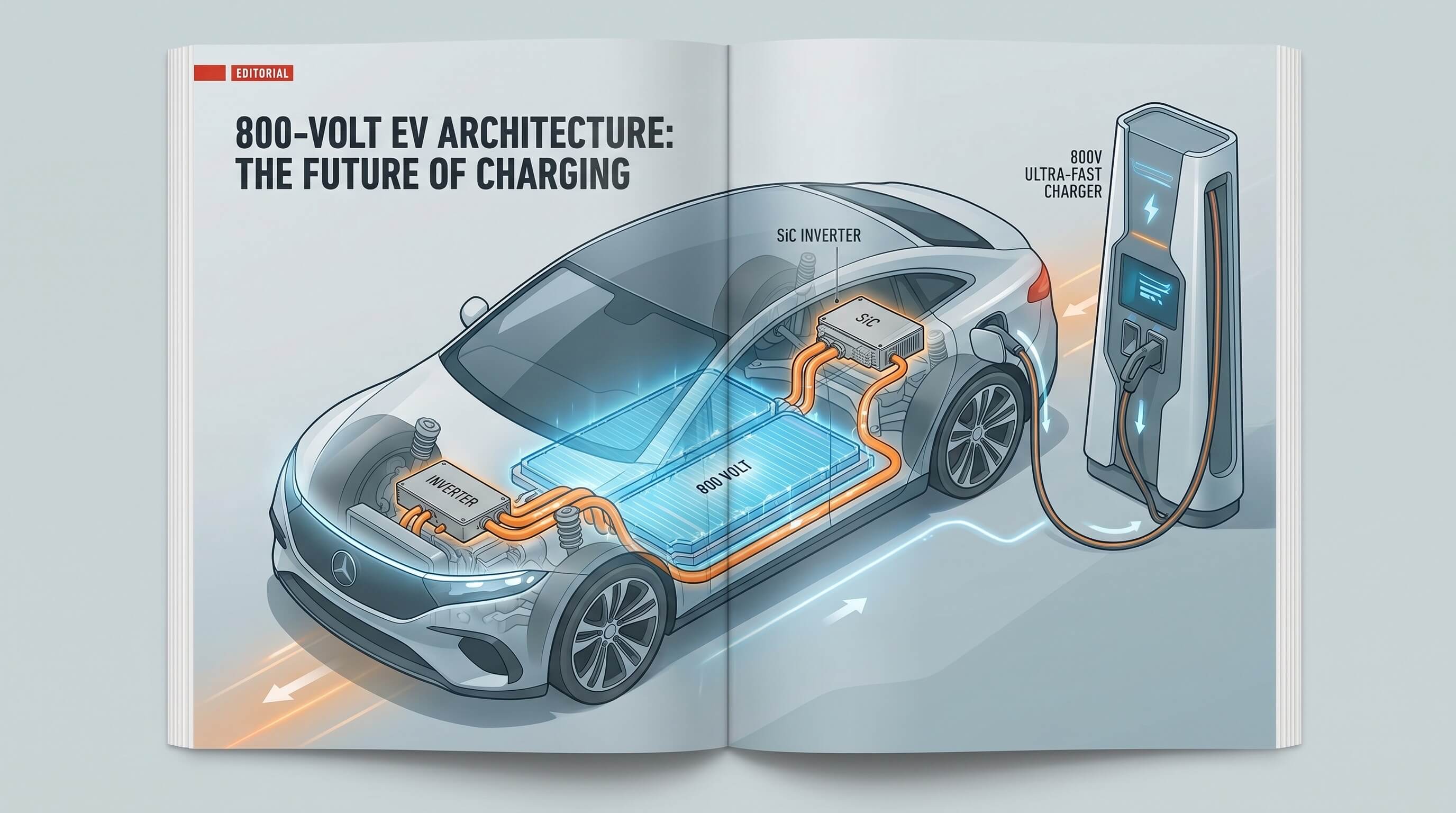
For a while, 800-volt electric vehicle architecture sounded like the kind of feature automakers highlighted mostly to impress investors, journalists, or early adopters. It was associated with premium models, ultra-fast charging demos, and spec-sheet bragging rights. That framing is starting to break down.
What looked like a high-end differentiator is becoming a deeper platform decision. As EV makers push for faster charging, lighter wiring, higher sustained performance, and better efficiency under load, higher-voltage systems are starting to make engineering sense well beyond halo vehicles. The real story is not that every EV will suddenly switch to 800 volts. It is that 800-volt design is becoming a strategic architecture choice rather than a marketing flourish.
Why voltage matters in the first place
In simple terms, higher voltage allows a vehicle to deliver the same power with lower current. That matters because current creates heat, and heat creates losses, cooling demands, and packaging tradeoffs. If an automaker can move more power through the system with less current, it can reduce stress on cables and components, improve efficiency in some operating conditions, and support faster charging without pushing everything else so hard.
This is why 800-volt systems are often discussed alongside charging speed. A higher-voltage platform can support very high charging power without requiring extremely high current. That helps explain why several of the most attention-grabbing charging curves in the market tend to come from vehicles built around higher-voltage electrical systems. But charging speed is only part of the value.
The platform advantage is broader than charging
Higher-voltage architecture can benefit the inverter, motor, thermal system, and wiring strategy across the vehicle. Thinner or lighter cables can help offset mass. Lower current can reduce some resistive losses. Power electronics can be optimized differently. In performance-oriented vehicles, repeated acceleration or sustained high-speed driving can be easier to manage when the system generates less waste heat for the same power target.
That does not make 800 volts automatically better in every case. It adds complexity, can increase component costs, and may require more careful supply-chain decisions. DC fast charging infrastructure also varies by region, and the best real-world outcome still depends on battery chemistry, thermal management, charging curve tuning, and software. A mediocre 800-volt implementation can still disappoint, while a very strong 400-volt system can feel excellent to live with.
Why the industry is leaning this way anyway
The direction of travel is still clear. Automakers are under pressure to improve charging experience without simply installing larger batteries. Bigger packs add cost, weight, and resource intensity. Faster charging, better efficiency, and smarter power delivery can improve usability more directly. That makes voltage architecture a meaningful lever.
There is also a manufacturing logic here. Once a company is designing a new EV platform from scratch, it has to decide what kind of electrical foundation it wants for the next several model cycles. If that platform is meant to support SUVs, sedans, performance trims, and software-driven upgrades over many years, a higher-voltage base can look like a future-proofing move. It creates room for better charging performance and stronger top-end variants without redesigning the whole electrical system later.
The ecosystem still has to catch up
None of this means the transition is frictionless. The broader charging ecosystem still needs consistency, especially in connector behavior, station reliability, and power delivery under real conditions. Suppliers need cost-effective high-voltage components at larger scale. Automakers also need to decide where 800 volts truly adds value and where it simply adds expense.
Even so, the industry conversation has changed. 800-volt architecture is no longer just shorthand for a premium EV. It is increasingly part of a wider argument about platform efficiency, charging experience, thermal performance, and long-term product strategy. In that sense, voltage is becoming less of a headline number and more of a systems decision.
That is usually what happens when a technology matures. The flashy feature slowly becomes infrastructure. For EVs, 800 volts appears to be entering that phase. It may not define every vehicle, but it is likely to shape how many of the next generation are designed.