Wall Street Is Tokenizing Real Assets on Blockchain — and the Numbers Are Real
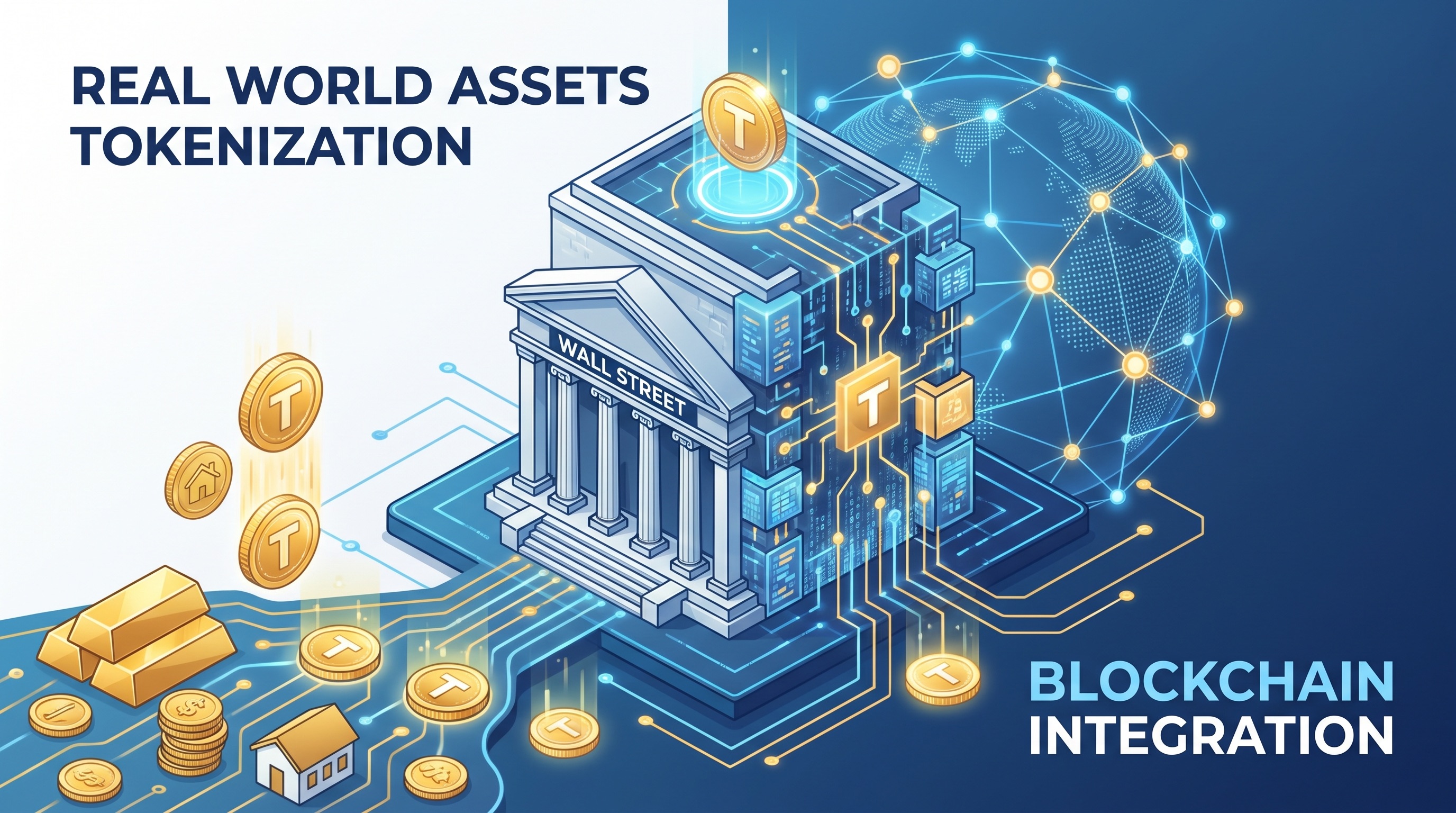
In May 2026, the total value of tokenized real-world assets on public blockchains crossed $32 billion — a 200% increase from the same point in 2025. BlackRock, JPMorgan, Franklin Templeton, and Standard Chartered are all active participants. This is not the crypto sector chasing institutional approval; it is institutional finance actively building on blockchain infrastructure because the technology solves real operational problems they have had for decades.
The shift matters for anyone trying to understand where crypto value is actually accumulating in 2026. The speculative layer — token price momentum, meme coins, trading volume — gets most of the attention. The infrastructure layer — tokenized Treasuries, credit, private equity, and real estate settling on-chain — is where the durable adoption is happening. These are not the same market, and conflating them leads to serious misreadings of where the technology is going.
What RWA Tokenization Actually Is
Real World Asset (RWA) tokenization converts the legal ownership of a traditional financial asset — a US Treasury bond, a real estate parcel, a private credit loan, a commodity — into a digital token on a blockchain. The token is not the asset itself; it is a claim on the asset, enforced by a legal structure (typically a special purpose vehicle or a trust) that holds the underlying asset and issues tokens as fractional representations of ownership.
When you transfer the token, you transfer the economic rights. Settlement happens on-chain in seconds rather than through the two-day T+2 settlement process of traditional securities markets. Custody is programmable: yield distributions, governance votes, and collateral calls can be automated through smart contracts. And fractional ownership becomes trivially easy — a $1,000 minimum investment in a previously institutional-only asset class is technically straightforward to implement.
Where the Market Actually Is
The $32 billion figure needs a breakdown to be useful. Tokenized US Treasuries dominate, accounting for roughly 60% of non-stablecoin RWA value on-chain. These products — Franklin Templeton's BENJI, Ondo Finance's OUSG, BlackRock's BUIDL — hold actual US government bonds and issue tokens that accrue Treasury yield. BlackRock's BUIDL fund crossed $2.4 billion in AUM by mid-2026, making it the largest tokenized money market fund by assets. In late April 2026, BlackRock, Standard Chartered, and OKX launched a framework allowing institutional traders to use BUIDL tokens as collateral in cryptocurrency derivatives trading — a direct bridge between TradFi yield and DeFi capital efficiency.
Private credit is the second-largest segment: on-chain loan origination through platforms like Centrifuge, Maple Finance, and Goldfinch. These platforms tokenize real loan receivables — corporate invoices, trade finance, emerging market loans — and allow DeFi capital to flow into yield-generating credit that was previously only accessible to institutional investors. The segment has experienced credit losses (Maple Finance, notably, had defaults in 2022), but the infrastructure has matured since then with better underwriting standards and clearer legal frameworks.
Real estate tokenization, commodities, and private equity make up the remainder. These segments are smaller but growing. Blockchain-native real estate platforms are now live in the UAE, Singapore, and several EU jurisdictions where regulatory clarity has enabled retail access to fractional property ownership.
What Problems It Actually Solves
The operational case for RWA tokenization is not theoretical. Traditional securities settlement requires custodian banks, clearinghouses, and brokers as intermediaries, each adding cost and time. T+2 settlement means capital is locked for two business days after a trade executes — a meaningful drag for high-frequency institutional portfolios. Corporate bond markets are still largely OTC, with price discovery that is opaque and transaction costs that disadvantage smaller participants.
On-chain settlement eliminates the T+2 cycle. Smart contract automation eliminates layers of reconciliation. Programmable compliance — KYC/AML checks baked into the token transfer logic — addresses regulatory requirements without manual review. For assets with cash flows (bonds, mortgages, revenue-sharing agreements), on-chain distribution means yield accrues and distributes automatically without a transfer agent.
The efficiency gains are real and measurable. JPMorgan's Onyx platform has processed over $1.5 trillion in overnight repo transactions using blockchain settlement. SWIFT's blockchain interoperability experiments are live with multiple central banks. These are not proofs of concept anymore — they are running infrastructure.
The Risks That Are Often Underweighted
The legal structure underpinning RWA tokens is the weakest link in most implementations. The token represents a claim on an asset, but that claim is only as good as the legal entity holding the asset and the jurisdiction enforcing the claim. A smart contract cannot enforce a court order. If the SPV holding the underlying bonds fails, token holders are unsecured creditors of that SPV — a legal fight, not a blockchain transaction.
Regulatory fragmentation is the other meaningful risk. The US SEC has not issued clear rules on whether tokenized securities require full securities registration. Different jurisdictions treat these instruments differently, which means a token legal in Singapore may create compliance exposure in the US or EU. The MiCA framework in Europe is clarifying the picture for European issuers, but global interoperability remains unresolved.
The oracle problem also applies: tokenized real estate or commodity prices require off-chain price feeds that can be manipulated or go stale. Chainlink and other oracle networks provide solutions, but the trust dependency shifts from the blockchain to the oracle network.
What This Means in Practice
For institutional investors, the case for tokenized Treasuries is already made: the yield is equivalent to holding the underlying bond directly, settlement is instant, and the programmable collateral use case (BUIDL-as-collateral for crypto derivatives) creates capital efficiency that does not exist in the traditional market. The adoption question is now about infrastructure integration rather than whether the concept works.
For individuals, direct access to most RWA products still requires KYC, minimum investment thresholds, and often accredited investor status. The fractional ownership pitch is real but partially constrained by regulation. What is accessible is the yield layer: products like OUSG and BENJI are available to qualified retail investors in several markets, offering Treasury-equivalent yields on-chain with daily liquidity.
McKinsey projects the tokenized asset market could reach $2 trillion by 2030. The more conservative reading — that it reaches $500 billion in active use with institutional adoption driving most of the growth — is probably more realistic in the near term. Either way, the direction is clear: traditional finance is not replacing blockchain, and blockchain is not replacing traditional finance. They are converging at the asset layer, and RWA tokenization is where that convergence is most advanced.