Vehicle-to-Grid Moves Out of the Lab: The V2G Vehicles and Programs That Exist in 2026
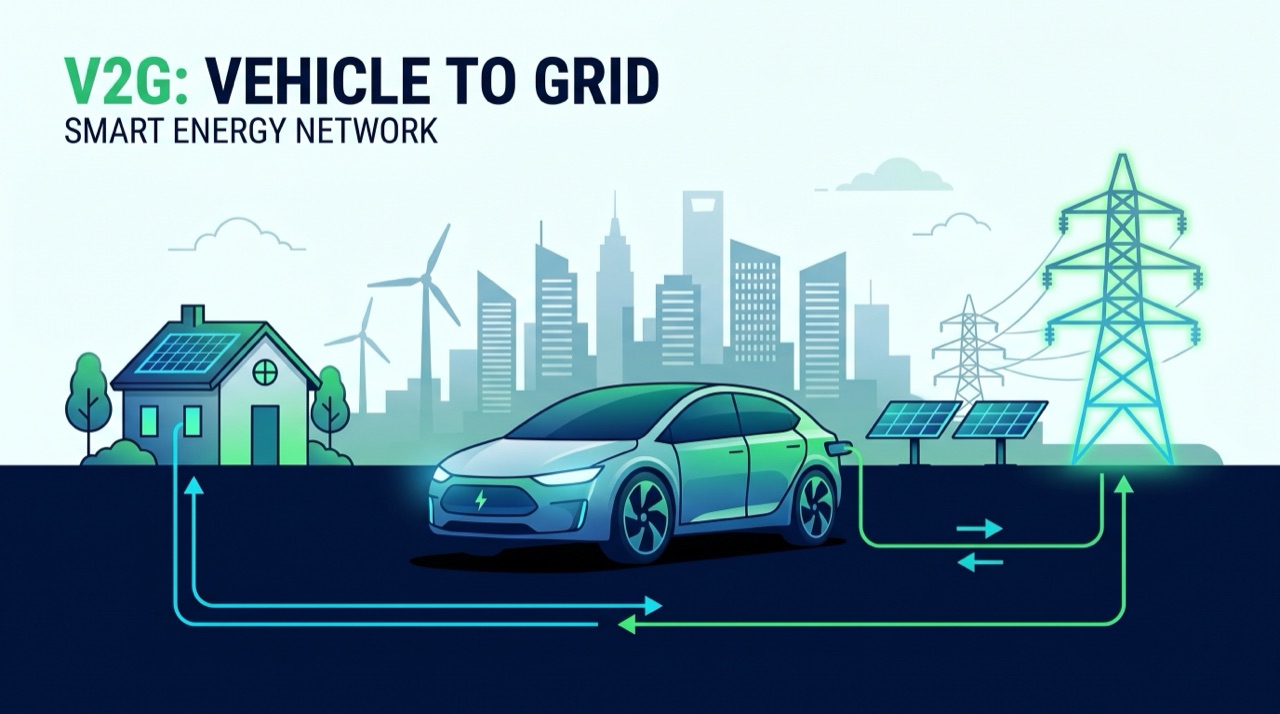
Vehicle-to-grid (V2G) technology has been in various stages of "almost ready" since the first Nissan LEAF shipped with CHAdeMO bidirectional capability in 2012. The premise is simple — your EV's large battery pack is idle 95% of the time, so why not use it as a grid resource? — but the practical barriers of standardization, utility agreements, and software integration kept it from scaling. In 2026, those barriers have not fully dissolved, but enough of them have moved that V2G is a real product category, not a research program.
The Vehicles That Actually Support Bidirectional Charging
Ford F-150 Lightning is the most capable V2G vehicle in the US market. With a 131 kWh battery pack (98 kWh usable), the Lightning can export up to 9.6 kW to a home via Ford's 80-amp Charge Station Pro. Ford calls this Intelligent Backup Power — in an outage, the truck switches automatically to backup mode and can run an average American home for 3-10 days depending on usage. Ford also participates in grid programs through partnerships with Pacific Gas & Electric and other utilities; Lightning owners in participating regions can enroll to sell power during grid events. The 1,000 lb payload and working-truck use case mean many Lightning owners were skeptical buyers who are now V2G participants somewhat by accident.
Hyundai and Kia have gone broader than any other automaker. The IONIQ 5, IONIQ 6, EV6, and EV9 all support V2X (vehicle-to-everything) — which includes V2H (home), V2L (load, for powering appliances directly), and V2G depending on regional infrastructure. The IONIQ 5 supports V2L natively at up to 3.6 kW through a 240V outlet in the frunk, making it genuinely useful for camping or construction sites. Hyundai partnered with E.ON in Europe and several US utilities to enable grid export in regions where the supporting inverter infrastructure exists.
Volkswagen Group committed to AC bidirectional charging (V2H) across its ID. platform in 2024, using CCS Combo 2 rather than CHAdeMO. The ID.4, ID.7, and Porsche Taycan received software and hardware updates to enable home backup. VW's approach focuses on V2H rather than V2G — returning power to your own home rather than the grid — which sidesteps utility integration complexity. This is a pragmatic trade-off: V2H works with a compatible home wallbox and does not require a utility agreement or smart meter.
Nissan LEAF remains notable for being first. The LEAF has supported CHAdeMO bidirectional charging since the second generation. In the UK, Nissan partnered with Enel X for a V2G trial that ran for several years, and the results — battery degradation was minimal when bidirectional cycling was managed within a sensible state-of-charge window — helped build the evidence base that V2G does not wreck batteries at the rate skeptics feared. The LEAF's relatively small battery (40-62 kWh) limits how much it can contribute, but the ecosystem it helped establish has been foundational.
Tesla Cybertruck added V2H support in 2024, allowing the truck to export power to a home without requiring a Tesla Powerwall. Given the Cybertruck's 123 kWh battery, it can run a typical American home for 3-6 days. Tesla's reluctance to support bidirectional charging on the Model 3 and Model Y — the actual volume products — means V2G remains Cybertruck-specific within Tesla's lineup for now.
What Utilities Are Paying
The commercial case for V2G depends on what utilities will pay EV owners for grid services. In the UK, Octopus Energy's Intelligent Octopus and Cosy Octopus tariffs are the most visible example: EV owners can charge at cheap overnight rates (as low as 7p/kWh between 11 PM and 5 AM) and sell power back during grid stress events at higher rates. Octopus customers with V2G-capable vehicles and compatible chargers have reported annual earnings of £500-2,000 depending on vehicle size, tariff enrollment, and how frequently they participate in grid events.
In the US, Pacific Gas & Electric's EV Grid program has been running for several years with a growing pool of participating vehicles. PG&E sends dispatch signals during periods of high grid stress — typically hot summer afternoons when air conditioning load peaks — and enrolled EVs discharge for 1-4 hour windows. Compensation varies by program but is generally in the range of $0.20-0.50 per kWh exported during grid events. National Grid in the UK has run similar pilots. The common thread: utilities want the flexibility, they are willing to pay for it, and the question has shifted from "will utilities do this" to "how do we scale the enrollment process."
What Still Holds V2G Back
Despite commercial progress, V2G has not reached the mass-market penetration that early advocates projected. Several constraints remain:
Charging standard fragmentation: CHAdeMO (Nissan, older Asian vehicles), CCS (European standard, now NACS-compatible in North America), and NACS (Tesla's connector, now adopted across the US) each require different bidirectional charging implementations. The ISO 15118-20 standard defines how V2G communication should work over CCS and NACS, but not every charger and vehicle that supports V2G uses the same protocol implementation. Interoperability testing is ongoing and improving, but it remains a friction point.
Utility integration: Grid dispatch requires smart metering, real-time communication between the utility and the vehicle, and billing systems that can handle power flowing in both directions. Many utilities are still building out this infrastructure. Enrollment processes vary by region and can require multiple account setups and hardware verifications.
Battery warranty concerns: Some manufacturers limit V2G use in their warranty terms, citing cycling concerns. The evidence from Nissan's long-running trial suggests degradation is manageable with good state-of-charge management, but blanket warranty terms have not universally caught up with that evidence. This is changing — VW's and Hyundai's V2G-capable vehicles include bidirectional use within standard warranty coverage — but it creates consumer uncertainty.
Missing from the volume market: The vehicles that support V2G most comprehensively — F-150 Lightning, IONIQ 5, Cybertruck — are all either trucks or higher-end models. The mass-market EV (compact crossover, sub-$35K) has not widely adopted bidirectional charging. Until V2G capability is standard on Model 3 / Model Y equivalents, the technology's grid impact will be limited by fleet composition.
The Bigger Picture: Virtual Power Plants
The grid-level case for V2G is compelling. An average US EV has 60+ kWh of battery capacity. There are now approximately 5 million plug-in EVs on US roads. If 10% participated in a coordinated V2G program with average available capacity of 30 kWh, that is 15,000 MWh of dispatchable storage — comparable to several large utility-scale battery storage facilities, available at locations distributed across the grid rather than concentrated at a few points.
Virtual power plant (VPP) programs are moving from pilot to commercial deployment. Companies like AutoGrid, Enbala, and Swell Energy aggregate distributed energy resources — including V2G EVs — and bid them into wholesale electricity markets. The revenue flows back to participants. This is the same model that has worked for aggregating home batteries and smart thermostats; EVs are simply larger, more widely owned batteries.
V2G is not going to solve grid storage by itself, and the per-owner economics only make sense if you are already driving an EV in a region with a participating utility. But the trajectory is clear: more vehicles with bidirectional capability, more utilities with V2G programs, and a steadily improving business case for participating. The concept moved from lab to real product between 2020 and 2026. The next five years are about scaling.