AI-Assisted Rendering: The New Foundation of Modern Game Design
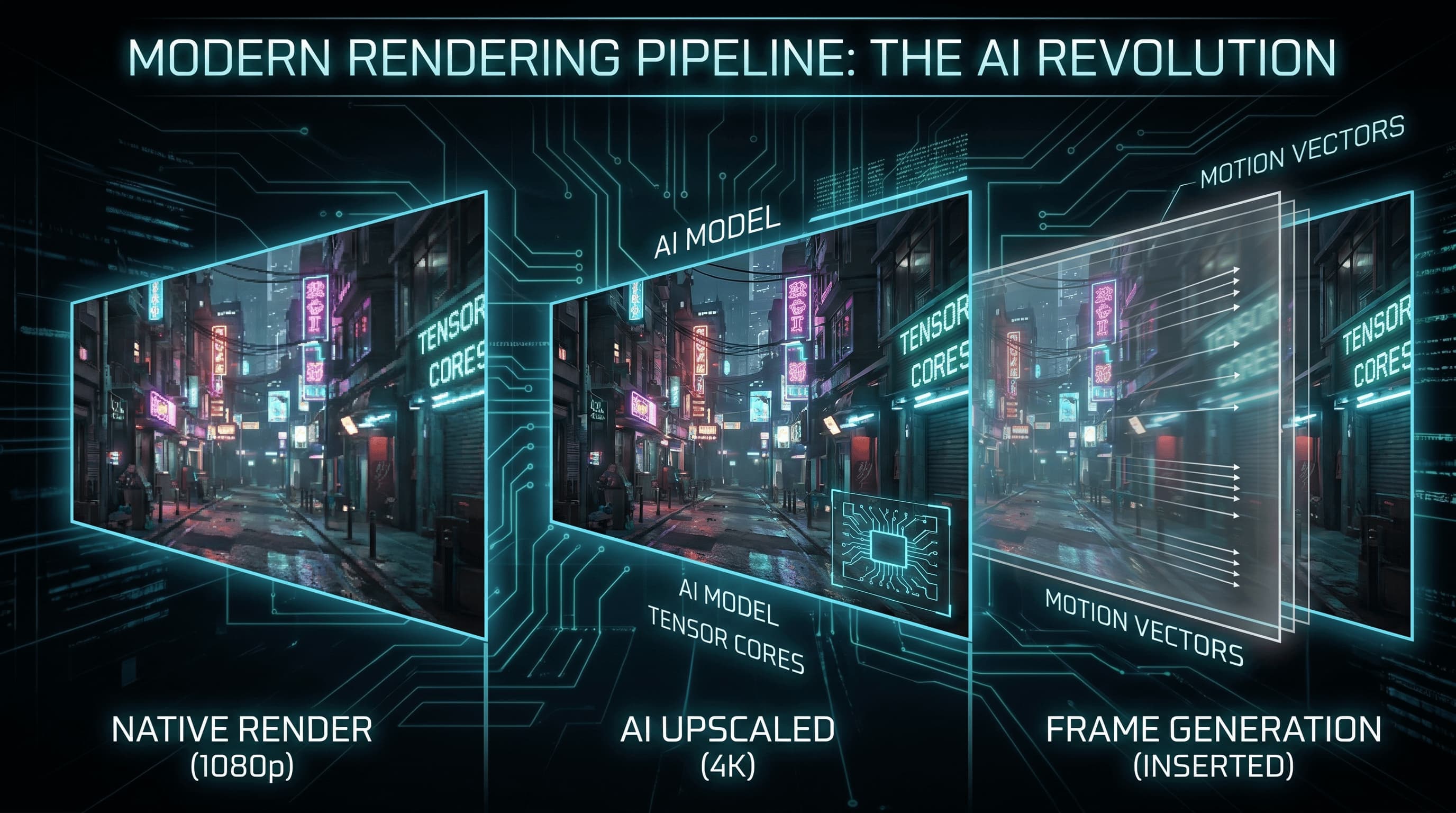
The landscape of PC gaming graphics has undergone a profound transformation in recent years, driven by the relentless pursuit of higher resolutions, more intricate visual effects, and smoother frame rates. What began as experimental features – technologies like NVIDIA's DLSS, AMD's FSR, and Intel's XeSS – have rapidly evolved from optional performance enhancers into indispensable pillars of modern game design. This isn't merely a marketing talking point; it's a fundamental shift in how games are conceived, optimized, and ultimately played. AI-assisted rendering is now embedded in game design, not just graphics card marketing, dictating performance targets and shaping the very visual experience.
For decades, the mantra was simple: more powerful GPUs meant better graphics and higher frame rates at native resolutions. While raw GPU horsepower remains crucial, the advent of sophisticated upscaling and frame generation techniques has introduced a new paradigm. Developers are increasingly designing games with the explicit assumption that players will utilize these technologies to achieve optimal performance and visual quality. This integration means that understanding the nuances of DLSS, FSR, and XeSS, along with frame generation, is no longer a niche concern for enthusiasts but a core competency for anyone involved in the gaming ecosystem, from developers to end-users making purchasing decisions.
The Genesis of Performance Enhancement
The concept of rendering at a lower resolution and then upscaling to a higher one isn't entirely new. Techniques like checkerboard rendering have existed for years, particularly in console gaming, to achieve higher perceived resolutions with less computational overhead. However, the modern era of AI-assisted upscaling began in earnest with NVIDIA's Deep Learning Super Sampling (DLSS). Leveraging dedicated Tensor Cores on RTX GPUs, DLSS uses AI to reconstruct a high-resolution image from a lower-resolution input, intelligently filling in missing details based on a trained neural network. The results were often superior to traditional spatial upscaling methods, offering near-native image quality with significant performance gains.
Following DLSS, AMD introduced FidelityFX Super Resolution (FSR), an open-source, hardware-agnostic solution. FSR operates on a spatial upscaling algorithm, analyzing the current frame to reconstruct details. While initially not matching DLSS's AI-driven fidelity, FSR's broad compatibility across a wide range of GPUs (including older NVIDIA cards and integrated graphics) made it incredibly popular. Intel then entered the fray with Xe Super Sampling (XeSS), which also utilizes AI, leveraging XMX (Xe Matrix Extensions) on Arc GPUs or DP4a instructions on other vendor GPUs, aiming for a balance of quality and compatibility.
Frame Generation: The Next Frontier
While upscaling focuses on improving the quality of existing frames, frame generation takes performance enhancement a step further by creating entirely new, interpolated frames. NVIDIA's DLSS 3, for instance, combines DLSS Super Resolution with Optical Multi Frame Generation. This technology uses AI to analyze two sequential frames and the optical flow field between them, then generates an intermediate frame. The result is a dramatic increase in perceived frame rate, often doubling or more, without requiring the GPU to render those frames natively. AMD's FSR 3 and Intel's XeSS with Frame Generation offer similar capabilities, albeit with their own algorithmic approaches.
The benefits of frame generation are undeniable: significantly smoother gameplay, especially in graphically demanding titles or at higher resolutions. However, it's not without its trade-offs. The primary concern is increased input latency. Since frames are being interpolated, there's a slight delay between your input and the visual feedback on screen. While technologies like NVIDIA Reflex aim to mitigate this, competitive gamers often prefer native rendering or pure upscaling to minimize latency. Additionally, frame generation can sometimes introduce minor visual artifacts, particularly in fast-moving scenes or with UI elements, though these are continually being refined.
The Developer's New Toolkit
For game developers, these technologies represent a paradigm shift in how performance targets are set. Instead of aiming for a native 60 FPS at 4K on high settings, developers can now realistically target 60 FPS with DLSS/FSR/XeSS Quality mode enabled, or even 120 FPS with frame generation. This allows them to push visual boundaries further, incorporating more demanding features like path tracing or highly detailed environments, knowing that performance can be recovered through AI-assisted rendering.
This integration means that developers must consider these technologies from the outset. Designing robust anti-aliasing solutions that work well with upscalers, ensuring UI elements scale correctly, and optimizing the base rendering pipeline to provide a clean input for the AI models are now critical tasks. The "performance budget" for a game now explicitly includes the gains expected from these technologies, making them an integral part of the optimization process rather than an afterthought.
Navigating the New Gaming Landscape: Player Considerations
For gamers, this evolution means that raw GPU benchmarks at native resolutions no longer tell the whole story. When evaluating a new graphics card or a new game, understanding its support for DLSS, FSR, and XeSS, and how effectively it implements them, is paramount. A mid-range GPU with excellent DLSS 3 support might outperform a higher-tier card lacking such features in certain scenarios, especially when frame generation is factored in.
Here are some actionable takeaways for players:
- Embrace Upscaling: Don't view DLSS, FSR, or XeSS as compromises. For most modern games, especially at 1440p and 4K, they are essential for achieving a smooth, high-fidelity experience. Experiment with different quality modes (Quality, Balanced, Performance) to find the sweet spot between visual fidelity and frame rate for your setup.
- Understand Frame Generation Trade-offs: While frame generation offers incredible FPS boosts, be mindful of the increased latency. For single-player, visually stunning games, it's often a fantastic option. For competitive multiplayer titles where every millisecond counts, you might prefer to stick to upscaling only or native rendering if your GPU allows.
- GPU Buying Decisions: When purchasing a new GPU, consider its ecosystem. NVIDIA offers DLSS (including DLSS 3 with frame generation), AMD offers FSR (including FSR 3 with frame generation), and Intel offers XeSS. While FSR is broadly compatible, the best quality and performance often come from a vendor's native solution on their respective hardware. Factor in which games you play most and which technologies they support best.
- Monitor Game Settings: Always check a game's graphics settings for upscaling and frame generation options. Many games now default to enabling these, but understanding and adjusting them can significantly impact your experience.
- Expect the New Normal: The days of expecting every game to run at native 4K 60 FPS on ultra settings without any assistance are largely behind us. AI-assisted rendering is the new baseline for high-performance gaming.
The Future is AI-Rendered
The trajectory is clear: AI-assisted rendering is not a fleeting trend but a fundamental shift in how games are developed and consumed. As AI models become more sophisticated, and hardware continues to evolve, we can expect even more seamless integration, higher fidelity, and potentially new forms of rendering that leverage machine learning in unprecedented ways. From dynamic resolution scaling that intelligently adjusts based on GPU load to even more advanced frame interpolation techniques, the future of gaming graphics will be inextricably linked to the power of AI.
This evolution means a more accessible high-fidelity gaming experience for a broader range of hardware, pushing the boundaries of what's visually possible without demanding exponentially more raw processing power. It's an exciting time for gaming, where the lines between rendered and AI-generated content blur, all in the service of delivering breathtaking virtual worlds and unparalleled performance.