Thinking Models vs Standard LLMs: What Changes When an AI Reasons Before Answering
The Core Difference Is Where the Work Happens
Standard large language models — GPT-4o, Claude Sonnet, Gemini Flash — are trained to predict the next token as efficiently as possible. They encode reasoning patterns during training, then apply them at inference in a single forward pass. The result is fast, cheap, and surprisingly capable for most everyday tasks. But the computation budget is fixed the moment you hit send.
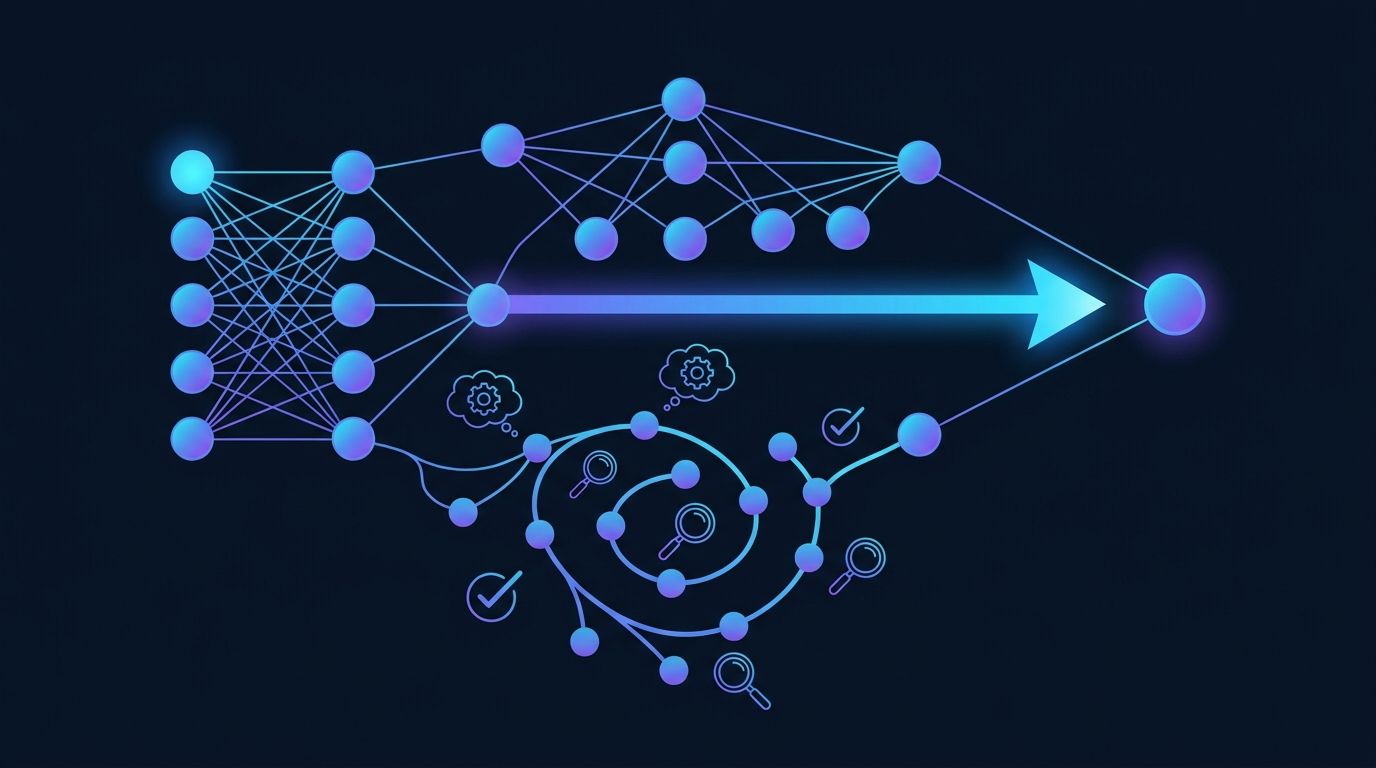
Reasoning models break that constraint. Models like OpenAI o3, o4-mini, Anthropic's Claude claude-opus-4-8 in extended thinking mode, and Gemini 2.5 Pro with reasoning enabled allocate additional compute at inference time — often called test-time compute. Before producing a final answer, the model runs an internal chain-of-thought, checks its own work, backtracks when a path leads nowhere, and tries alternative approaches. DeepSeek R2 applies a similar technique, trained with reinforcement learning to reward correct outcomes rather than just fluent outputs. The visible effect: answers take longer and cost more tokens, but on hard problems they are substantially more accurate.
What Chain-of-Thought Actually Does to the Model
Chain-of-thought is not a new idea — researchers showed in 2022 that prompting a model with "let's think step by step" improved math scores. What reasoning models do differently is internalize that process and scale it with search. OpenAI o3, for instance, uses a form of Monte Carlo tree search over candidate reasoning paths during inference. Rather than committing to one chain of thought, it explores branches, scores them, and synthesizes from the best. That is qualitatively different from a prompted CoT on GPT-4o, where the model still follows one pass of reasoning without genuine backtracking.
The practical consequence shows up in benchmarks. On the 2024 AIME mathematics competition, GPT-4o scores around 13%. OpenAI o3 scores above 96%. On the ARC-AGI visual reasoning benchmark — designed to resist pattern-matching — o3 reached 87.5% while GPT-4o stayed below 10%. These are not marginal improvements. They reflect a structural difference in how the model handles problems that require multi-step deduction with no obvious shortcut.
Where Standard Models Still Win
Despite the benchmark gap, most production workloads are not AIME problems. A customer service bot summarizing a return policy does not benefit from 30 seconds of internal deliberation. For tasks that are primarily retrieval, reformatting, translation, classification, or short-form generation, a fast standard model is the correct choice — and usually the cheaper one by an order of magnitude.
- GPT-4o remains the default for high-volume, low-latency applications: real-time chat, document drafting, API integrations where response time matters more than solving novel problems.
- Claude Sonnet (the non-extended-thinking variant) is well-suited for long-context summarization, coding assistance on well-defined problems, and tasks requiring careful instruction-following at speed.
- Gemini Flash handles high-throughput pipelines where cost per token is the primary constraint — batch classification, content tagging, lightweight Q&A over structured data.
The rule of thumb: if a competent human could answer the question in under a minute without scratch paper, a standard model is probably sufficient.
When Reasoning Models Are Worth the Cost
The use cases where test-time compute pays off share a common structure: the problem has a correct answer, reaching it requires multiple dependent steps, and an error early in the chain cascades into a wrong final result.
- Complex code generation: Writing a working algorithm from a formal specification, debugging a subtle concurrency issue, or refactoring a large codebase where changes interact. O4-mini outperforms GPT-4o on competitive programming benchmarks by 30+ percentage points.
- Mathematical and scientific reasoning: Proof verification, physics word problems, financial modeling with constraint satisfaction. This is where o3 and Gemini 2.5 Pro in reasoning mode demonstrate their largest advantages over standard models.
- Multi-step planning under constraints: Legal contract analysis where conclusions depend on cascading clause interpretations, logistics optimization, or medical differential diagnosis chains. Claude claude-opus-4-8 with extended thinking is particularly cited for long-horizon planning tasks where maintaining coherent context over many reasoning steps matters.
- Adversarial or edge-case inputs: When user input is ambiguous, contradictory, or designed to probe model limits, reasoning models are less likely to confidently hallucinate because the verification step catches inconsistencies before output.
DeepSeek R2 is worth flagging here for cost-sensitive deployments that still need reasoning depth. Its inference cost is substantially lower than o3, and on many coding and math benchmarks it performs within a competitive range of OpenAI's flagship reasoning models. For organizations building reasoning-heavy pipelines at scale, R2 is a credible option that does not require routing through US-based API providers.
The Latency and Cost Tradeoff Is Real
Using o3 on a task that GPT-4o could handle is not just wasteful — it degrades user experience. O3's median response time on complex tasks can exceed 30 seconds. O4-mini is faster and cheaper than o3 while preserving most of the reasoning capability, which is why it has become the default reasoning choice for many developers. Gemini 2.5 Pro in reasoning mode sits in a similar position: capable of deep reasoning but slower and pricier than Gemini Flash for simple tasks.
A practical architecture that many teams are converging on: use a fast standard model as the first pass, route only the queries that fail a confidence threshold or belong to a flagged category (math, code, legal) to a reasoning model. This keeps average latency low while applying test-time compute where it actually matters.
Takeaways for Choosing the Right Model
- Default to GPT-4o, Claude Sonnet, or Gemini Flash for anything that is primarily language generation, retrieval, or classification. Reserve reasoning models for problems with verifiable correct answers requiring multi-step deduction.
- O4-mini is the most cost-efficient entry point into OpenAI's reasoning tier. O3 is for the hardest problems where accuracy justifies the latency and price.
- Gemini 2.5 Pro's reasoning mode and Claude claude-opus-4-8's extended thinking are strong alternatives with different cost structures and context window advantages — benchmark on your specific task rather than defaulting to a single provider.
- DeepSeek R2 is the option to evaluate if you need reasoning capability at lower cost and have flexibility on hosting or API provider.
- Build routing logic early. A system that always uses the most capable model is not a well-engineered system — it is an expensive one.
Reasoning models did not make standard LLMs obsolete. They expanded what AI can do on a specific class of problems that was previously out of reach. Understanding where that boundary sits is the practical skill that separates thoughtful AI integration from expensive overengineering.