The New Factory Workers: Humanoid Robots Are Clocking In
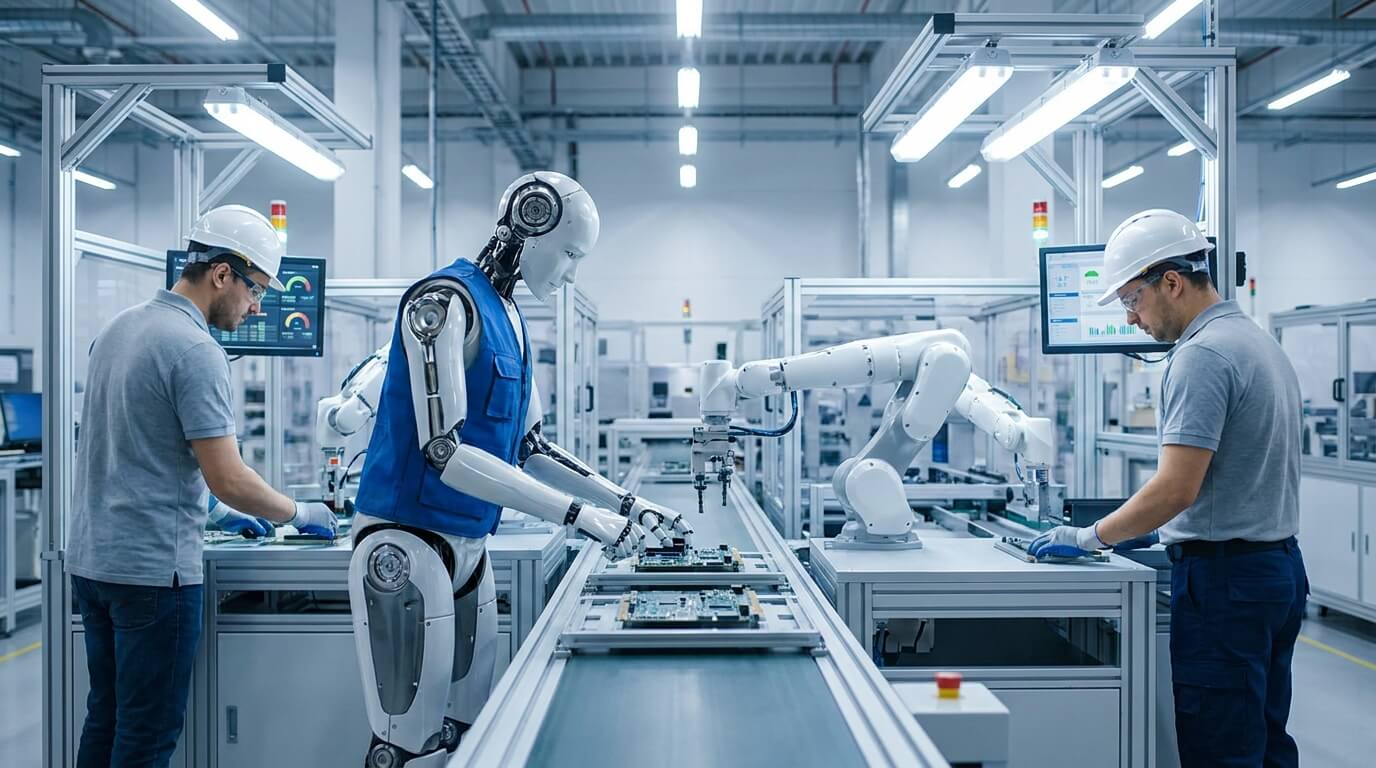
# The New Factory Workers: Humanoid Robots Are Clocking In The factory floor, a landscape once defined by the rhythmic clang of machinery and the precise, repetitive motions of caged robotic arms, is on the cusp of a profound transformation. The next wave of automation is not bolted down; it walks on two legs. Humanoid robots, long the stuff of science fiction, are stepping out of research labs and into the demanding environments of manufacturing and logistics. Companies like Boston Dynamics, Tesla, Agility Robotics, and Figure AI are leading a charge that promises to redefine not just how we make things, but who—or what—does the making. ## Why Humanoid? The Advantage of a Familiar Form For decades, industrial robots have been hyper-specialized, designed for a single task and confined to a safety cage. The humanoid form factor upends this paradigm. Its key advantage is adaptability. A robot built like a human can navigate a world built for humans. It can walk up stairs, move through narrow aisles, and operate in spaces designed for people, eliminating the need for costly facility redesigns. Furthermore, a humanoid robot can theoretically use the same tools and interact with the same interfaces as a human worker. This opens up a vast range of potential applications, from operating machinery to picking items from shelves, without needing to re-engineer the entire process around the robot. It’s about creating a machine that fits into our workflow, not the other way around. ## The Contenders: A New Breed of Industrial Titans The race to deploy humanoid robots is heating up, with several key players making significant strides: * **Boston Dynamics' Atlas:** After years of breathtaking but experimental videos, Boston Dynamics unveiled a commercial, all-electric version of Atlas in early 2026. Designed for heavy lifting and physically demanding tasks, it’s making its debut with Hyundai Motor Group. The new Atlas is built for continuous operation, featuring self-swappable batteries and an advanced AI that allows it to learn new tasks that can be deployed across an entire fleet in under a day. * **Tesla's Optimus:** Elon Musk’s vision for Optimus is characteristically ambitious. Tesla is retooling production lines to mass-produce the robot, aiming for millions of units. Optimus is already being tested in Tesla’s own factories, assisting with parts assembly and material transport. Leveraging Tesla's deep expertise in AI and manufacturing at scale, the goal is to create a general-purpose robot that could eventually be more significant than its automotive business. * **Agility Robotics' Digit:** Digit has a crucial first-mover advantage: it is the world's first commercially deployed humanoid robot, already at work in the warehouses of companies like Spanx and Mercado Libre. Focused squarely on logistics, Digit excels at tasks like tote handling and material movement. With its cloud-based fleet management platform, Agility Arc, and a dedicated manufacturing facility, Digit is proving the real-world viability of humanoid robots in logistics today. * **Figure AI's Figure 03:** Partnered with BMW for automotive manufacturing, Figure AI is developing a sophisticated, AI-driven robot capable of learning directly from human demonstration. The recently unveiled Figure 03 boasts enhanced sensory input, with high-frame-rate cameras and tactile sensors in its fingertips. The company’s vision is to create a general-purpose robot that can perform a wide variety of tasks with minimal training, and it is uniquely using its own robots to help build its robot factory. ## From Pilot Programs to Production Lines The applications for these robots are moving from theory to practice. In warehouses, Digit is already a common sight in some facilities, autonomously moving totes and packages, bridging the gap between other automated systems. In manufacturing, Figure 03 is being tested on BMW's production lines, while Atlas is preparing for deployment in Hyundai’s plants. These initial use cases focus on the "dull, dirty, and dangerous" jobs—repetitive lifting, moving heavy materials, and tending to machinery. The tasks are often ergonomically challenging for humans and represent key bottlenecks in production and fulfillment. By automating them, companies aim to increase efficiency, reduce workplace injuries, and free up human workers for more complex, cognitive tasks. ## The Roadblocks to Mass Adoption Despite the rapid progress, a future teeming with robotic co-workers isn't here just yet. Several significant hurdles remain: * **Cost:** While prices are expected to fall, the initial investment for a fleet of humanoid robots is substantial. * **Battery Life & Power:** Continuous operation is critical in an industrial setting. Ensuring robots can work long shifts without lengthy downtime for charging is a major engineering challenge. * **Safety:** The most critical component. These robots will work alongside people, uncaged. Developing software and hardware that is flawlessly safe and predictable in dynamic human environments is non-negotiable. * **Software Intelligence:** The "brain" is everything. The robot's ability to understand commands, adapt to unexpected situations, and learn new tasks quickly and robustly is the biggest differentiator and the area of most intense research. ## The Dawn of a New Industrial Era The question is no longer *if* humanoid robots will become a staple of industry, but *when*. The first deployments are already happening. Within the next 2-3 years, we can expect to see them become an increasingly common sight in the warehouses and factories of major corporations. Within the decade, they could be widespread. The long-term vision extends far beyond the factory. The same technology that allows a robot to assemble a car could one day enable it to assist in a hospital, stock shelves in a grocery store, or even help in the home. We are witnessing the birth of a new category of machine—a general-purpose tool that can adapt to our world and augment human capability in ways we are only beginning to imagine. The new factory workers are here, and they're ready to get to work.