Tender Offers Are Becoming a Product Strategy for Late-Stage Startups
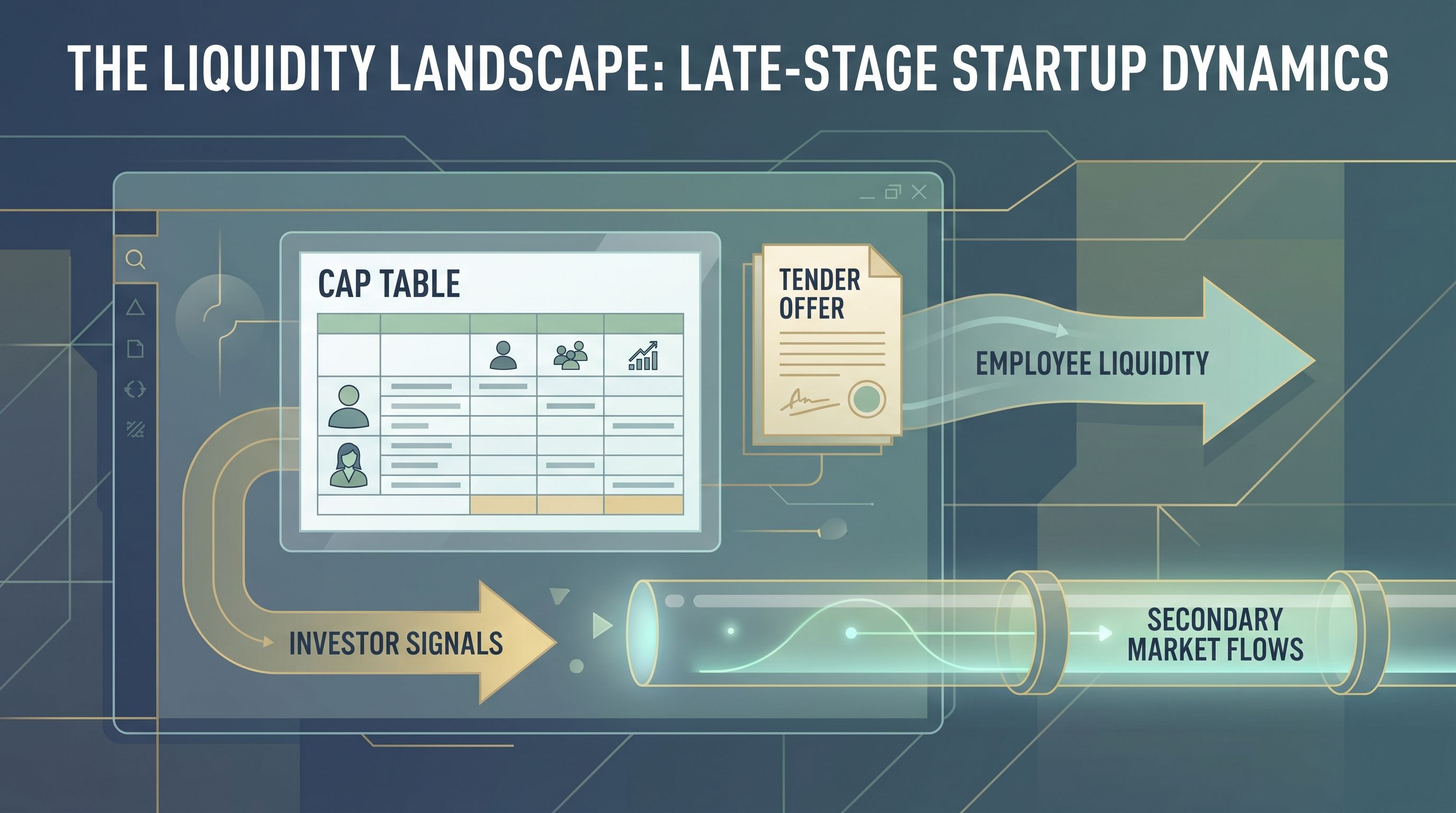
For most of the venture era, tender offers sat in the background as occasional financial events. They happened when a company stayed private for a long time, when early employees needed liquidity, or when investors wanted to rebalance a crowded cap table. Today that framing is changing. At a growing number of late-stage startups, tender offers are being treated less like emergency finance and more like product strategy: a designed mechanism for managing employee incentives, market expectations, and corporate timing.
The reason is simple. Modern startups stay private longer, hire at larger scale, and accumulate far more paper wealth before an IPO or acquisition becomes realistic. That creates an operating problem, not just a balance-sheet problem. If employees cannot convert any of their equity into cash for years, retention suffers, compensation becomes harder to explain, and the company risks turning stock options into an abstract promise. A structured tender offer can reset that dynamic by making equity feel real again without forcing the company into a public listing before it is ready.
Liquidity is now part of the employee product
Late-stage startups already think carefully about the internal product they offer employees: mission, cash compensation, tooling, growth path, manager quality, and equity upside. Secondary liquidity increasingly belongs on that list. In a world where private-company timelines stretch well beyond a decade, workers are making life decisions, tax decisions, and career decisions long before a terminal event arrives. Equity that cannot be partially realized may be emotionally motivating in theory but fragile in practice.
A well-designed tender offer changes the psychology. It signals that management understands employee risk, not just shareholder upside. It can reduce pressure on high-performing staff to leave for a public company. It can also help newer employees believe the equity package has practical value rather than purely narrative value. This is why some founders now discuss liquidity windows almost the way they discuss refresh grants or promotion bands: as a tool for keeping the talent system credible.
Pricing discipline matters more than ever
Tender offers also force a more honest conversation about price. In euphoric markets, private valuations could drift upward through fundraising rounds that had strategic motives of their own. But a secondary transaction asks a sharper question: at what price are real buyers and real sellers willing to transact now? That makes tender offers a form of live price discovery, even when they are carefully structured and partially managed.
This is one reason boards have become more strategic about timing and design. A company that wants to demonstrate valuation resilience may welcome a tender offer that clears at a disciplined price. A company that fears a weak signal may delay or narrow the process. Either way, the tender is not neutral. It broadcasts information to employees, existing investors, and future investors about how the company views its own durability. In markets where headline valuations have lost some credibility, controlled secondary liquidity can be a more persuasive signal than a theoretical mark from a prior round.
Tender offers as investor signaling
Investors have their own reasons to support this shift. New capital entering a late-stage company often wants cleaner alignment and lower internal pressure. If employees are frustrated or large seed holders are seeking ad hoc sales, that uncertainty can bleed into fundraising discussions. A structured tender offer is a way to channel those pressures into a visible, governable process. It can show that the company has enough confidence and operational maturity to run a complex liquidity event without destabilizing the cap table.
It also lets lead investors shape the narrative. They can participate as buyers, support an organized process, and communicate that the company is not merely surviving between rounds but actively managing stakeholder trust. That matters because private markets now reward signals of governance quality almost as much as growth. A startup that can execute a tender with clear rules, sensible limits, and coherent communication looks more institutionally mature than one relying on sporadic side deals.
Why this is a product strategy, not just finance
Calling tender offers a product strategy may sound strange, but it fits the way modern companies operate. Product strategy is about designing systems that shape user behavior and trust. In a late-stage startup, employees and existing shareholders are internal users of the equity system. They respond to clarity, timing, constraints, and incentives. A tender offer is therefore an interface choice as much as a finance choice. It determines who gets access, how much can be sold, what message leadership sends, and whether the company treats liquidity as an exceptional favor or an expected part of the employee journey.
That framing changes execution. Instead of asking only whether a tender is possible, companies ask whether it solves a retention problem, eases tax pain, supports recruiting, or sets up a cleaner path to the next financing. They think about eligibility rules the way product teams think about rollout rules. They consider communication sequencing, fairness, and expectation management. The most sophisticated operators understand that a badly designed tender can damage morale just as easily as a well-designed one can strengthen it.
The operational tradeoffs are real
None of this means every company should run a tender offer. The legal, administrative, and signaling risks are real. If the company sets the wrong price, opens the window too widely, or creates the impression that insiders are rushing for the exit, the event can backfire. There are also distributional questions. Should senior staff be able to sell more than junior staff? Should founders participate? Should long-tenured employees receive priority? These are not merely financial mechanics. They are governance and culture choices that people inside the company will study closely.
Still, the broader direction is clear. As companies remain private for longer, liquidity cannot be treated as an afterthought. It is becoming one of the operating levers of a mature startup. Tender offers are attractive because they let management create partial release valves without surrendering strategic timing to public markets. They can reduce pressure, strengthen retention, and produce a more grounded signal about valuation discipline.
The deeper lesson is that equity has become a product surface. Employees experience it, talk about it, compare it, and make career choices around it. Once that is true, liquidity design becomes part of company design. Tender offers are not replacing growth, product-market fit, or fundraising. But for late-stage startups navigating long private timelines, they are increasingly becoming a deliberate feature of how the business is run, not just a rare event tucked into the finance calendar.