Tauri vs Electron in 2025–2026: Which Should You Use?
Why This Comparison Matters Now
For most of the last decade, if you wanted to ship a cross-platform desktop app using web technologies, Electron was the answer. GitHub created it in 2013, and it went on to power VS Code, Slack, Discord, Figma, Notion, and countless others. It works. It is proven. Companies bet their products on it.
Then Tauri arrived, reached 1.0 in 2022, and shipped a major Tauri 2.0 release in October 2024 that added iOS and Android support. The question is no longer "should I look at Tauri" — it is "when does Tauri win, and when does Electron still make sense?"
Why Electron Apps Are So Large
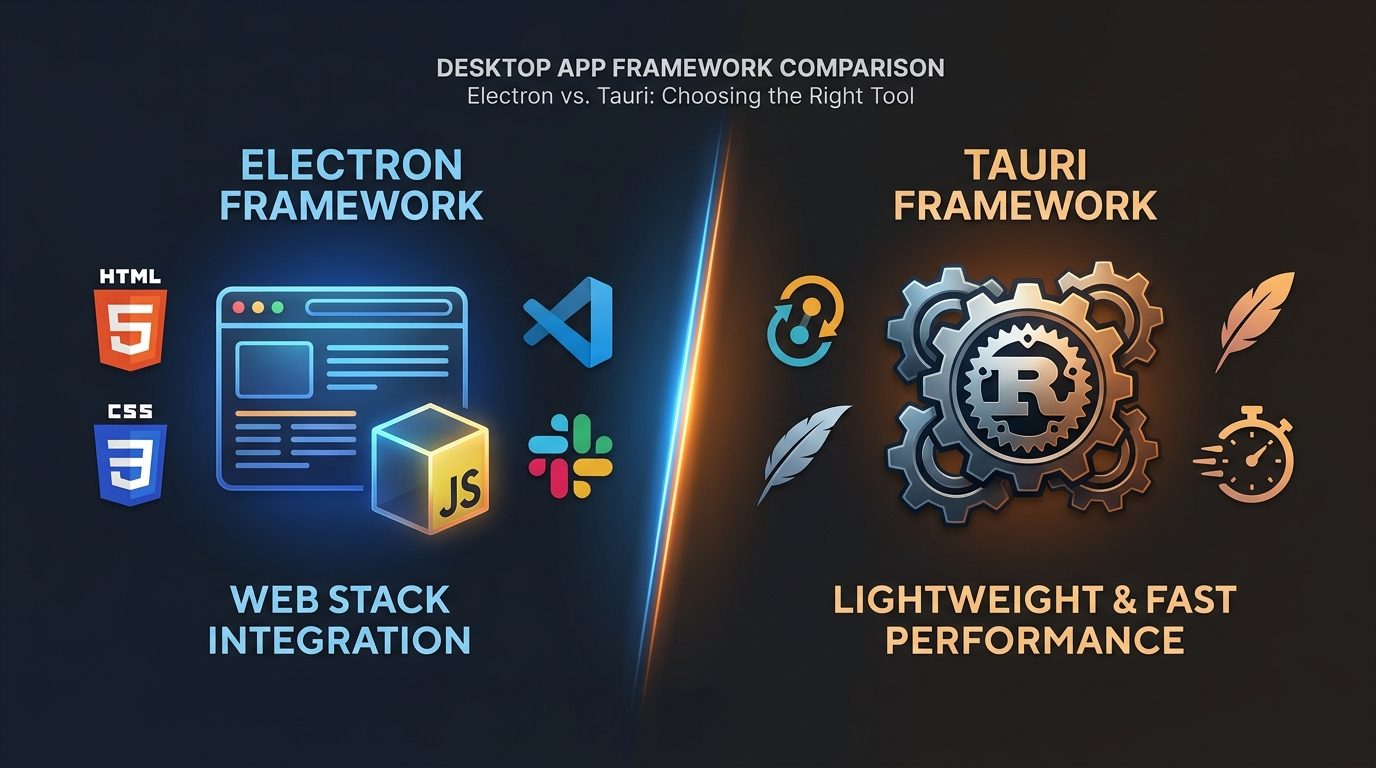
The honest answer to why an Electron app weighs 150–300 MB minimum is simple: every single Electron app ships its own copy of Chromium and Node.js. Your app does not use the browser already installed on the user's machine. It brings its own. That is by design — it gives you a controlled, consistent rendering environment — but it means every user downloads essentially a stripped-down browser just to run your app.
Discord routinely consumes 500 MB or more of RAM in normal use. That is not a Discord engineering failure; it is what happens when you run multiple Chromium renderer processes. The memory cost is structural.
What Tauri Does Differently
Tauri takes the opposite bet. Instead of bundling Chromium, it uses whatever WebView the operating system already provides: WebKit on macOS, WebView2 (Edge-based) on Windows, and WebKitGTK on Linux. The result is that a Tauri app can ship as a 2–10 MB binary. No bundled browser. No bundled runtime.
The backend is written in Rust instead of Node.js. Rust compiles to native code, starts fast, and is substantially faster than Node.js for CPU-bound work. Tauri also ships with an explicit permission model: by default, the frontend cannot call any Rust function unless you have explicitly listed it in an allowlist. Electron's IPC is less restrictive out of the box, which has historically been a source of security vulnerabilities in poorly written Electron apps.
The Real Tauri Tradeoff: WebView Inconsistency
Tauri's biggest drawback is the one you feel most directly as a frontend developer. Because each platform uses a different WebView engine, the same CSS and JavaScript does not always render identically. WebKit on macOS and Edge/Chromium on Windows have real differences. If your app relies on specific layout behavior, font rendering, or newer CSS features, you will hit platform-specific bugs that simply do not exist in Electron.
With Electron, you control the Chromium version. Every user on every platform runs exactly the same browser engine. That consistency is genuinely valuable — it is the reason companies with large, complex UIs have not rushed to switch.
There is also the Rust learning curve. If your team writes Node.js and you want to add native functionality, Electron lets you stay in JavaScript. Tauri requires Rust for backend logic. Rust is an excellent language, but it has a steep onboarding cost for teams that have never used it.
Who Is Already Using Tauri
1Password 8 is the most prominent production example — they rewrote the app in Tauri and Rust and shipped it to millions of users. That is a serious security-sensitive application running on Tauri in production, which is meaningful validation. Clash Verge, Clash Nyanpasu, and the Pake project (which turns websites into lightweight desktop apps) are other examples. Zed, the high-performance code editor, is often mentioned alongside Tauri but actually uses native GPU rendering rather than a WebView — it is a different category.
The GitHub star counts tell a similar story: Electron sits at roughly 115K stars, Tauri at roughly 90K. For a project that has existed for less than a third of Electron's lifespan, that is a striking rate of adoption.
Tauri 2.0 and the Mobile Angle
Tauri 2.0, released stable in October 2024, does something Electron has never done: it targets iOS and Android alongside desktop. The same Rust backend and the same frontend JavaScript codebase can deploy to macOS, Windows, Linux, iPhone, and Android.
This puts Tauri in direct competition with React Native and Flutter for a specific category of teams — those who are already comfortable with web frontend frameworks and want a single codebase that covers both desktop and mobile without learning a new UI paradigm. React Native and Flutter have larger ecosystems and more mobile tooling maturity today, but Tauri's approach is compelling if desktop is your primary target and mobile is secondary. You do not need to maintain a separate codebase or learn Dart or React Native's native bridge model.
It is still early. Tauri 2.0 mobile is new, and the ecosystem around it — plugins, device API coverage, production case studies — is still building. But the direction is clear.
The Verdict: When to Use Each
Use Electron when:
- Pixel-perfect, consistent rendering across platforms is non-negotiable
- Your team is deep in JavaScript and Node.js and has no Rust experience
- You need access to the enormous Node.js package ecosystem
- You are building a complex, document-heavy UI (code editors, design tools) where WebView inconsistency would be painful to debug
- App size and memory usage are not significant concerns for your users
Use Tauri when:
- App size matters — shipping a 5 MB binary instead of a 200 MB one is a real user experience win, especially for utility apps and tools
- Memory footprint matters — system tray apps, background utilities, and developer tools that stay open all day benefit significantly from not running a full Chromium process
- You want a Rust backend for performance, safety, or access to native Rust crates
- You are building a new project in 2025 and want mobile coverage without a separate codebase
- Security is a top priority — Tauri's explicit allowlist model is a better starting position
The Bottom Line
Electron is not going away. VS Code is not rewriting itself in Tauri. The apps that are already built on Electron will stay on Electron, because the cost of migration is not justified by the benefits for most large, established applications.
But for new projects started today, the calculation has shifted. Tauri 2.0 is stable, production-validated by 1Password, and the only framework that covers desktop and mobile in a single Rust/JS codebase. If you are building a utility, a developer tool, a security-sensitive application, or anything where binary size and RAM matter to your users, Tauri is the right default in 2025 and 2026. Electron is the lower-risk choice only if your team cannot absorb Rust or if rendering consistency is critical and you cannot afford platform-specific QA.
The trend is clear. Tauri is not an experiment anymore.