Submarine cables are the physical bottleneck behind the AI data center boom
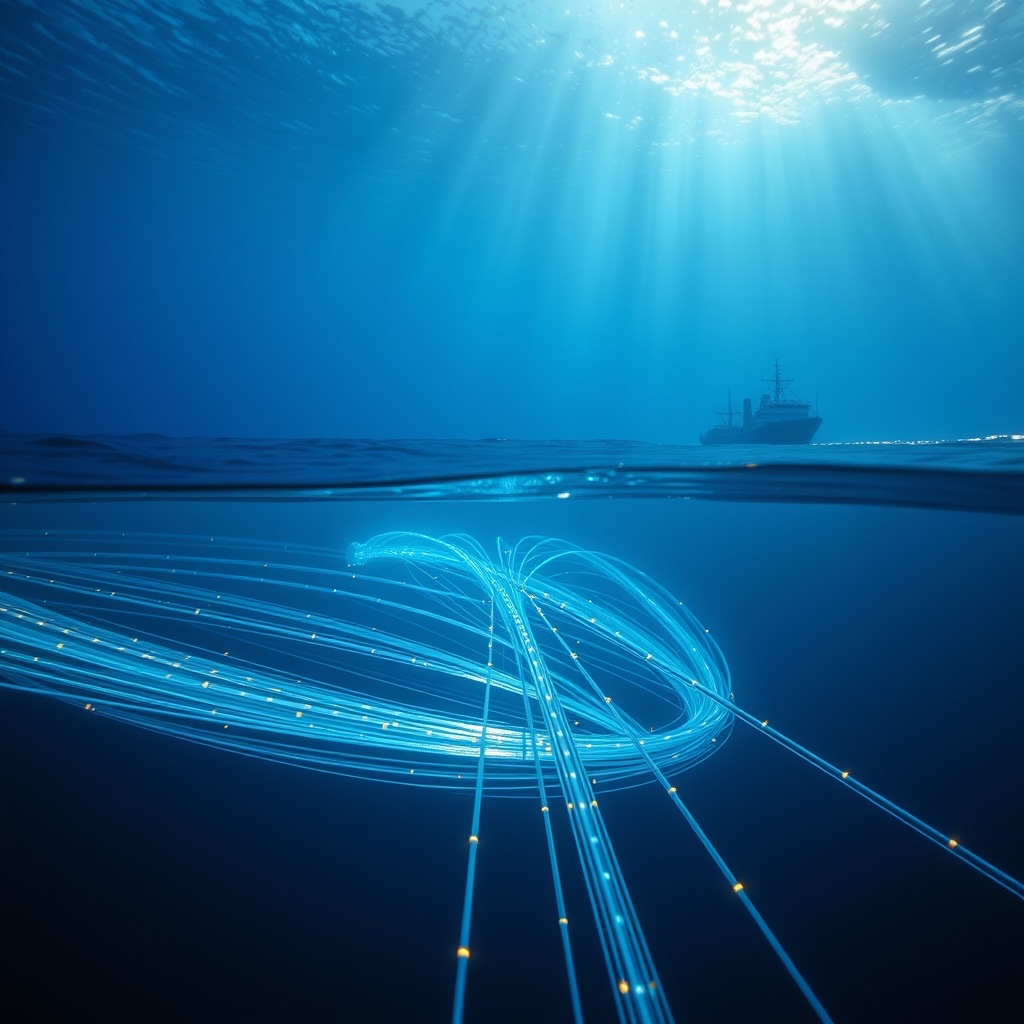
In February 2026, Meta announced Project Waterworth: a 50,000-kilometer subsea cable with 24 fiber pairs, connecting the United States, India, Brazil, and South Africa, at a budget north of $10 billion. It will be the longest submarine cable ever built. Meta didn't build it because it wanted to own infrastructure for its own sake — it built it because the alternative was competing with Google, Microsoft, and Amazon for space on someone else's cable, and losing.
That's the real story underneath the AI infrastructure boom that doesn't get told as often as the GPU shortage: the bottleneck increasingly isn't compute. It's the physical fiber connecting the data centers that hold that compute.
Every Hyperscaler Is Now a Cable Company
Meta's Waterworth is the biggest of the announcements, but it isn't alone. Microsoft, partnering with Lightstorm, announced I-2SEA in July 2026 — a 3,600-kilometer cable linking India, Malaysia, and Singapore, though it won't be operational until late 2029. Microsoft has also filed plans for three separate cables connecting Ireland and Wales specifically to feed its European data center cluster. Amazon is building Fastnet, AWS's first independently owned submarine cable, running from Maryland to Ireland with a targeted 2028 in-service date. Google has committed roughly $15 billion to new transoceanic routes under its America-India Connect initiative and is anchoring eight new Asia-Pacific cable systems.
None of these companies were in the cable-owning business five years ago. They rented capacity on cables owned and operated by telecom consortiums. The fact that all four are now building and part-owning their own physical cables tells you the rental market can no longer guarantee the capacity, the routes, or the timeline they need.
Why AI Specifically Broke the Old Model
The demand driver isn't simply "more data," and it isn't primarily raw training-data transfer either. It's cross-region interconnects between GPU clusters running distributed training and inference. TeleGeography, the industry's benchmark analyst firm, projects that international bandwidth consumed by cloud, AI, and social platforms will grow ninefold between 2025 and 2035. Hyperscalers' share of total international bandwidth demand has gone from negligible in 2010 to roughly 75% today — and it's still climbing.
The technical detail that makes this a genuine bottleneck rather than a temporary shortage: cross-region bandwidth between data centers currently runs at roughly one-tenth the bandwidth available within a single region. A single fiber pair on a modern cable carries 20-60 terabits per second; TeleGeography and Ciena both point to roughly 1 petabit per second as the reasonable near-future target for inter-region AI cluster capacity. Getting there means either dramatically better fiber technology or dramatically more fiber pairs in the water — and there's a hard physical ceiling on the second option.
The 24-Pair Ceiling
Modern submarine cables cap out at around 24 fiber pairs, not because engineers haven't tried to add more, but because each fiber pair needs its own optical amplifier repeated every 60-100 kilometers along the cable, and those repeaters need power delivered from shore through the cable's copper conductor. Past roughly 24 pairs, the power budget and the physical diameter of the cable both become unworkable with current technology. This is the ceiling TeleGeography and cable engineers cite as the real physical limit on subsea capacity growth — it's not a funding problem, it's a materials-and-power-delivery problem, and no amount of hyperscaler capital changes the physics on its own.
The Ship Shortage Makes It Worse
Even where the physics cooperates, there's a second bottleneck: building and laying a cable requires a specialized cable-laying vessel, and the global fleet is small and aging. There are roughly 60 such vessels worldwide, averaging around 25 years old, operated mostly by SubCom, Alcatel Submarine Networks, and HMN Tech, each running two to seven ships. NEC, a major Japanese supplier, owns none outright and leases a Norwegian vessel whose charter is ending — Tokyo is reportedly preparing subsidies specifically so NEC can buy its own ship.
A new cable-laying vessel takes 24 to 36 months to build in the best case, 36 to 48 months realistically given current shipyard backlogs. Prysmian has committed roughly $381 million just to build two new vessels. SubCom's order backlog alone hit a record $4.7 billion. Every hyperscaler cable competes for the same scarce shipyard slots and laying-vessel time as every telecom consortium cable — Meta's capital doesn't buy its way to the front of a queue that's constrained by how many ships physically exist.
Sabotage Adds a Second Kind of Scarcity
The same scarce fleet that lays new cable also has to repair damaged cable, and 2025-2026 gave it plenty of repair work. Since October 2023, at least 11 cables in the Baltic Sea have been severed or damaged by what regional governments attribute to Russia's "shadow fleet" dragging anchors across the seabed — the most recent confirmed incident involved the vessel Fitburg, boarded by Finnish forces on December 31, 2025. The EU responded in February 2026 with a €347 million subsea infrastructure protection package, including a €20 million Rapid Repair Pilot fund. Every hour a repair ship spends fixing a severed Baltic cable is an hour it isn't laying new capacity for Meta, Microsoft, or anyone else — repair and expansion draw on the exact same scarce resource.
What This Means Going Forward
TeleGeography's numbers put this in perspective: submarine cable investment for 2025-2027 is running around $13 billion, nearly double the prior three-year window, with roughly 40 new cables entering service in 2026 alone at a combined capex near $6 billion. The firm describes current investment levels as unseen since the dot-com-era cable boom of 2000-2001 — except this time, two-thirds of planned deployments involve a hyperscaler as owner or anchor tenant, not a telecom consortium.
The practical takeaway for anyone planning AI infrastructure that spans continents: cross-region bandwidth is not a line item you can simply pay more to accelerate. Lead times are measured in years, driven by ship availability and a hard physical ceiling on fiber pairs per cable — plan multi-region AI deployments around existing and already-funded cable capacity, not around capacity you assume will exist because the demand justifies it. The GPUs can be manufactured faster than the ocean floor can be wired.