Spatial transcriptomics is turning tissue into a usable data layer
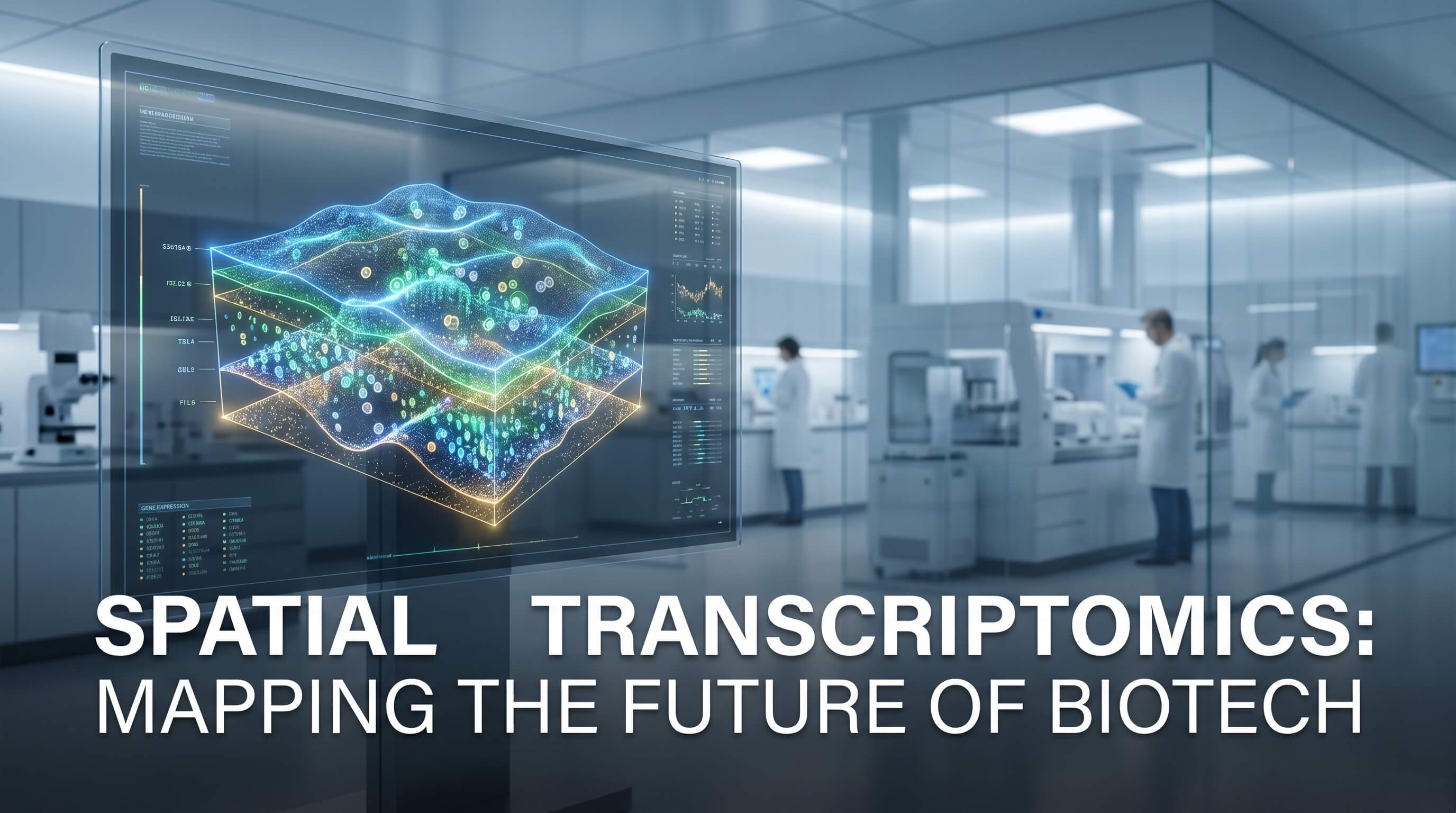
Single-cell biology changed modern life science by showing researchers that tissues are not made of average cells. They are made of many distinct cell states, often sitting next to each other in ways that shape disease. But single-cell sequencing also came with a frustrating trade. It could tell you what a cell was doing, yet often lost the precise map of where that cell lived inside the tissue. That missing location data matters more than it first sounds. A tumor cell at the invasive edge of a cancer lesion is not the same problem as a similar-looking cell buried deep in a different microenvironment. Inflammation near a blood vessel is not identical to inflammation spread diffusely across an organ. Biology happens in place.
That is why spatial transcriptomics has become one of the most consequential research tool shifts in years. The field is moving beyond niche demonstrations and becoming a practical platform layer for translational biology. Instead of forcing researchers to choose between broad gene-expression data and physical context, newer systems are trying to deliver both at once. In April 2026, 10x Genomics introduced Atera as an in situ platform aimed at whole-transcriptome spatial analysis with single-cell sensitivity at larger scale, while Illumina says its advanced spatial technology will bring high-resolution, sequencing-based whole-transcriptome analysis in intact tissue sections in mid-2026. The signal here is bigger than any one vendor launch. Spatial biology is turning into core infrastructure.
Why location changes the question
Traditional RNA sequencing is excellent at quantifying expression, but it treats tissue a bit like shredded evidence. Researchers can recover powerful insights after dissociation, yet key architectural clues disappear. Spatial approaches shift the unit of analysis. Instead of asking only which genes are active, scientists can ask where those signals occur, which neighboring cells are interacting, how immune cells are distributed around pathology, and whether rare cell states cluster in meaningful patterns.
This is especially important in cancer, neurobiology, immunology, fibrosis, and developmental biology. Researchers increasingly want to understand not merely whether a cell type exists, but whether it forms boundaries, gradients, niches, or contact zones that change biological behavior. A therapy target might look promising in bulk or single-cell data and still fail because the relevant cell population is sparse, spatially constrained, or organized around the wrong tissue compartment. Spatial transcriptomics gives scientists a way to inspect that missing layer instead of inferring it indirectly.
The field is maturing from beautiful images to scalable systems
For several years, spatial biology had a reputation for producing spectacular figures and expensive pilot studies. That phase mattered, but it also kept the field slightly at arm’s length from routine deployment. The practical questions were hard. Could platforms handle fresh-frozen and FFPE samples? Could they scale beyond a few curated genes? Could they reach enough sensitivity to be useful in real translational research? Could they fit into actual lab workflows rather than only into flagship academic centers?
The latest platform race is an answer to those concerns. 10x is positioning Atera as a way to do whole-transcriptome analysis in intact tissue at single-cell sensitivity and larger throughput. Illumina is making a similar argument around high-resolution whole-transcriptome sequencing with spatial context. The competition itself is revealing. Vendors are no longer selling spatial biology as a luxury insight tool. They are selling it as a reproducible data-generation system that can sit closer to the center of drug discovery and biomarker work.
That matters because platform maturity changes who can use the technology. Once spatial workflows become less custom and more productized, they stop being only for elite method developers. They become tools that translational teams, biopharma programs, CROs, and larger clinical research groups can operationalize.
Why spatial and single-cell now belong together
The most useful way to think about this market is not spatial versus single-cell. It is spatial plus single-cell. Single-cell sequencing remains unmatched for broad profiling, throughput, and cell-state discovery. Spatial data adds anatomical truth. Together, they let researchers move from cataloguing populations to understanding how those populations assemble into tissue behavior.
This combination is becoming especially important in oncology. Researchers want to know not only which immune cells exist in a tumor microenvironment, but where exhausted T cells sit relative to stromal barriers, malignant clones, or antigen-presenting cells. In autoimmune disease, they want to map which inflammatory programs occur near damaged tissue and which remain peripheral. In neuroscience, spatial context may separate biologically distinct neighborhoods that look similar in dissociated data. The value is not decorative. It changes interpretation.
There is also a growing computational story here. Once labs start producing large spatial datasets, they need pipelines that can integrate spatial maps with single-cell references, pathology images, metadata, and eventually clinical outcomes. That turns spatial biology into a software problem as much as a wet-lab one. The labs that win will not just buy instruments. They will build the informatics muscle to turn layered spatial data into decisions.
What still holds the field back
None of this means spatial transcriptomics is easy. Cost remains high. Data volumes are heavy. Analysis is not yet standardized across every platform. Researchers still navigate tradeoffs among resolution, throughput, sensitivity, sample compatibility, and operational complexity. There is also a risk that buyers confuse platform ambition with immediate readiness for every use case.
Another challenge is interpretation. More dimensions of data do not automatically produce better science. They can also produce prettier confusion if studies are underpowered or if investigators do not know what biological question the spatial layer is meant to answer. Spatial transcriptomics is strongest when it resolves a real uncertainty that nonspatial methods could not settle.
Why this matters beyond academic novelty
The long-term significance is that spatial biology could improve how targets are selected, how biomarkers are validated, and how patient heterogeneity is understood earlier in the research process. Drug discovery has always suffered from models that flatten disease too aggressively. Spatial tools offer a way to preserve more of the biological structure that therapies must actually confront in the body.
If the current platform wave holds, the next few years will make tissue far more legible as a data object. That will not eliminate the need for careful experiments or good pathology. It will, however, give researchers a richer way to connect molecular state with physical reality. For science, that is the real shift. Tissue is no longer just a sample to be broken apart and measured. It is becoming a map that can be read.