Sovereign AI: Why Countries Are Building National Models and What It Means for the Global Tech Race
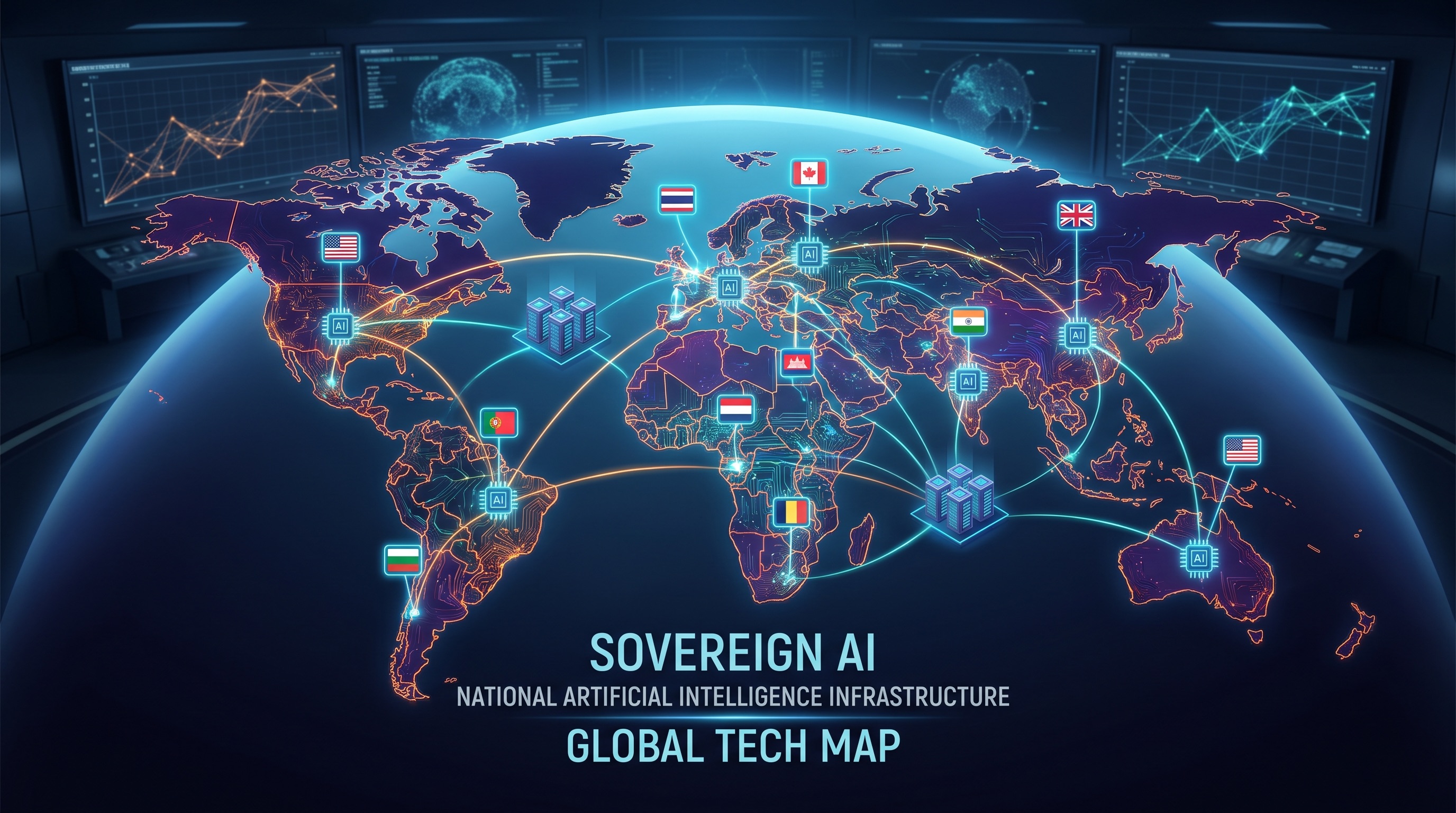
In 2022, running a competitive large language model required access to compute clusters that only a handful of US technology companies controlled, trained on data that flowed primarily through US-based infrastructure, accessed via APIs provided by US companies operating under US law. For most governments, this was an acceptable arrangement — the technology was new and primarily useful for consumer applications.
By 2026, AI has become foundational infrastructure for defense intelligence, government services, healthcare, financial services, and judicial systems. The calculation has changed entirely. Governments that rely on US or Chinese hyperscalers for this infrastructure are handing over sensitive data to foreign jurisdictions and accepting terms-of-service changes they have no power to influence. Sovereign AI — national or regionally controlled AI infrastructure — is the response.
What Sovereign AI Actually Means
The term is used loosely, but in practice sovereign AI programs exist on a spectrum. At one end are countries building everything from scratch: national compute clusters, domestically trained foundation models, and locally operated inference infrastructure. At the other end are countries that have made policy decisions to use only locally hosted versions of foreign models, with data remaining under domestic jurisdiction.
Most programs fall somewhere between. The common thread is control: over the training data, over the compute, over the model weights, and over which organizations have access to what.
What Is Actually Being Built
The most advanced sovereign AI programs as of mid-2026 are concentrated in a handful of countries with the capital and technical capacity to pursue them seriously.
UAE: The Technology Innovation Institute's Falcon model family is the most prominent open-weights sovereign AI project outside China and the US. Falcon 180B was genuinely competitive with leading models at its 2023 release. The UAE's AI strategy is explicitly tied to economic diversification — using AI to develop a knowledge economy that is not dependent on oil revenue.
France and the EU: Mistral AI, though technically a private company, has strong ties to the French government and has received significant EU backing. The EU's broader AI strategy, anchored in the AI Act, is pushing member states toward European AI infrastructure through EuroHPC — a network of publicly funded supercomputing centers that give EU researchers and businesses access to European compute rather than AWS or Azure. France, Germany, and the Netherlands are the most active participants.
Saudi Arabia: The country has invested heavily in Allam, an Arabic-language model developed by the Saudi Data and AI Authority. The Arabic language gap in existing models — where performance on Arabic tasks lags English significantly — creates a genuine use case for a domestically developed model, particularly for government services in Arabic-speaking populations.
Japan: The Plamo family of models, developed by Preferred Networks, and NEC's cotomi models represent Japan's investment in Japanese-language AI. Japan faces a distinctive challenge: its language uses three different scripts and has a grammatical structure that existing English-centric models handle poorly. A domestically developed model that natively handles Japanese outperforms fine-tuned versions of foreign models for Japanese-language tasks.
India: The BharatGPT consortium and Sarvam AI are developing models that handle India's diversity of languages — Hindi, Tamil, Telugu, Bengali, and 18 other constitutionally recognized languages. India's AI strategy ties into its Digital Public Infrastructure program, which has already deployed nationally scaled systems for identity (Aadhaar), payments (UPI), and healthcare.
South Korea: NAVER's HyperCLOVA X and SK Telecom's A-dot are among the most technically capable sovereign models outside the US and China. South Korea's electronics and semiconductor industry gives it a meaningful advantage in building the underlying compute infrastructure.
What Is Driving the Push
Three forces are pushing governments toward sovereign AI, and they are distinct enough that collapsing them into a single explanation misses important dynamics.
The first is data sovereignty and regulatory compliance. GDPR and its equivalents require that personal data about EU residents not leave EU jurisdiction without specific legal mechanisms. Running inference through US-based APIs creates jurisdictional complexity. Having EU-based compute for EU data is cleaner legally and reduces compliance overhead — particularly for healthcare and financial services organizations.
The second is geopolitical risk management. The US export control regime, which has restricted access to advanced semiconductors for China and a widening list of other countries, demonstrated that AI infrastructure access can be weaponized as a foreign policy tool. Countries that were entirely dependent on US compute and US model providers are now aware that this dependency is a vulnerability. Even close US allies have started diversifying.
The third is language and cultural fit. As AI is deployed in more sensitive contexts — judicial systems, medical diagnosis, civil service — the quality of performance in the local language matters substantially. English-dominant frontier models underperform on non-English tasks, and fine-tuning them is a partial fix at best. Domestically developed models, trained on domestic language data, offer better baseline performance for government use cases.
The Quality Gap
Honesty requires acknowledging that most sovereign AI models trail the frontier significantly. GPT-5, Claude Opus 4.8, and Gemini 3 are substantially more capable than Falcon, Allam, Plamo, or BharatGPT on general benchmarks. The gap in pure model capability is real and is not going to close quickly — training frontier models requires years of iteration and hundreds of millions to billions of dollars in compute.
But the quality gap matters differently in different contexts. For a government customer using AI to process Arabic-language legal documents, Allam may outperform a general-purpose English-dominant model even if the latter scores higher on English benchmarks. For a Japanese-language customer service deployment, Plamo may be more practical than a fine-tuned version of a US model. Sovereign models do not need to be frontier models to win their target use cases — they need to be good enough for the specific tasks and better in ways that matter for those tasks.
What This Means for Enterprises in Regulated Industries
Sovereign AI is already a procurement reality for organizations in regulated industries. Healthcare providers, financial institutions, and government contractors in the EU, India, Saudi Arabia, and an increasing number of other jurisdictions are being asked — and in some cases required — to use domestically hosted AI infrastructure.
For enterprises making AI vendor decisions in these markets, several factors now enter the evaluation:
- Data residency: Where does inference happen, and under which legal jurisdiction? This is not a future consideration — it is a present procurement requirement in many markets.
- Model provenance: Who trained the model, on what data, under what terms? Sovereign AI programs are creating a new dimension of vendor evaluation.
- Continuity risk: If your AI vendor is a foreign company subject to export controls or sanctions, what is your contingency? This risk assessment is now standard in large enterprise procurement.
- Performance in your language: If your primary use case involves a non-English language, benchmark your preferred models on your actual tasks before committing to a vendor.
The global AI market is not going to fragment into entirely separate national ecosystems — the leading US models are genuinely too capable to be replaced entirely by sovereign alternatives for most uses. But the emerging architecture is hybrid: frontier foreign models for general capability tasks, sovereign or regionally controlled models for sensitive applications involving local data, local languages, or regulatory requirements that preclude offshore processing. For enterprises in regulated industries, understanding where your AI workloads fall on this spectrum is now a strategic necessity, not a future consideration.