Sodium-ion batteries beat lithium on cost, and CATL bets on them for entry-level EVs
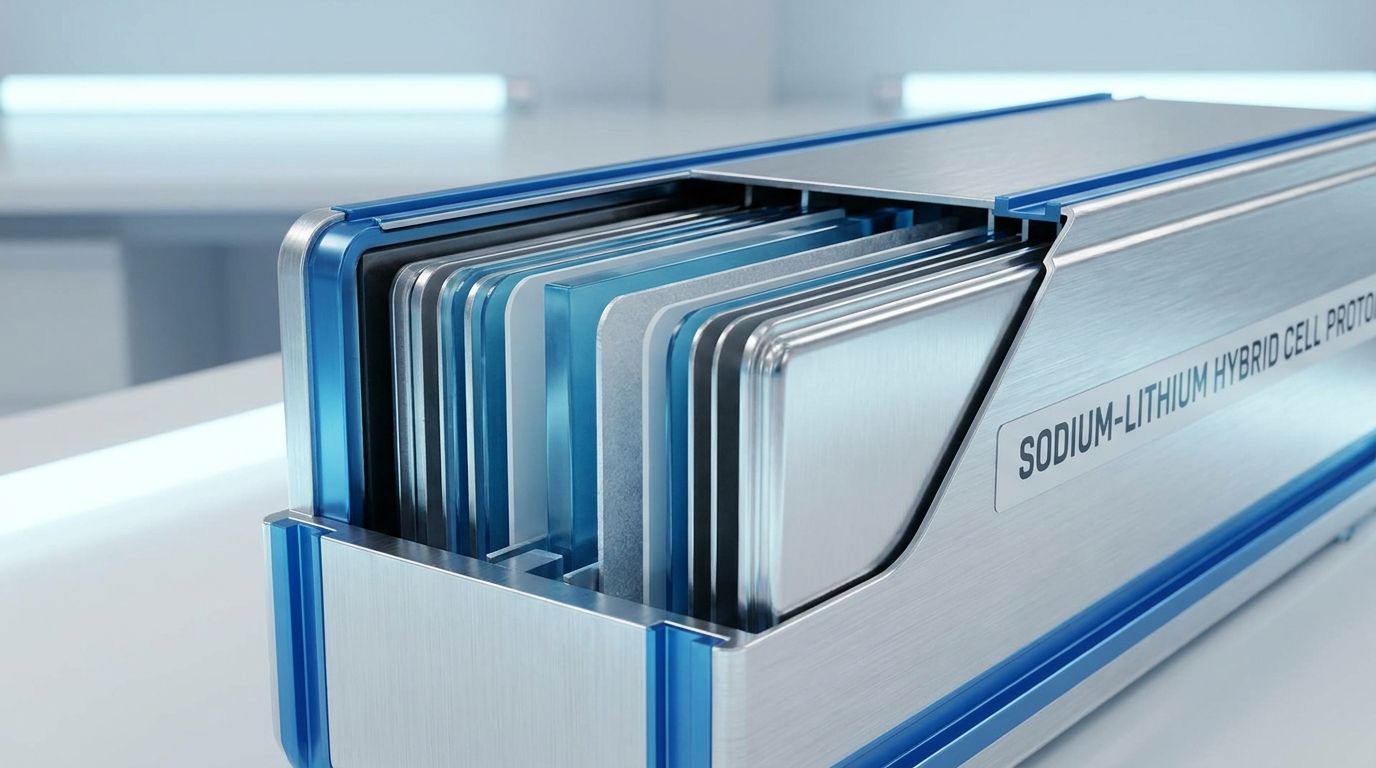
Sodium-ion battery cells cost $55 to $70 per kWh in 2026, a 35 to 40 percent discount to lithium iron phosphate (LFP) cells, which run $95 to $110 per kWh. That gap is why CATL, the world's largest EV battery maker, is pushing sodium-ion into mass production this year across passenger EVs, commercial vehicles, battery swap systems, and energy storage.
This is not a story about sodium replacing lithium. Sodium-ion cells hold less energy per kilogram than lithium chemistries, so they cannot yet power a flagship EV that needs 400+ miles of range. What's happening instead is segmentation: sodium-ion is becoming the default chemistry for cheap, short-range, and stationary applications, while lithium keeps the high end. The economics are strong enough that this split is arriving fast.
Why sodium costs less to build into a battery
The cost advantage isn't marketing — it comes from chemistry and materials sourcing. Sodium is roughly 1,000 times more abundant in the Earth's crust than lithium, which is concentrated in a handful of brine deposits and hard-rock mines in Australia, Chile, and China. Sodium can be extracted from common salt deposits and seawater essentially everywhere, which removes the geographic supply bottleneck that has made lithium prices volatile.
The bigger structural saving is in the current collectors — the thin metal foils that carry electrons in and out of each electrode. Lithium-ion cells need copper on the anode side because aluminum reacts with lithium at low voltages during charging, a phenomenon that degrades the cell. Sodium doesn't have that problem, so sodium-ion cells use aluminum on both electrodes. Copper trades several times higher than aluminum by weight, and it's a meaningful share of a cell's bill of materials, so swapping it out cuts costs directly.
Sodium-ion chemistries also skip cobalt and nickel entirely. Both metals are expensive, geopolitically concentrated — cobalt supply is dominated by the Democratic Republic of Congo — and have been the primary target of EV battery cost-reduction efforts for a decade. Sodium-ion sidesteps that problem by not needing them in the first place, using iron- and manganese-based cathode materials instead, which are cheap and widely available.
CATL's rollout, from battery swap stations to production cars
CATL is targeting mass production of sodium-ion cells by the end of 2026. The company is deploying the chemistry across four segments simultaneously: passenger EVs, commercial EVs, battery swap networks, and stationary energy storage. That breadth matters — CATL isn't betting on a single product category, it's building manufacturing scale across use cases that all tolerate sodium-ion's current limitations.
The first production result of that push is already on the road. The Changan Nevo A06 became the first sodium-ion-powered production EV, debuting in China in February 2026. It's a mainstream, not-flagship model — exactly the kind of vehicle where sodium-ion's lower cost matters more than its lower range.
On the storage side, CATL has separately signed a 60 GWh sodium-ion energy storage deal, according to Electrek's reporting. Stationary storage is arguably an easier fit for sodium-ion than EVs: grid batteries don't move, so energy density per kilogram is far less important than cost per kWh and cycle life. That makes storage a natural first market to absorb sodium-ion output at scale while automotive applications mature.
The range tradeoff is real, and CATL isn't hiding it
CATL's own roadmap acknowledges the limitation directly: the company is aiming to reach LFP-level energy density — enough for roughly 600 km, or 370-plus miles, of range — within three years. That's an explicit admission that sodium-ion isn't there yet. Today's sodium-ion packs deliver meaningfully less range than LFP, let alone the nickel-rich chemistries used in long-range EVs from Tesla, Hyundai, or BYD's higher-end models.
That's why the early sodium-ion deployments are concentrated in vehicle categories where lower range is an acceptable trade for lower price: small-range and entry-level electric cars, light commercial vehicles operating in urban delivery routes, two- and three-wheelers (a massive market in China, India, and Southeast Asia), and industrial equipment like forklifts that run short duty cycles and get recharged frequently. None of these need 300+ miles of range. All of them are extremely price-sensitive, which is exactly where a 35-40 percent cell cost cut changes the purchasing calculus.
A small market today, growing fast
The global sodium-ion battery market is projected at $1.08 billion in 2026, growing at a 15.8 percent compound annual rate. That's still a rounding error next to the roughly $150 billion global lithium-ion battery market, which underscores that sodium-ion is entering as a complement, not a competitor, to the dominant chemistry. But the growth rate and CATL's willingness to commit manufacturing capacity signal that suppliers expect the entry-level and stationary-storage segments to be large enough to justify the investment well before energy density catches up.
What to watch next
A few signals will show whether sodium-ion moves from a China-centric niche to a global mainstream chemistry. First, watch which vehicle segments adopt it fastest — two- and three-wheelers and urban light commercial vehicles are likely to scale before passenger cars, since range requirements are lower and price sensitivity is higher. Second, watch whether Western and Korean automakers and battery makers (LG Energy Solution, Samsung SDI, Panasonic) commit to sodium-ion production lines or stay on the sidelines waiting for energy density to improve — so far, the deployment has been almost entirely Chinese, led by CATL and BYD's HiNa spinoff. Third, track CATL's three-year timeline to LFP-parity energy density; hitting that target would open the door to sodium-ion in mainstream compact EVs, not just entry-level and commercial niches. Until then, treat sodium-ion as what the economics say it is: the battery for cheap, short-range, and stationary use cases, not a lithium replacement.