Small Reasoning Models Are Turning Edge AI Into a Real Business
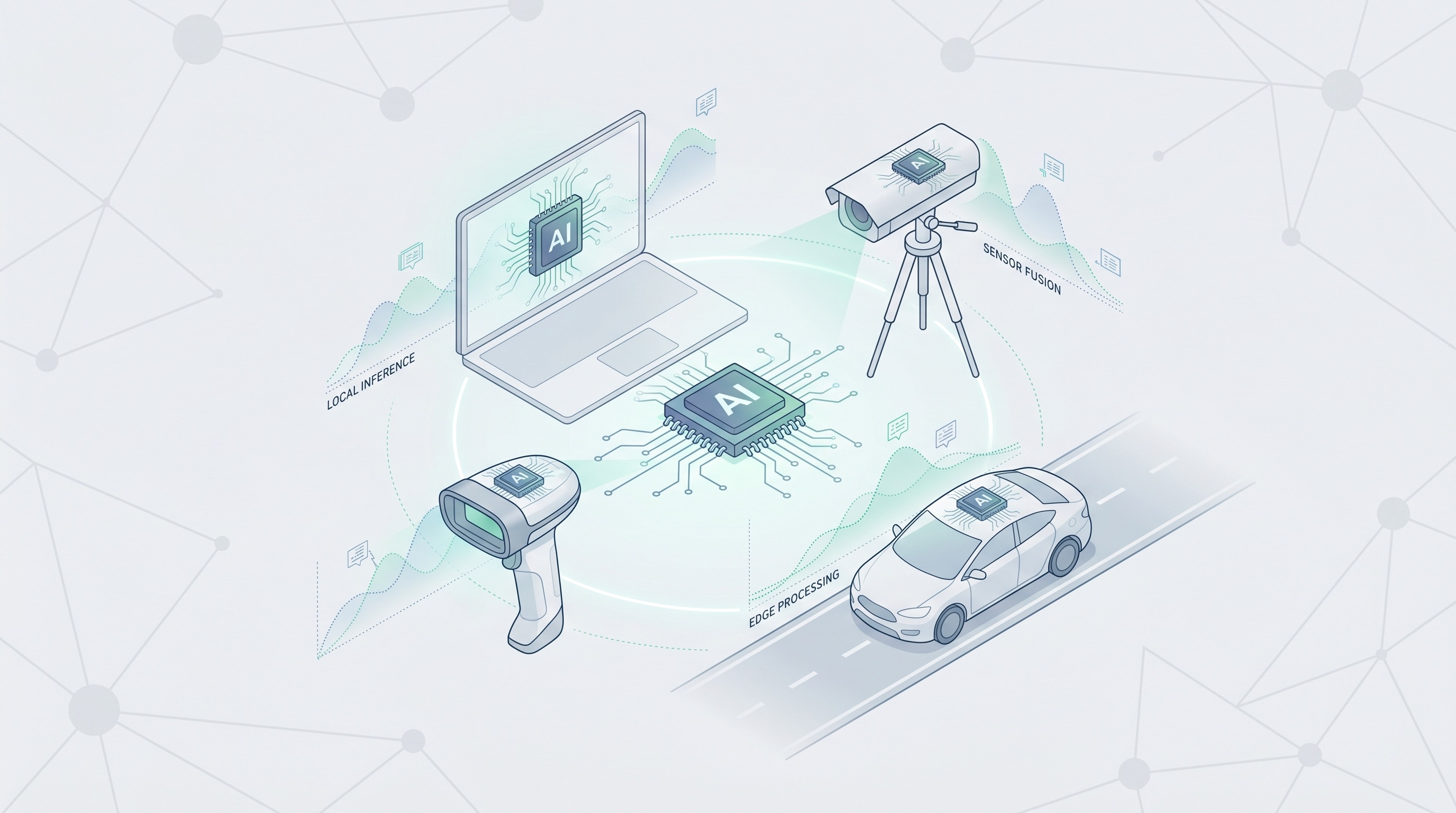
Edge AI has been stuck in an awkward middle ground for years. Companies liked the idea of running intelligence on-device, but the real systems that generated useful results were often too large, too power-hungry, or too expensive to deploy at scale. That is starting to change. Smaller reasoning models are giving device makers and enterprise teams something they have not had before: a way to ship AI features that are both commercially sensible and good enough to matter.
The important shift is not that tiny models suddenly beat frontier systems. They do not. The shift is that compact models can now handle bounded reasoning tasks well enough for real products when paired with the right hardware, retrieval, and workflow design. That opens the door for a different edge AI business case: lower inference cost, predictable latency, stronger privacy, and fewer cloud dependencies. For many commercial applications, those advantages matter more than absolute benchmark leadership.
Why smaller reasoning models change the edge AI equation
Classic edge AI workloads were mostly narrow: wake-word detection, basic vision classification, keyword spotting, simple anomaly detection. The moment a product needed multi-step decision making, context handling, or more flexible language interaction, teams usually pushed inference back to the cloud. The hardware budget on the device could not support larger models, and even if it could, battery life and thermal limits got ugly fast.
Smaller reasoning models are changing that tradeoff because they are being designed for constrained environments from the start. Quantization, distillation, mixture-of-experts variants, and architecture-level efficiency gains have made it possible to run models with useful planning and structured output on NPUs, mobile GPUs, embedded accelerators, and modern CPUs. They are not universal problem solvers, but they do not need to be. In commercial deployments, most tasks are narrower than marketing suggests.
Consider what many products actually need: summarize a sensor event, classify a maintenance issue, rank likely next actions, generate a short explanation, route a workflow, or answer questions against a local knowledge base. These are reasoning tasks, but they are bounded reasoning tasks. A smaller model that is tuned for the domain and supported by retrieval can often do them well enough at a much lower cost envelope.
Commercial viability is about unit economics, not model prestige
Many edge AI projects failed quietly because the economics collapsed during deployment planning. A prototype looked impressive in a demo, but the bill of materials increased, battery life dropped, or cloud inference costs scaled faster than revenue. Smaller reasoning models improve the business case because they reduce pressure across multiple cost centers at once.
1. Lower hardware requirements
If a useful model fits within the memory and compute budget of existing silicon, a company can ship on current hardware tiers instead of redesigning the product. That matters for laptops, industrial cameras, retail kiosks, medical devices, and vehicles. A feature that runs on an existing NPU or embedded accelerator is much easier to justify than one that requires a more expensive board revision.
2. Lower operating cost
Cloud inference is manageable when usage is occasional or margins are high. It becomes painful when every device sends frequent requests, especially for video, audio, or constant telemetry. On-device inference cuts bandwidth and API spend while making cost more predictable. For subscription products, that can be the difference between a viable gross margin and a feature that users love but finance teams hate.
3. Better latency and reliability
Edge deployments live in the real world, where networks are patchy, congested, or unavailable. A warehouse scanner, a field service tablet, or an in-car assistant cannot assume perfect connectivity. Smaller local models eliminate round-trip delay and allow graceful operation offline. That is not just a performance gain. It changes whether a product can be trusted in operational settings.
4. Stronger privacy and compliance posture
Keeping inference on-device reduces the amount of sensitive data that needs to leave the endpoint. That matters in healthcare, enterprise collaboration, industrial monitoring, and consumer devices that process voice, camera, or location data. Privacy is often discussed as a user benefit, but it is also a sales enabler. Procurement and compliance teams are far more receptive when raw data can stay local.
Where small reasoning models are already a strong fit
The sweet spot is not every AI workload. It is products where local context is rich, decisions are time-sensitive, and outputs can be constrained.
Industrial maintenance
A handheld device or smart headset can inspect equipment, compare observed symptoms against a local service manual, and propose likely failure modes. It does not need to solve general intelligence. It needs to reason across a limited parts catalog, known error codes, and a maintenance workflow. A compact model with retrieval can do that without forcing every query through a remote cloud pipeline.
Retail and field operations
Store associates and technicians often need quick answers in environments with inconsistent connectivity. An on-device assistant can summarize procedures, flag compliance steps, and recommend next actions based on a local knowledge pack. The value here is not flashy conversation. It is reducing friction in repetitive decisions that cost time and create mistakes.
Automotive and mobility
Vehicles already contain heterogeneous compute platforms and operate under strict latency expectations. Smaller reasoning models can support local voice workflows, cabin assistance, driver documentation, diagnostics, and context-aware controls without relying entirely on a cloud link. In this environment, predictable response time and resilience matter more than maximum model breadth.
Security and monitoring
Edge cameras and local monitoring systems generate too much data to ship everything upstream for expensive analysis. Compact reasoning models can triage events, attach natural-language summaries, and prioritize what gets escalated. That reduces operator load and network cost at the same time.
The stack matters as much as the model
Teams that succeed with edge AI rarely treat the model as the whole product. They design around it. A small reasoning model becomes commercially powerful when paired with three things: retrieval, constraints, and fallback paths.
Retrieval keeps the model grounded in local documents, telemetry, or state. Instead of expecting the model to memorize every policy or manual, the system injects only the relevant context. Constraints keep outputs structured and narrow the chance of expensive errors. Fallback paths send hard cases to a larger cloud model or a human operator only when needed.
This architecture is important because it replaces the false choice between all local and all cloud. A well-designed product can handle most interactions on-device, then escalate the rest selectively. That hybrid approach usually produces better economics than defaulting every interaction to a large hosted model.
What buyers should watch before committing
There is real momentum here, but not every edge-ready AI claim deserves trust. Buyers should ask whether the model can run within the target device power and thermal budget, what percentage of tasks actually stay local, how often the system needs cloud fallback, and what accuracy looks like on real domain data rather than generic benchmarks.
They should also examine update strategy. Edge AI products need a practical path for model refreshes, safety improvements, and telemetry feedback without turning every device into a permanent cloud dependency. The companies that get this right will treat on-device intelligence as part of a broader lifecycle, not a static model drop.
Actionable takeaways
For product teams, the lesson is to stop asking whether a small model can match the best cloud model in the abstract. Ask whether it can solve a bounded task profitably on the hardware you already ship. For enterprise buyers, focus on unit economics, offline resilience, privacy requirements, and fallback design instead of being distracted by benchmark theater. For chip and device vendors, this is an opening to sell complete local AI experiences rather than just more compute.
Smaller reasoning models will not replace large frontier systems. They do not need to. Their real significance is that they make edge AI easier to justify in products that live or die by cost, latency, privacy, and reliability. That is what turns a technical possibility into a business.