Small Models Are Winning the Enterprise Edge AI Race
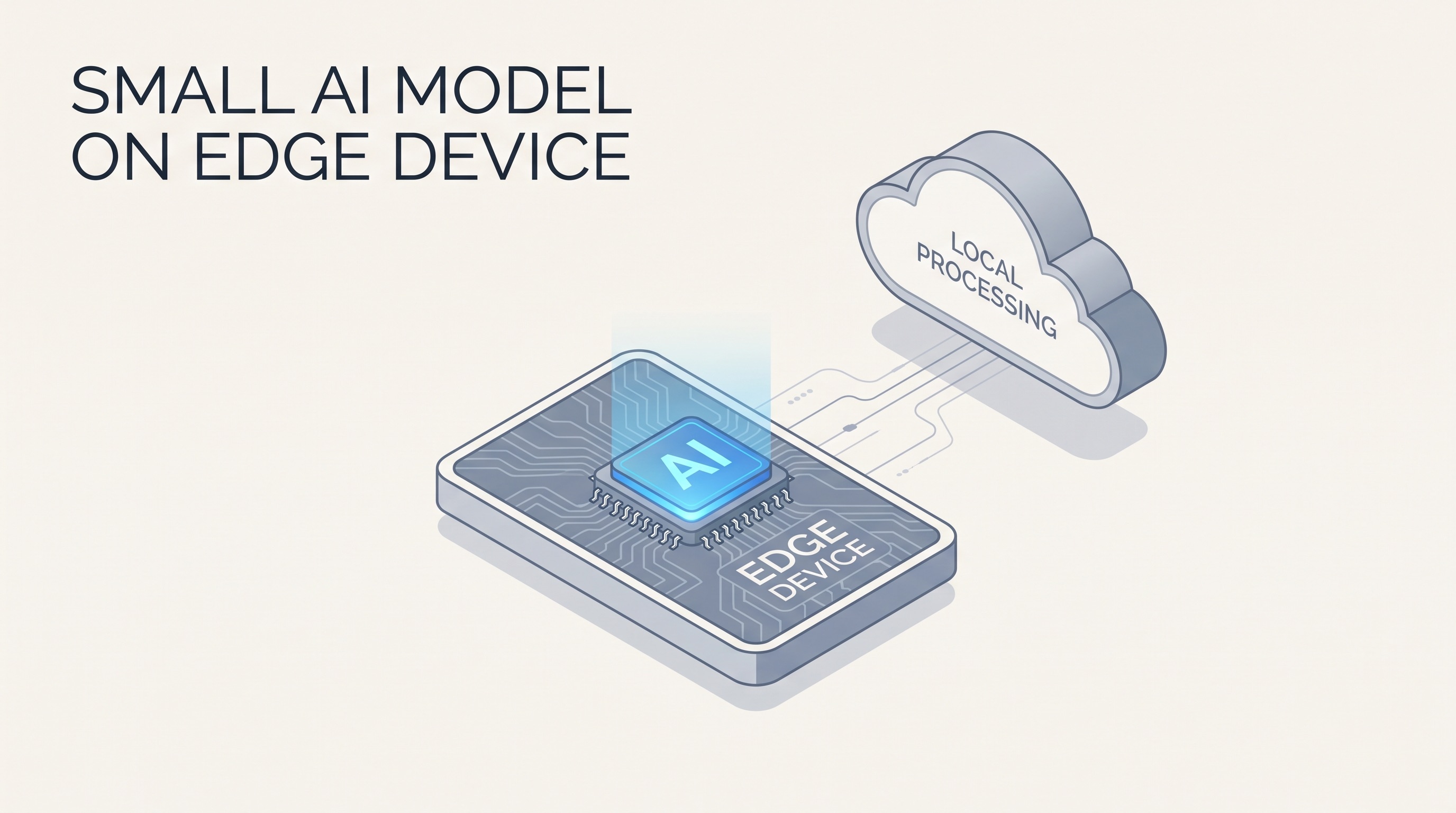
Most enterprise AI traffic in 2026 is not hitting GPT-5-class or Claude-class frontier models anymore. It's hitting models with 1 to 13 billion parameters, running on a server rack in the company's own data center or directly on a factory-floor device. Gartner projects task-specific small models will outnumber general-purpose frontier models 3:1 in enterprise deployments by 2027, and on-premise AI inference has already jumped from 12% of workloads in 2023 to 55% in 2025 — a 4.6x swing in two years. The reason isn't that small models got lucky. It's that 80% of enterprise NLP tasks — classification, extraction, routing, structured summarization — never needed a 500-billion-parameter model in the first place, and now there are small models good enough to prove it.
The models actually being deployed
Four families dominate real 2026 enterprise deployments, and each has a distinct niche:
- Microsoft Phi-4-mini and Phi-4-Reasoning (3.8B–14B) — the default choice for math and code-heavy workloads. Phi-4-mini scores 67.3% on MMLU (5-shot), 88.6% on GSM8K, and 64.0% on MATH — ahead of Llama 3.2 3B's 63.4% MMLU / 77.7% GSM8K, the model most teams still benchmark against. Phi-4-Reasoning, at 14B parameters, has been shown to outperform models fifty times its size on Olympiad-grade math problems.
- Google Gemma 4 E4B (4.5B effective parameters) — the pick for multimodal edge work. It hits 69.4% on MMLU-Pro and supports image input, which is why manufacturers are running it on NVIDIA Jetson Orin boards for real-time visual inspection on production lines.
- Alibaba Qwen3-4B and Qwen3.5-9B — the strongest all-around reasoners in this size class. Qwen3-4B rivals Qwen2.5-72B, a model eighteen times larger, on several benchmarks. Qwen3.5-9B scores 82.5% on MMLU-Pro and 81.7% on GPQA Diamond, and is the standard choice for retail and Traditional Chinese-market deployments where connectivity at the edge is unreliable.
- Meta Llama 3.2/3.3 variants (3B–11B) — still the default where ecosystem maturity and tooling support matter more than squeezing out the last few benchmark points, especially with a RAG layer bolted on.
The economics: 5–20x, not a rounding error
The cost gap between running a small model on your own infrastructure and calling a frontier model's API is not marginal. Industry cost data for 2026 puts a private SLM endpoint handling 10,000 queries per day at $500–$2,000 per month in infrastructure cost. The equivalent volume against a frontier-model API runs $5,000–$50,000 per month. That's a 5x to 20x gap, and it compounds: the more an enterprise workload scales, the worse the frontier-API economics get, while the SLM's fixed hardware cost stays roughly flat.
Quantization is what makes the on-device side of that math work. A 3.8B-parameter model needs about 7.6GB of memory in FP16 — too much for most edge devices to carry alongside everything else running on them. At 4-bit quantization, the same model fits in under 2GB with minimal quality loss. That's the difference between "needs a GPU server" and "runs on a Jetson board bolted to a production line."
Why privacy compliance is the real driver, not just cost
Cost gets the headlines, but compliance is what actually moves enterprise budgets. 44% of enterprises cite data privacy as their top barrier to LLM adoption at all — not performance, not cost, privacy. When a compliance team rules that data cannot touch a third-party API, a small model running entirely on-premise stops being a nice-to-have and becomes the only architecture that clears legal review.
Healthcare is the clearest example. A radiology deployment combining Llama 3.2 11B with a RAG layer cut hallucination rates from 8% to 0% in reported testing, while keeping every patient record inside the hospital's own infrastructure — a hard requirement under HIPAA and GDPR that a hosted frontier-model API can't satisfy no matter how good its outputs are. Reported administrative workload reductions in healthcare deployments using this pattern run around 60%. In financial services, Capital One's fine-tuned open-source security models reportedly improved attack-detection rates by more than 50%, again without sending transaction data to an external API.
Where small models still lose
None of this means frontier models are obsolete for enterprise use — it means the workload split has gotten much more specific. Small models still fall behind on:
- Multi-step reasoning and proof-style math — the gap is widest on high-difficulty GSM8K and MATH problems and on complex multi-file code generation, where smaller models run out of working "capacity" mid-chain-of-thought.
- Long-context and multilingual generalization — SLMs degrade faster than frontier models as context grows, and current research still flags multilingual reasoning as a weak point even for the strongest sub-10B models.
- Open-ended, low-specification tasks — anything closer to "write me something good" than "extract these five fields" still favors a larger model's broader world knowledge.
The practical pattern enterprises have converged on isn't "replace the frontier model" — it's routing: a small model handles the narrow, high-volume, privacy-sensitive slice of the workload, and a frontier model (often via API, sometimes the same vendor's largest model) is called selectively for the harder tail of requests that actually need it.
How to actually decide: a real evaluation checklist
Before defaulting to a frontier-model API for a new enterprise AI feature, an engineering team should run the workload through four questions:
- Is the task narrow and repeatable? Classification, extraction, routing, structured summarization, and templated generation are exactly where 3B–9B models close most of the gap to frontier models. Open-ended creative or strategic tasks are not.
- Does compliance rule out third-party data transfer? If yes, that alone can decide the architecture regardless of the benchmark gap — an on-premise 90%-as-good model beats an off-premise 100% model that legal won't approve.
- What's the actual query volume? Below a few hundred queries a day, frontier-API costs may be trivial and not worth the engineering overhead of self-hosting. Above a few thousand a day, the 5–20x cost gap becomes a budget-line item, not a rounding error.
- Can a RAG layer close the knowledge gap? The Llama 3.2 11B radiology case shows that pairing a small model with retrieval can close most of the accuracy gap that raw parameter count would otherwise leave open — often more cheaply than jumping to a larger base model.
Takeaways
Run a two-week pilot comparing a 4B–9B model (Phi-4-mini, Gemma 4 E4B, or Qwen3-4B, depending on whether the workload needs math/code strength, multimodal input, or general reasoning) against the frontier model currently in production, on the exact production task — not a generic benchmark. Measure accuracy on your own labeled examples, not MMLU. Quantify the per-query cost difference at your actual volume. And treat any workload where compliance has flagged third-party data transfer as a small-model candidate by default, independent of the benchmark numbers, because that constraint isn't going away and the model gap keeps shrinking.