Small Language Models: Reshaping Enterprise AI at the Edge
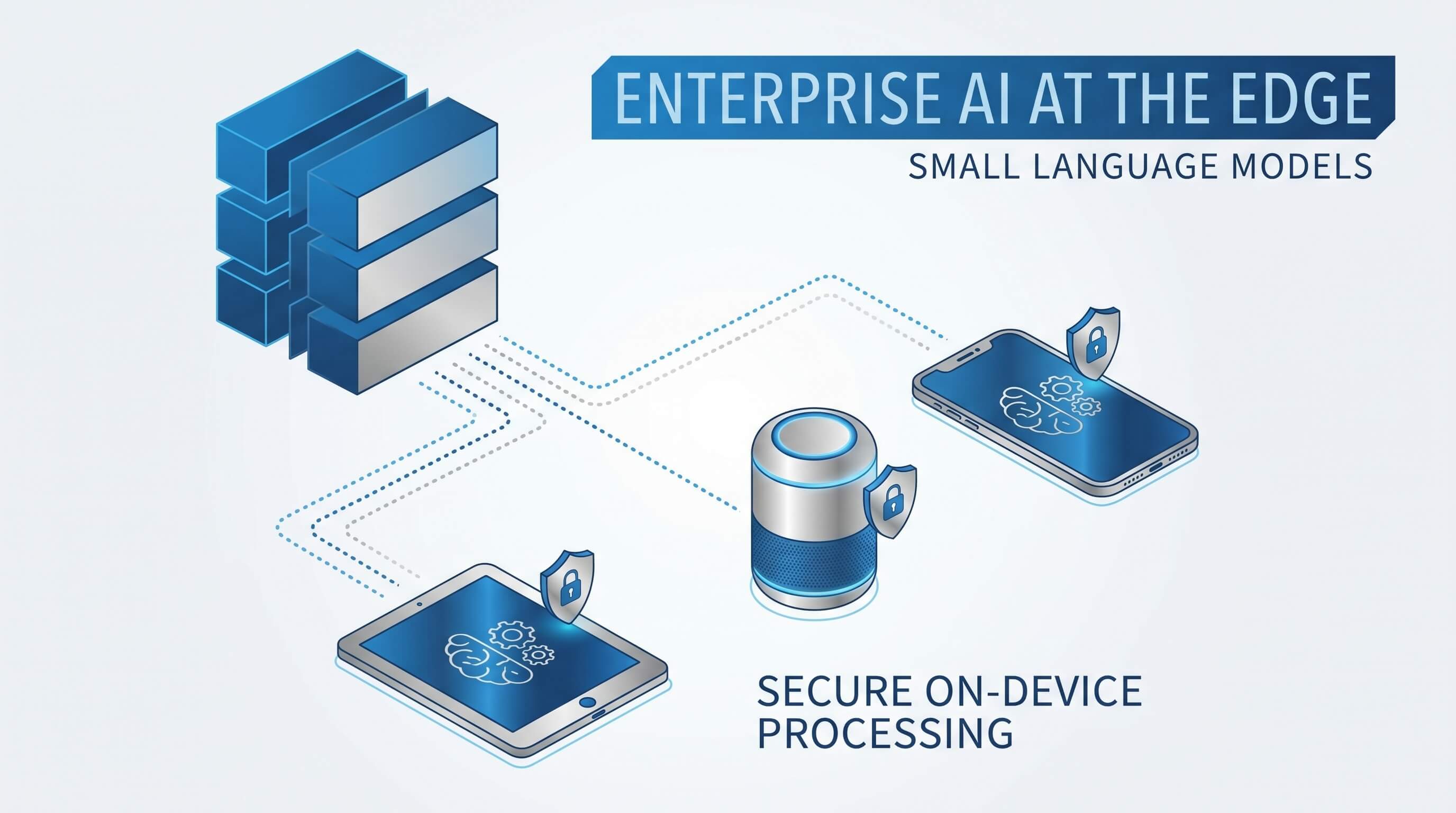
The world of Artificial Intelligence often conjures images of massive, powerful models like GPT-4 or Gemini, running on vast cloud infrastructure. These frontier models are undeniably impressive, pushing the boundaries of what AI can achieve. However, beneath the surface of these giants, a more subtle yet equally transformative revolution is taking place, driven by what we call Small Language Models, or SLMs.
SLMs aren't designed to replace their larger counterparts; instead, they are carving out a crucial niche, particularly within the enterprise sector and at the very edge of our networks. They represent a pragmatic shift, making advanced AI capabilities accessible and practical for specific, real-world business needs where privacy, cost, and latency are paramount.
What Exactly Are Small Language Models?
At their core, SLMs are language models with significantly fewer parameters than their larger siblings, typically ranging from a few hundred million to a few billion parameters. While this might sound like a limitation, it's actually their greatest strength in certain contexts. They are often trained on more focused datasets, or fine-tuned extensively for particular tasks, allowing them to achieve impressive performance within their specialized domains.
Think of it this way: if a frontier model is a vast, general-purpose encyclopedia, an SLM is a highly specialized, expertly curated handbook for a specific field. Both have immense value, but they serve different purposes.
The Enterprise Imperative: Why SLMs are Gaining Traction
Enterprises face unique challenges when adopting AI. While the allure of powerful cloud-based models is strong, practical considerations often stand in the way. This is where SLMs shine, addressing critical pain points:
Cost-Effectiveness and Resource Efficiency
Running and maintaining large language models can be incredibly expensive, both in terms of computational resources and energy consumption. IBM has highlighted that SLMs, particularly those in the 1 to 3 billion parameter range, can run efficiently on modest hardware. This translates directly into lower operational costs for businesses, making AI more accessible to a wider range of companies, including those with tighter budgets or less extensive IT infrastructure.
Enhanced Data Privacy and Security
For many industries—healthcare, finance, government, and manufacturing, to name a few—data privacy is not just a preference; it's a stringent regulatory requirement. Sending sensitive proprietary or customer data to external cloud servers for processing raises significant security and compliance concerns. SLMs offer a compelling solution by enabling on-device or on-premise processing. This means sensitive data can remain within the enterprise's secure perimeter, never leaving the device or local network, thereby drastically reducing privacy risks and simplifying compliance efforts.
Reduced Latency for Real-Time Applications
In scenarios where every millisecond counts, the round trip to a distant cloud server can introduce unacceptable delays. Think of an autonomous manufacturing robot, a real-time fraud detection system, or an in-store customer service assistant. By running AI models directly on the edge device, SLMs eliminate network latency, enabling near-instantaneous responses and real-time decision-making capabilities critical for operational efficiency and safety.
Robust Offline Capabilities
Not all enterprise environments have constant, reliable internet connectivity. Remote field operations, smart infrastructure in areas with poor network coverage, or even scenarios where network outages occur, demand AI solutions that can function autonomously. SLMs deployed on edge devices can operate entirely offline, ensuring business continuity and uninterrupted service even in disconnected environments.
SLMs and Edge AI: A Synergistic Partnership
The rise of SLMs is intrinsically linked to the growth of Edge AI. Edge computing brings computation and data storage closer to the sources of data, and SLMs are the ideal AI engine for this paradigm. IBM has pointed to several compelling edge use cases:
- Manufacturing: Predictive maintenance on factory floors, real-time quality control, and robotic guidance systems can all benefit from SLMs running directly on machinery, processing sensor data instantly.
- Government: Secure, on-device processing of classified information or citizen data, without relying on external cloud services, is a game-changer for public sector applications.
- Smartphones and Consumer Devices: On-device language tasks like advanced autocorrection, offline translation, or personalized virtual assistants can run efficiently without constant cloud dependency, enhancing user privacy and experience.
- Offline Scenarios: From agricultural monitoring in remote fields to disaster response in areas with compromised infrastructure, SLMs enable critical AI functions where traditional cloud-based solutions are impractical or impossible.
Strengths and Limitations: A Balanced View
While the advantages of SLMs are clear, it's important to have a balanced perspective:
Strengths:
- Resource Efficiency: Lower computational and memory requirements.
- Specialization: Can be fine-tuned to excel at specific tasks with high accuracy.
- Deployment Flexibility: Ideal for embedded systems, IoT devices, and edge hardware.
- Enhanced Privacy: Keeps sensitive data local.
- Lower Latency: Enables real-time processing.
- Cost-Effective: Reduces infrastructure and operational expenses.
Limitations:
- Less Generalizable: Not designed for broad, open-ended tasks like frontier models.
- Performance Ceiling: May not match the absolute peak performance of much larger models for highly complex, nuanced problems.
- Requires Careful Fine-tuning: Achieving optimal performance often necessitates domain-specific data and expert fine-tuning.
- Data Dependency: Still reliant on quality data for effective training and specialization.
The Future is Hybrid: SLMs Complementing Frontier Models
It's crucial to understand that SLMs are not here to replace frontier models. Instead, they represent a complementary layer in the broader AI ecosystem. Frontier models will continue to drive research, handle the most complex, general-purpose tasks, and serve as foundational models for fine-tuning. SLMs, on the other hand, are becoming the practical, deployable workhorses for privacy-sensitive, cost-sensitive, and latency-sensitive enterprise applications.
This hybrid approach allows enterprises to leverage the best of both worlds: the raw power and versatility of large models for strategic insights and development, and the efficiency, security, and immediacy of small models for day-to-day operations at the edge.
Conclusion
Small Language Models are quietly but profoundly reshaping the landscape of enterprise AI. By bringing advanced natural language processing capabilities directly to the edge, they are democratizing AI, making it more affordable, secure, and responsive. For businesses grappling with data privacy regulations, high operational costs, or the need for real-time decision-making in disconnected environments, SLMs offer a compelling and practical path forward. They are not just a smaller version of something grander; they are a distinct and vital component in the evolution of intelligent systems, ensuring that AI is not just powerful, but also practical, pervasive, and profoundly impactful where it matters most.