Silicon Anode Batteries Are Finally in Real Products — and EV Range Is About to Feel It
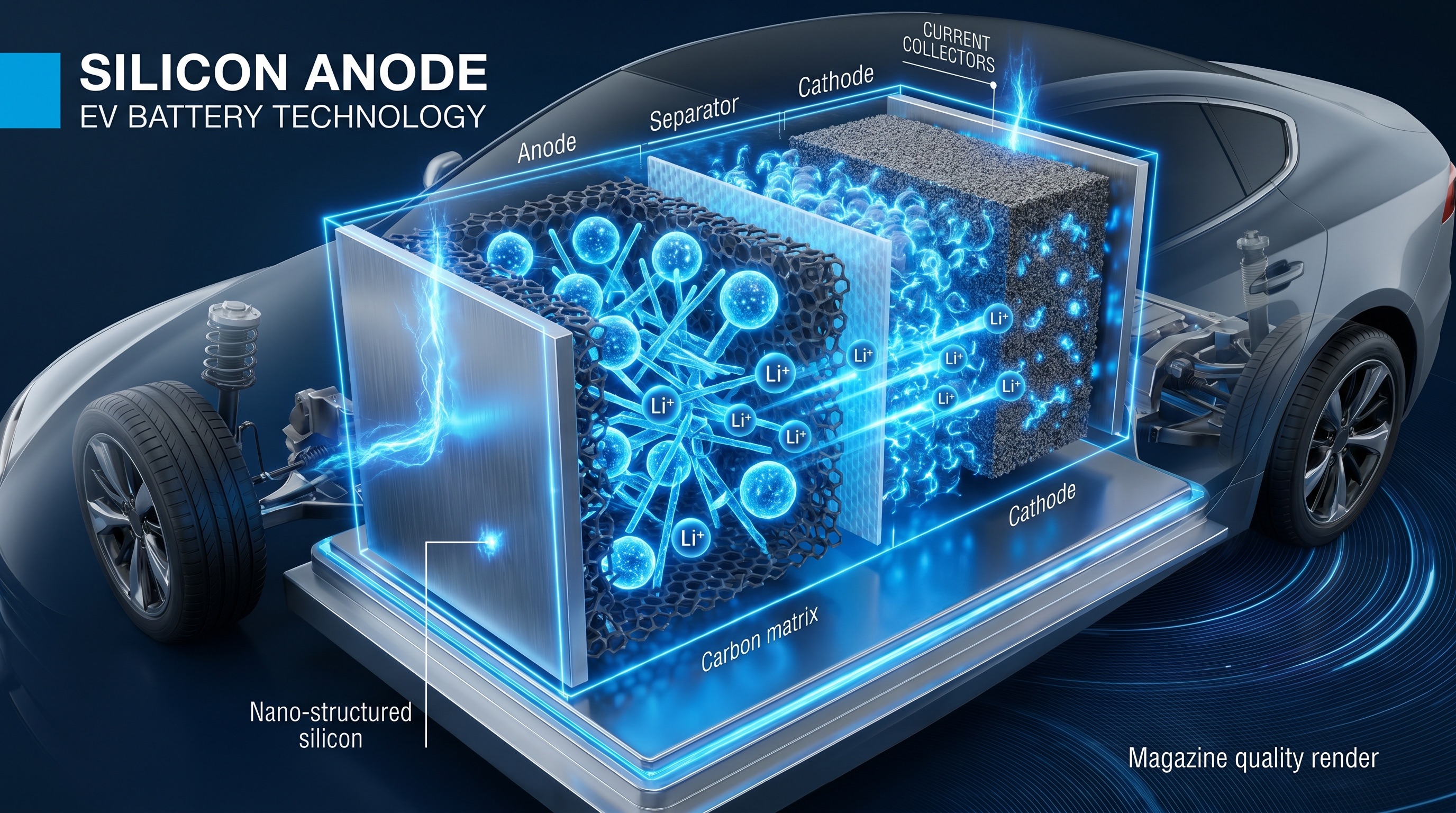
Every major advance in EV range over the past decade has come from incremental improvements: better cathode chemistry, higher energy density through cell engineering, and thermal management that lets batteries operate closer to their theoretical limits. The fundamental anode material — graphite — has stayed the same. Silicon anodes change that, and after 20 years of laboratory promise and commercial near-misses, they are arriving in real vehicles.
The core advantage is straightforward: silicon can store approximately 10 times more lithium ions per gram than graphite. The practical problem that delayed commercial deployment for two decades is equally straightforward: silicon expands by up to 300% in volume when it absorbs lithium during charging, then contracts when it releases lithium during discharge. Repeated over thousands of cycles, that expansion and contraction cracks silicon particles, degrades contact with the current collector, and causes rapid capacity loss. Solving that mechanical problem is what the past decade of battery materials science has been about.
How the Cracking Problem Was Solved
Three approaches have reached production scale, and all three work by constraining the expansion at the nanoscale rather than trying to prevent it entirely.
The first approach, pioneered by Sila Nanotechnologies, uses nano-sized silicon particles encapsulated in a carbon matrix. At that scale, silicon particles have enough room to expand and contract without fracturing — the carbon shell provides structural support while remaining electrically conductive. Sila's material, branded Titan Silicon, replaces a portion of the graphite anode rather than the entire electrode, allowing gradual performance improvement without redesigning the entire cell.
The second approach uses silicon-carbon composites — silicon dispersed throughout a graphite matrix — where the graphite provides a dimensional buffer for silicon expansion. This is the path Panasonic is pursuing for its 4680 cells destined for Tesla vehicles, blending silicon content into an existing graphite anode architecture. The result is a more conservative energy density improvement but an easier manufacturing transition.
The third approach, used by companies like Amprius Technologies, replaces graphite almost entirely with silicon nanowires grown directly on the current collector. Silicon nanowires flex rather than crack, allowing very high silicon content (greater than 95%) and the highest energy densities commercially available. The tradeoff is manufacturing complexity and higher cost per kWh — which is why Amprius has initially focused on aviation and defense applications where energy density matters more than cost.
Who Is Shipping Silicon Anodes Right Now
The first silicon anode batteries in consumer products appeared in smartphones, not EVs. Samsung SDI began incorporating silicon-carbon anode materials into smartphone cells in 2022, with the primary benefit being smaller battery packs at the same capacity rather than more range. The EV rollout is following the same pattern: start with premium vehicles where customers will pay for range, then scale down as manufacturing costs drop.
The most commercially significant deployment is Sila Nanotechnologies' partnership with Mercedes-Benz, announced in 2022 and shipping in the 2025 Mercedes-Benz EQG and updated EQS SUV. The EQS SUV with Titan Silicon cells achieves approximately 800 km of WLTP range — a meaningful step up from the 700 km of the graphite-anode version. Mercedes paid to be Sila's exclusive automotive customer for several years, which is how a startup materials company can fund production scale-up.
Panasonic's 4680 silicon anode cells for Tesla are in a different stage. The 4680 cell format (46mm diameter, 80mm height) shipped in the Tesla Model Y and Cybertruck using a graphite-dominant anode. The silicon content transition is a product roadmap step that Panasonic has publicly committed to but has not shipped in volume as of mid-2026. The timeline points to 2026-2027 for the silicon-blend 4680 to reach high-volume production.
CATL, the world's largest battery manufacturer, is developing its own silicon anode technology under the Freevoy program, targeting an 800 Wh/L energy density. CATL has not announced a specific vehicle partner for silicon anode cells, but given its customer base — Tesla, BMW, Volkswagen, Li Auto, NIO — when it ships, it will deploy at scale immediately.
What the Numbers Actually Look Like
The energy density improvement from silicon anode substitution is proportional to how much silicon replaces graphite. A 5-10% silicon content blend (what Panasonic is targeting initially) produces roughly a 10-15% improvement in anode capacity, translating to a 5-8% improvement in full-cell energy density. A 20-30% silicon content, closer to what Sila is targeting, produces 20-40% cell-level energy density improvements.
In real-vehicle terms: a 400-mile graphite-anode EV becomes a 430-460 mile vehicle with a modest silicon blend, or a 480-560 mile vehicle with higher silicon content — assuming the same pack volume. Alternatively, the same range is achievable in a smaller, lighter, cheaper pack, which has more significant implications for vehicle cost and weight distribution than raw range increase.
Charging speed also improves. Silicon anodes accept lithium ions faster than graphite under the right conditions, allowing higher C-rates during fast charging. In practice this means 10-15 minute fast charging becoming viable at lower temperatures than graphite allows — though thermal management systems still limit peak charging rates in cold conditions.
What Silicon Anodes Do Not Solve
Silicon anodes do not eliminate battery degradation — they change its character. The first-cycle irreversible capacity loss (where some lithium gets permanently trapped in the anode on the first charge) is higher for silicon than graphite and requires compensation in cell design. Long-term cycle life at the same energy density as graphite is harder to match, particularly for nano-silicon designs that constrain expansion through encapsulation rather than preventing it.
Cost remains the other constraint. Silicon anode precursor materials cost more to produce than graphite, and the manufacturing processes are more demanding. The cost premium over graphite cells is currently 15-25% at the cell level, which at the battery pack level translates to several thousand dollars per vehicle. The premium will compress as volume scales, following the same learning curve as LFP chemistry did — but it will take several years of high-volume production to close the gap significantly.
The Timeline for Mass Market
The realistic path to silicon anode batteries in mass-market EVs runs through 2027-2029. Premium vehicles and performance models will carry higher silicon content first. Mid-range EVs will follow as CATL, Samsung SDI, and Panasonic achieve manufacturing scale that brings costs to graphite-competitive levels. Entry-level EVs will likely continue using graphite-dominant or LFP chemistry through 2030 for cost reasons.
For buyers making a purchase decision now: a silicon anode EV at a price premium is worth considering for buyers who prioritize range or who do most charging on DC fast chargers. For everyone else, the graphite-anode generation being sold today will be a mature technology at competitive prices, and the silicon anode generation will be a meaningful upgrade in three to four years.