Right-to-Repair Laws Are Finally Reaching Everyday Gadgets
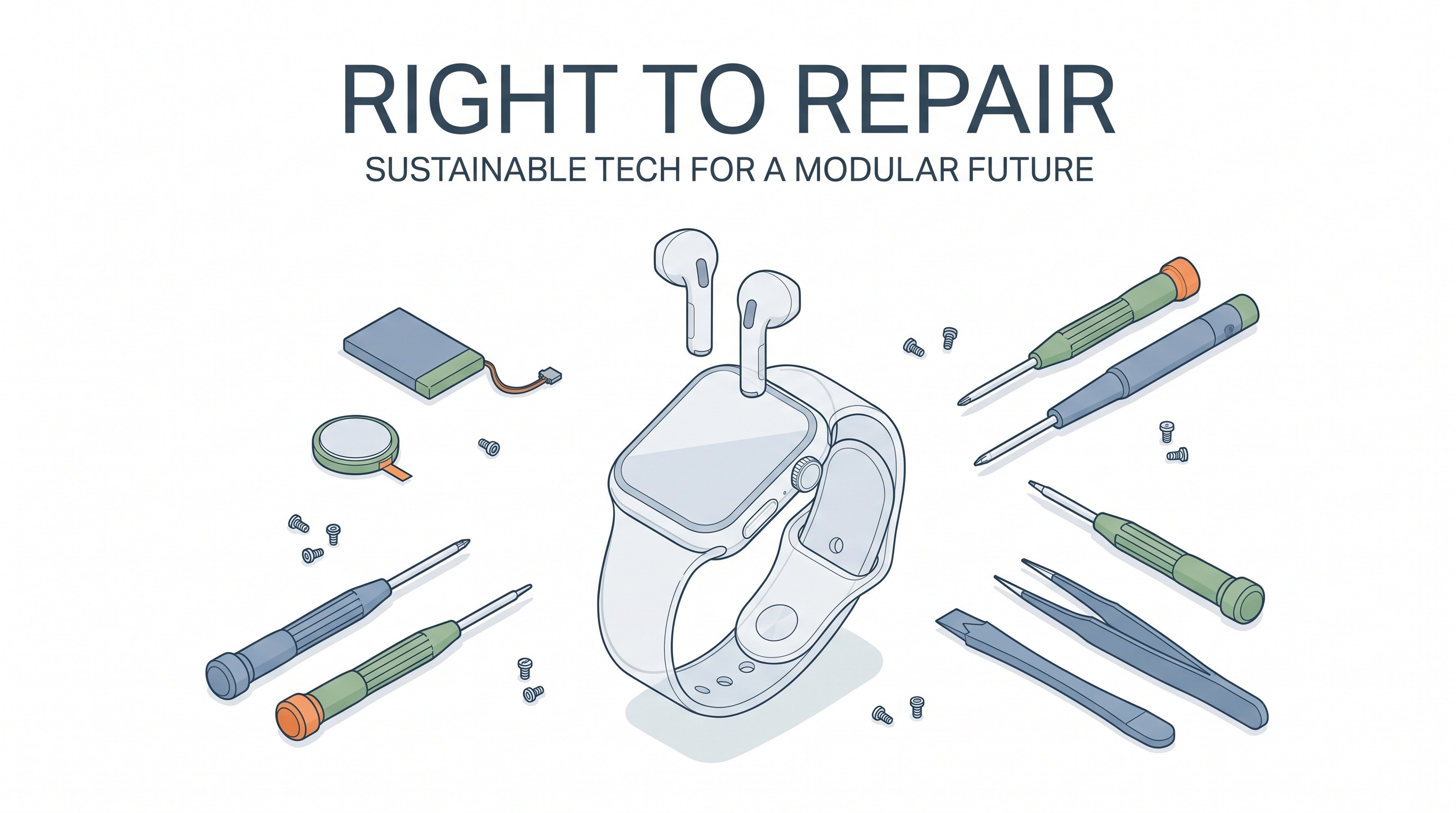
For a long time, the right-to-repair conversation lived at the edges of consumer tech. It showed up in arguments about tractor firmware, smartphone parts pairing, and whether laptop batteries should require glue, heat, and patience to remove. In 2026, that conversation is becoming more mainstream and more interesting, because the pressure is spreading from flagship devices to the small gadgets people cycle through constantly: earbuds, smartwatches, portable audio gear, smart home accessories, and other electronics that have quietly become disposable.
The core thesis is that repairability is no longer just a moral argument about waste or ownership. It is turning into a market-shaping product requirement. New laws in Europe and a growing patchwork of rules in the United States are forcing manufacturers to think harder about spare parts, service documentation, battery replacement, and the software locks that make independent repair harder than it needs to be. The result will not be a sudden golden age of perfectly fixable gadgets. But it will push design in a direction that consumers have not seen for years.
Why small gadgets matter so much
Phones get most of the repair headlines because they are expensive and personal. But everyday gadgets are where disposability hides in plain sight. Wireless earbuds lose battery capacity quickly. Smartwatches age out when one sealed component fails. Small speakers, trackers, camera accessories, and home devices often die for reasons that would be trivial in a more modular design. Because each item looks relatively cheap compared with a phone or laptop, replacement feels frictionless. Across millions of products, that creates a huge waste stream and a habit of low expectations.
This is also why legislation is starting to bite. Regulators increasingly see repairability as a competition issue, a consumer-rights issue, and an environmental issue at the same time. When manufacturers restrict parts, pair serial numbers tightly, or refuse to provide manuals and diagnostics, they are not just shaping a support channel. They are shaping who gets to keep a device alive.
The battery question is central
If there is one component that explains why repairability matters for gadgets, it is the battery. Small electronics live and die by battery health. A pair of earbuds can still sound fine when the cells no longer hold a useful charge. A wearable can still track well while becoming annoying to live with because its battery life collapses. The frustrating part is that many of these products fail at the exact point where a replaceable battery could have extended their life meaningfully.
That design choice is not always driven by physics alone. Miniaturization is hard, but companies have often optimized for slimness, assembly speed, water resistance marketing, and service control at the expense of maintainability. New rules will not erase those tradeoffs, yet they will make it harder to hide behind them. If battery access and parts availability become expected rather than optional, product teams will have to justify sealed designs more carefully.
Why the legal shift matters even outside Europe
The European Union has become the biggest forcing function because large manufacturers rarely want region-specific hardware architectures unless they absolutely have to. When EU rules require broader access to parts, clearer repair rights, or design concessions that support replacement, those changes often influence global product planning. Consumers outside Europe can benefit because it is inefficient for vendors to maintain entirely separate repair philosophies across markets.
The US still looks more fragmented, but state-level right-to-repair laws are adding pressure from another direction. That matters because it changes compliance math. Once multiple jurisdictions push against anti-repair practices, companies can no longer assume that obstruction is the stable default. Even if enforcement evolves slowly, the strategic direction becomes clearer: repair-hostile product decisions carry more regulatory and reputational risk than they used to.
What this will change in real products
The first visible changes may not look dramatic. Expect more official spare-part programs, more service manuals, and more devices designed so batteries and common wear components can be replaced without destroying the enclosure. The real shift is subtler. Product managers may begin treating repairability as a spec that must be negotiated during the design process instead of a problem to hand off to customer support later.
That can affect materials, adhesives, screw choices, connector layouts, charging case design, and even how companies think about accessory ecosystems. In earbuds, for example, the most meaningful improvement may be a serviceable charging case or better access to battery replacement rather than full modular reconstruction of each bud. In wearables, it may mean more honest compromises between waterproofing and serviceability. These are not flashy launch-event features, but they matter to ownership far more than one extra AI trick.
Manufacturers will resist, but they are losing the old argument
The classic industry defense is that consumers value thinness, seamlessness, and reliability more than repair access. There is truth in that, but the argument is weaker than it once was. Many users are no longer impressed by sealed elegance if it means a product becomes e-waste after two years. They have lived through enough dead earbuds, swollen batteries, and unsupported accessories to understand the tradeoff. Repairability no longer sounds like a niche enthusiast demand. It sounds like basic product honesty.
There is also a business case. More durable gadgets can support premium positioning, stronger trade-in programs, refurbished sales, and longer customer relationships. A company that makes a device easier to service does not automatically lose money. It may shift when and how that money is made. In a more mature gadget market, that can be an advantage.
What buyers should watch for
Consumers do not need to become repair technicians to benefit from this shift. They do need to get more selective. Look for brands that publish parts policies, battery replacement options, and repair documentation. Pay attention to teardown reports and service programs, not just launch-day marketing. If a company talks about sustainability but offers no path to replace common failure points, the message is incomplete.
It is also worth recognizing that repairability is not binary. Few tiny gadgets will become beautifully modular overnight. The more realistic near-term win is movement from effectively disposable to practically serviceable. A charging case with accessible cells, a smartwatch with an official battery program, or earbuds supported by real parts distribution can materially change how long a device stays useful.
The broader significance
Everyday gadgets helped normalize a throwaway relationship with technology. They were cheap enough to replace, small enough to ignore, and trendy enough that fast turnover felt natural. Right-to-repair rules are pushing back on that culture at exactly the right moment. Consumers are spending more on accessories than they used to, and they are getting less patient with products that fail on predictable timelines.
The most interesting outcome is not that every gadget becomes easy to fix at home. It is that repairability starts showing up as an ordinary expectation in categories where it was mostly absent. Once that happens, companies will have to compete on longevity and service as well as style. That would be a healthy change for users, for repair shops, and for the kind of gadget market we end up living with.