Regulated DeFi Is Turning Crypto Into Institutional Infrastructure
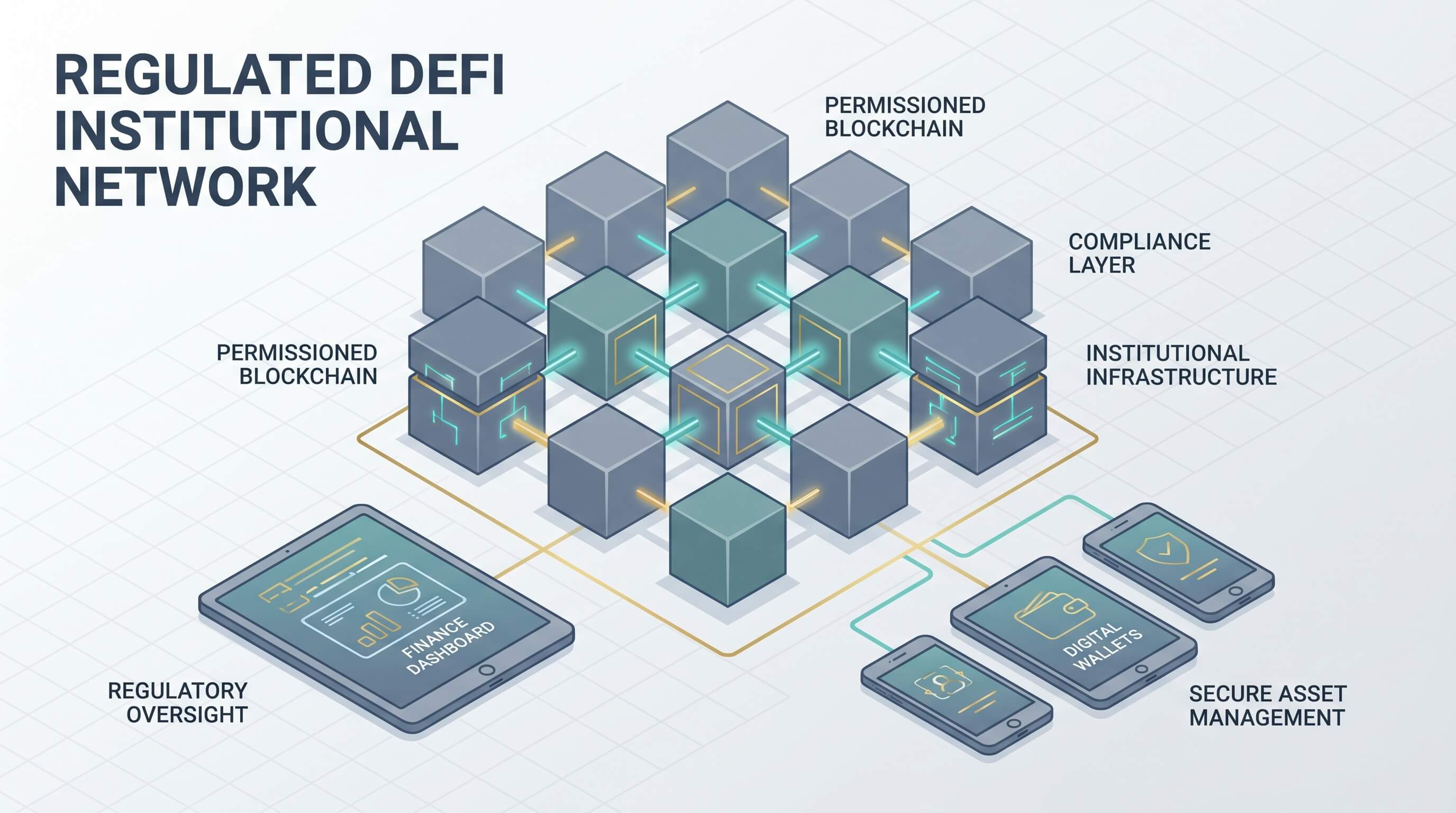
Institutional capital is not waiting for crypto to become less programmable. It is waiting for crypto to become more governable. That distinction matters. For years, the industry treated regulation and decentralization as opposing forces, which made DeFi difficult for banks, asset managers, and treasury teams to approach beyond passive exposure. The real breakthrough is not that institutions suddenly became comfortable with open, anonymous liquidity. It is that a new layer of regulated DeFi is making blockchain markets accessible through rules that can be enforced in code.
Programmable compliance is becoming the bridge. Instead of asking institutions to step into systems built for pseudonymous actors and post-trade legal cleanup, regulated DeFi allows identity, permissions, transfer restrictions, and reporting obligations to be embedded directly into the transaction flow. That changes crypto from a high-friction exception into an operationally manageable environment. The institutions that enter next will not do so because DeFi abandoned its mechanics. They will do so because those mechanics are being adapted into something their risk, legal, and operations teams can actually approve.
Why traditional institutions stalled at the edge of crypto
The first wave of institutional participation focused on the simplest products: custody, futures, exchange-traded wrappers, and limited venture exposure. Those structures worked because they insulated institutions from the operational reality of public blockchain markets. But they also prevented firms from using the features that make DeFi valuable in the first place, including continuous settlement, composability, and transparent collateral logic.
The barrier was never only volatility. It was control. Institutions need to know who can access a market, what assets can move, whether counterparties meet eligibility standards, how activity is monitored, and what records can be exported to auditors and regulators. Open DeFi protocols historically offered none of that in a form that mapped cleanly to institutional obligations. Even when yields were attractive, the governance model around those yields was too uncertain.
What regulated DeFi actually changes
Regulated DeFi does not mean replacing smart contracts with manual oversight. It means encoding oversight into the system architecture. In practice, that often begins with permissioned pools. A lending or liquidity venue can restrict participation to wallets that have passed KYC, sanctions screening, accreditation checks, or jurisdictional review. The pool still settles on-chain and may still use automated market or lending logic, but access is no longer universal.
This is a crucial design shift. A permissioned pool allows an asset manager, corporate treasury, or regulated fund to interact with tokenized assets or stablecoin liquidity without inheriting the full counterparty ambiguity of public permissionless markets. For an institution, the question is not whether the pool is less pure from a decentralization perspective. The question is whether it creates a market structure that can be defended in an investment committee memo and an examination cycle.
Compliant wallets as policy endpoints
Wallet design is also evolving from simple key control into a policy layer. Institutions do not want a wallet that merely signs transactions. They want wallets that can enforce spending rules, approval workflows, whitelisted counterparties, asset restrictions, and segregation of duties. A compliant wallet can require that only approved addresses receive certain tokens, or that redemptions above a threshold trigger additional authorization. In some cases, the wallet itself becomes the container for an institution's internal governance.
This matters because institutions rarely fail compliance at the moment of strategic intent. They fail at the moment of operational execution. A wallet that only stores assets is not enough. A wallet that enforces policy reduces the gap between what compliance teams approve on paper and what traders or treasury staff can actually do on-chain.
Attestation as the missing trust primitive
Attestation is emerging as another critical building block. Rather than exposing full identity details on a public chain, a participant can present a verifiable credential showing that it meets specific requirements: qualified investor status, geographic eligibility, AML clearance, or affiliation with an approved entity. The protocol or transfer agent does not need to know everything about the participant. It only needs trustworthy proof that the required condition has been satisfied.
This selective disclosure model is one of the most practical ways to reconcile privacy with regulation. It gives institutions a way to participate without broadcasting sensitive data, while still allowing issuers and platforms to gate access. A tokenized fund, for example, could permit subscriptions only from wallets carrying a valid attestation issued by an approved compliance provider. That is a far cleaner workflow than re-running fragmented manual checks across every transaction venue.
Reporting is where institutional confidence is won or lost
Even strong access controls are not enough if the data exhaust from on-chain activity cannot be turned into reliable reporting. Institutions need position visibility, transaction histories, counterparty classification, exception alerts, and records that can feed accounting, risk, and regulatory systems. Regulated DeFi platforms are increasingly being built with reporting in mind from day one, not as an afterthought layered on top of blockchain explorers.
This is where programmable compliance becomes especially powerful. A smart contract can enforce transfer rules, but it can also emit standardized event data for downstream monitoring. A treasury desk using a permissioned stablecoin pool may be able to generate near real-time records of collateral movements, interest accrual, and exposure concentration. That is fundamentally different from the old model where operations teams had to reconstruct intent from raw wallet activity after the fact.
Better reporting also improves governance inside the institution. Risk teams can define exposure limits, compliance teams can review exceptions, and auditors can trace controls with much less ambiguity. Once that reporting discipline exists, crypto stops looking like a parallel shadow system and starts looking like another programmable financial rail.
Concrete use cases are already taking shape
The most immediate opportunity is not that every bank will rush into fully open DeFi markets. It is that specific institutional use cases can now be designed with constrained participation and clear control logic. Consider a permissioned liquidity pool for tokenized short-term credit instruments. Only approved wallets can supply capital or borrow, every participant carries a current attestation, collateral parameters are visible on-chain, and reporting feeds into existing risk dashboards. That is recognizably a DeFi structure, but one adapted to institutional tolerances.
Another example is fund distribution. A tokenized private credit or money market fund can use transfer restrictions so shares move only between verified wallets. Subscription eligibility can be checked through attestations, and compliance events can be logged automatically for reporting. This does not eliminate regulation. It operationalizes it.
Cross-border treasury is another candidate. Institutions already move capital through slow, fragmented correspondent channels because predictability matters more than novelty. A regulated DeFi setup using compliant wallets and monitored stablecoin rails can shorten settlement time while preserving approval controls and auditability. That combination is what makes the model credible.
The strategic implication for crypto markets
Some crypto natives will argue that regulated DeFi is a compromise. It is. But it is also likely to be one of the most economically important compromises the industry makes. Institutions do not need every protocol to become permissioned. They need a credible zone of the market where programmable finance and enforceable compliance coexist. Once that zone matures, capital can enter with fewer translation costs between blockchain systems and institutional obligations.
The long-term result may be a layered market rather than a single ideological one. Open DeFi will continue to serve experimentation and permissionless innovation. Regulated DeFi will serve firms that require identifiable participants, embedded controls, and dependable reporting. The bridge between traditional finance and crypto will not be built by marketing language about adoption. It will be built by infrastructure that allows institutions to participate without suspending the rules they live under every day.
That is why regulated DeFi matters now. It is not simply making crypto safer for institutions. It is making crypto legible to them, and legibility is what turns interest into allocation.