Quantum Computers Just Cleared Their First Practical Error-Correction Milestone
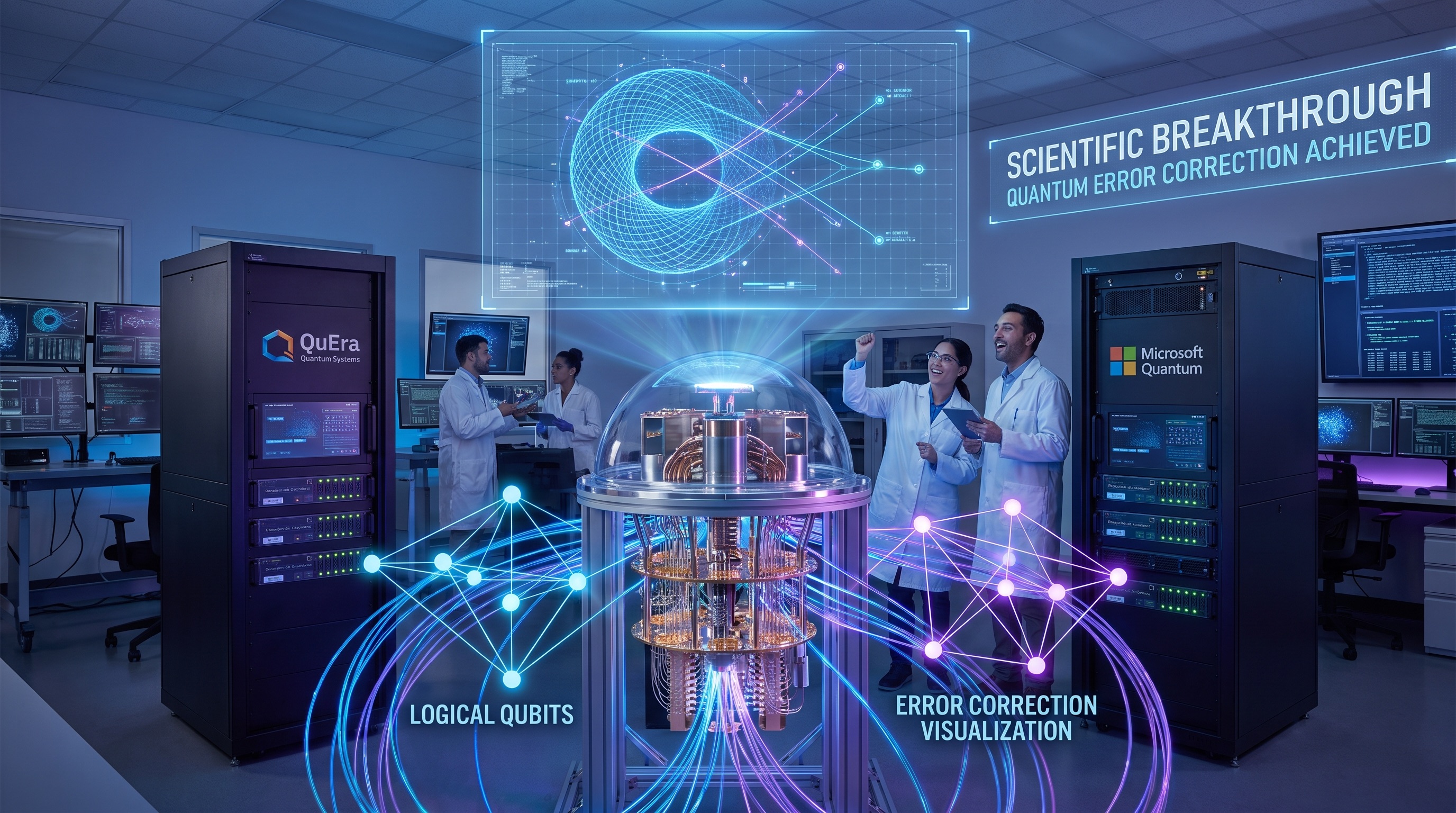
Quantum computing has been perpetually five to ten years away for most of the last decade. The claims were real — the underlying physics is sound — but the engineering gap between theoretical qubits and reliable computation has been enormous. That gap is closing in 2026, and the milestone being crossed this year is specific enough to be worth paying attention to: error-corrected quantum computers are now being delivered to paying customers for the first time.
This does not mean quantum computers are ready to replace classical machines for general workloads. What it means is that the foundational problem — quantum errors accumulating faster than you can correct them — has been solved at small scale. That is the unlock for everything that comes after.
Why Error Correction Is the Central Problem
A classical bit is either 0 or 1. A qubit can exist in a superposition of states, which is what gives quantum computers their theoretical power. The problem is that qubits are extraordinarily fragile — thermal noise, electromagnetic interference, and even cosmic radiation cause them to flip or lose coherence. A computation that takes thousands of gate operations quickly accumulates errors that corrupt the result.
The solution is error-correcting codes: using many physical qubits to encode a single reliable "logical" qubit. A typical system might need 20–1,200 physical qubits per logical qubit, depending on the error rate and the code used. The engineering challenge is building systems with enough physical qubits, low enough error rates, and fast enough correction cycles to make logical qubits practical.
2026 is the year when the first systems meeting that bar have shipped.
QuEra's Delivery to Japan: 37 Logical Qubits
QuEra, a Harvard spinout, delivered an error-corrected quantum computer to Japan's National Institute of Advanced Industrial Science and Technology (AIST) earlier this year. The system operates with approximately 37 logical qubits built from 260 physical qubits. QuEra's approach uses neutral atoms — rubidium atoms trapped by lasers — which offer advantages in connectivity (any qubit can interact with any other) compared to superconducting architectures where connectivity is topologically constrained.
37 logical qubits is not large by any practical definition — classical computers routinely work with billions of bits. But these are error-corrected logical qubits, not raw physical qubits prone to noise. That makes them usable for real algorithmic work in a way that the larger but noisier systems of 2023–2024 were not.
Microsoft and Atom Computing: Magne
Microsoft is delivering a system called Magne to Denmark's Export and Investment Fund and the Novo Nordisk Foundation. The machine will feature 50 logical qubits built from approximately 1,200 physical qubits, operational by early 2027. Microsoft's approach differs from QuEra's: it is pursuing topological qubits (via Majorana 1, announced earlier this year), which are theoretically more resistant to errors by design, potentially requiring fewer physical qubits per logical qubit at scale.
Microsoft's VP of Quantum has been careful to frame the 2026–2027 milestones as "scientific advantage" rather than commercial advantage — an honest position given where the technology sits. These systems will be used for quantum chemistry simulations, optimization problems, and materials science research where classical computers are genuinely bottlenecked. They are not general-purpose replacements for anything running in your data center today.
IBM and Google: The Superconducting Track
IBM's roadmap targets verified quantum advantage by end of 2026 using its 120-qubit Nighthawk processor, with a claimed 10x speedup in quantum error correction one year ahead of schedule. Google's Willow chip already demonstrated "below threshold" error correction — meaning adding more qubits actually reduces errors rather than increasing them — and ran an out-of-order time correlator algorithm 13,000 times faster than classical supercomputers on the specific benchmark designed to showcase quantum advantage.
The Google benchmark deserves the standard caveat: quantum advantage demonstrations are typically on problems specifically constructed to favor quantum approaches. Showing a quantum computer outperforms a classical supercomputer on a carefully chosen problem is not the same as showing it outperforms a data center on workloads that matter commercially. IBM and Google know this; the milestones are real, but the framing sometimes gets ahead of the practical applications.
What the Practical Applications Actually Are Right Now
The organizations with active quantum computing programs in 2026 are concentrating on three domains where early quantum advantage is most plausible:
- Quantum chemistry and drug discovery: Simulating molecular interactions at quantum scale is exponentially hard for classical computers. Pharmaceutical companies are running molecular simulation workflows through cloud-based quantum processors.
- Portfolio optimization: Finance institutions are running quantum optimization pilots for portfolio construction and risk modeling, where the combinatorial search space exceeds what classical heuristics can efficiently explore.
- Logistics routing: Boeing launched a $2.5 million quantum project (QUICK) for aircraft corrosion modeling via hybrid quantum-classical workflows. Logistics teams are benchmarking routing algorithms with similar hybrid approaches.
"Hybrid" is the operative word. In 2026, the most effective quantum computing setups combine quantum processors for the hard combinatorial or simulation core of a problem with classical compute handling everything else. Pure quantum computation for end-to-end workloads remains a future milestone.
The Timeline That Makes Sense
Error-corrected systems with 50–100 logical qubits: 2026–2027 (happening now). Systems with hundreds of logical qubits capable of running commercially meaningful algorithms at advantage: 2028–2030 by most credible estimates. General-purpose quantum computers that displace classical machines across broad workloads: 2035 or beyond, if ever.
The reason the 2026 milestone matters is not that quantum computers are useful for your infrastructure today. It is that the fundamental engineering barrier — error correction at logical qubit scale — has been crossed at small scale. That validates the roadmaps and makes the 2028–2030 projections considerably more credible than they were two years ago.
Watch the logical qubit count in the next 18 months. When that number crosses 200 on a reliable, accessible system, the applications will follow.