Private 5G networks are quietly replacing Wi-Fi on factory floors
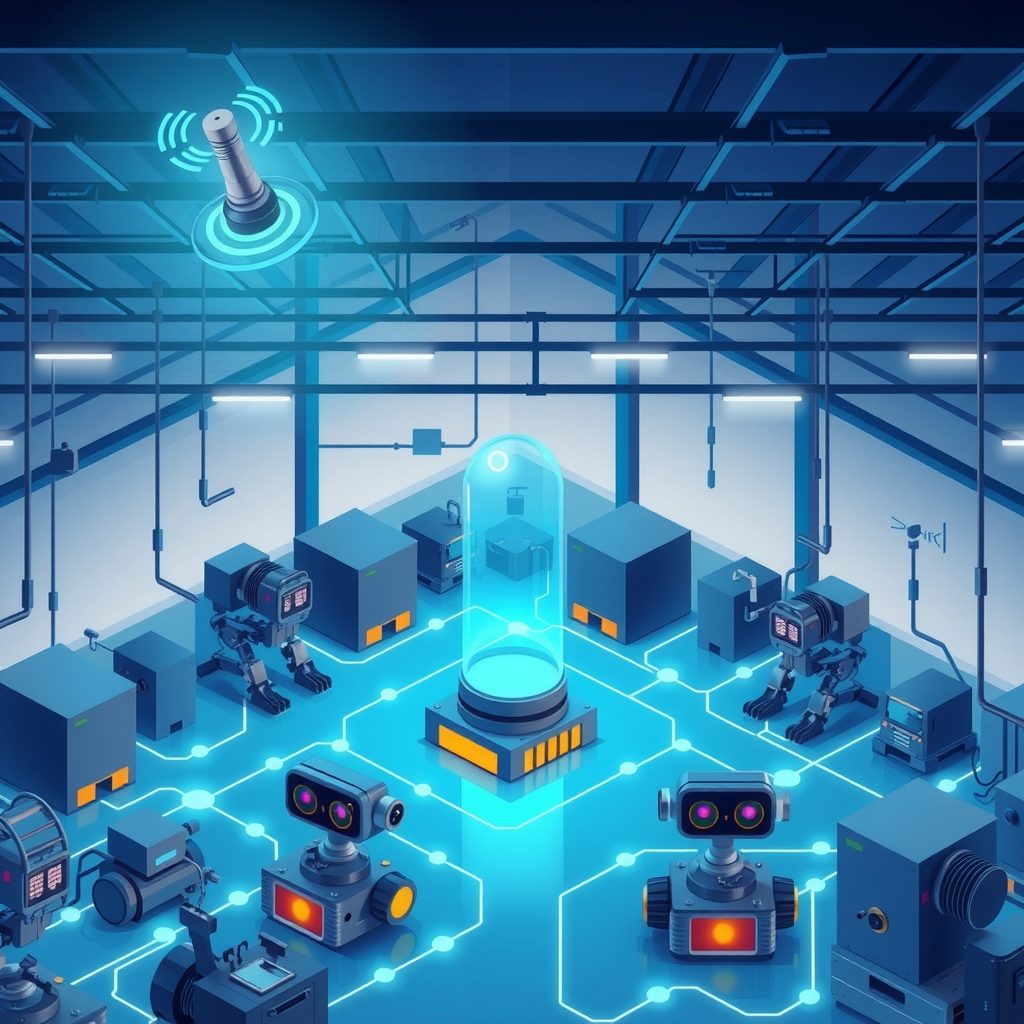
Factory floors are a uniquely hostile environment for wireless networking, and 2026 is the year enterprises stopped tolerating it. Metal machinery reflects and absorbs radio signals unpredictably. Welding equipment and motors generate electromagnetic interference that Wi-Fi's unlicensed spectrum has no defense against. Moving robots and AGVs need handoffs between access points that Wi-Fi handles poorly at industrial speeds. The result: enterprises that spent years patching Wi-Fi dead zones with more access points are now ripping sections out and replacing them with private cellular.
The physics problem Wi-Fi can't engineer around
Wi-Fi operates in unlicensed spectrum, which means every microwave, Bluetooth device, and neighboring company's network is a potential interference source. On a factory floor, add welding arcs, VFD motor drives, and dense metal racking, and you get a wireless environment where signal reflection and multipath interference cause the kind of intermittent packet loss that's tolerable for an office laptop and unacceptable for a robot arm mid-motion. Private 5G operates on licensed or lightly-licensed spectrum (CBRS in the US, similar frameworks elsewhere), which means the operator controls interference sources within their own facility — a fundamentally different reliability guarantee than Wi-Fi can offer in the same physical environment.
Ericsson has been running its own factories as a proof point, demonstrating private 5G outperforming Wi-Fi specifically on the metrics that matter for industrial automation: deterministic sub-10ms latency, guaranteed quality-of-service through network slicing, and device density that Wi-Fi 6 simply can't match. A single private 5G cell can support device densities an order of magnitude higher than a Wi-Fi 6 access point handling the same physical footprint — roughly a million devices per square kilometer in 5G specifications, versus 50-100 devices per access point that Wi-Fi 6 manages in practice.
What's actually driving the 2026 shift
The move from pilot to production-grade deployment in 2026 reflects three converging pressures. First, sensor density on modern factory floors has exploded — industrial IoT deployments that were experimental three years ago are now core to production monitoring, and Wi-Fi's device-density ceiling has become an actual operational constraint, not a theoretical one. Second, mobile robotics — AGVs and AMRs navigating shop floors — need seamless handoffs between coverage cells while carrying live control-loop data; Wi-Fi's roaming and handover mechanisms weren't designed for that use case, while cellular handover was built for exactly this from the start. Third, enterprises are prioritizing operational control: owning your own private network means you're not dependent on a carrier's public infrastructure or a Wi-Fi vendor's firmware roadmap for mission-critical connectivity.
Private 5G doesn't replace Wi-Fi everywhere — and that's the actual 2026 story
The nuance that's easy to miss: 2026 isn't a private-5G-versus-Wi-Fi story, it's a hybrid-architecture story. Wi-Fi 7 is maturing in parallel, and for office spaces, warehouses without heavy machinery interference, and general enterprise connectivity, Wi-Fi 7's higher throughput and lower deployment cost still win. The emerging enterprise pattern for 2026 is deploying private 5G specifically for the shop floor — where deterministic latency and device density matter for automation and robotics — while keeping Wi-Fi 7 for office networking, guest access, and lighter-duty IoT. Enterprises are increasingly linking the two rather than choosing one exclusively.
This matters for anyone budgeting network infrastructure in 2026: a blanket private-5G deployment across an entire facility is usually the wrong call. The right call is segmenting by use case — cellular where interference and latency are operational risks, Wi-Fi 7 where they're not — and that segmentation is what "enterprise connectivity in 2026" actually means in practice, rather than either technology winning outright.
Actionable takeaways
- Don't evaluate private 5G as a Wi-Fi replacement — evaluate it as a solution for specific zones where interference, latency, or device density are measurable operational problems today.
- If your facility has moving robots (AGVs/AMRs) or heavy machinery causing intermittent Wi-Fi dead zones, that's the strongest signal private 5G will show fast ROI.
- Plan for hybrid architecture from the start — private 5G for shop-floor automation, Wi-Fi 7 for office and lighter IoT — rather than a facility-wide rip-and-replace.
- Budget for CBRS or local spectrum licensing costs alongside hardware; the licensing model is a real deployment cost that differs meaningfully from Wi-Fi's unlicensed-spectrum simplicity.