Private 5G networks are quietly replacing enterprise Wi-Fi in warehouses and ports
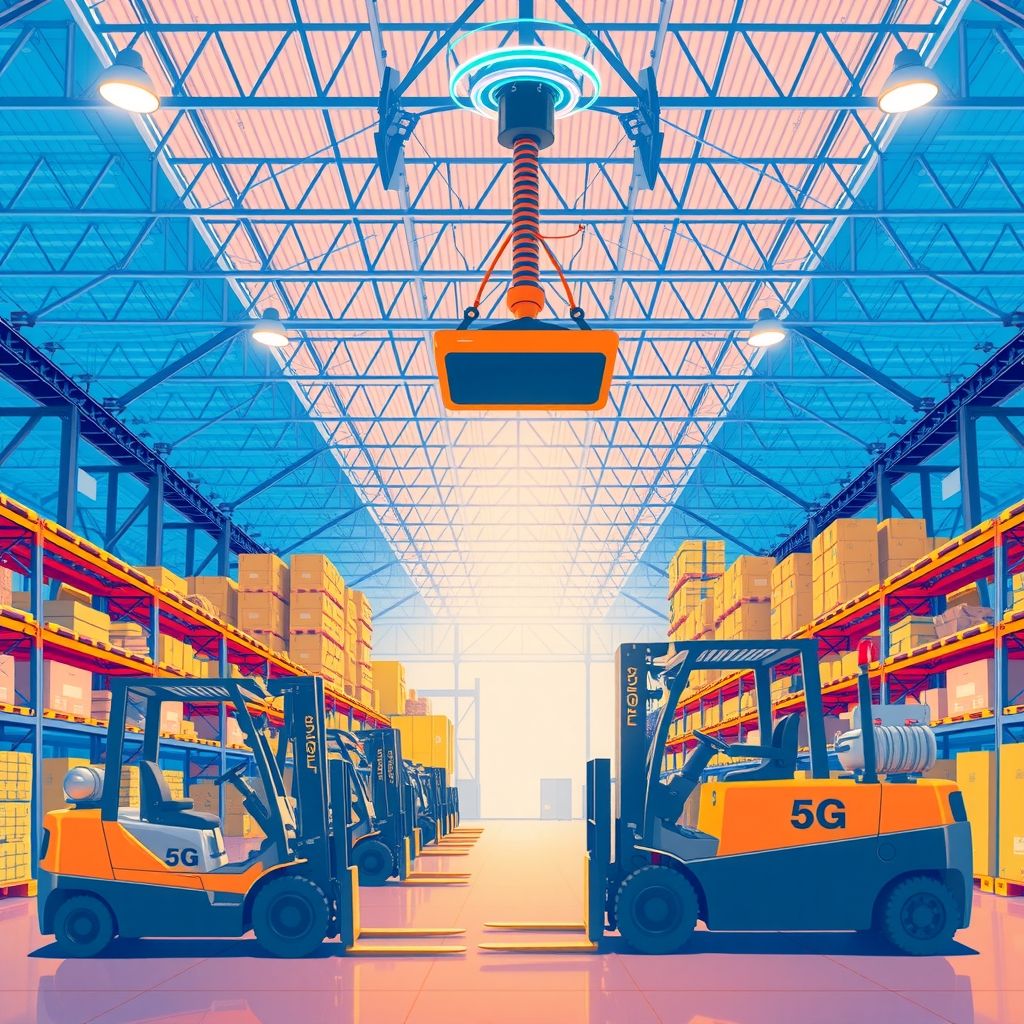
Warehouse and port operators are quietly ripping out enterprise Wi-Fi and replacing it with private cellular networks — not because Wi-Fi 6E is slow, but because it was never designed for buildings full of moving metal. A forklift roaming between access points drops its connection for the half-second it takes to re-authenticate with a new AP. On a conveyor line or an automated guided vehicle (AGV), half a second is enough to trigger an emergency stop. Private 5G and the CBRS spectrum band in the US have turned from a Verizon sales pitch into the default fix for that problem.
The shift matters because it inverts who controls network infrastructure. Enterprise Wi-Fi has always been something IT departments buy, configure, and own outright. Private cellular, until recently, meant leasing spectrum and equipment from a carrier. CBRS changed that in the US by opening the 3.5 GHz band to shared, lightly-licensed use through a Spectrum Access System — companies like Boingo, Celona, and Betacom now sell private 5G as a packaged product that a facilities team can deploy without ever talking to AT&T or Verizon. In Europe, operators like Bosch and the Port of Hamburg have run campus 5G networks since 2022 under local licensing regimes that work the same way.
Why Wi-Fi breaks down in these environments
The core issue is physical, not architectural. Dense metal racking in a warehouse reflects and absorbs 2.4 GHz and 5 GHz signals unpredictably, creating dead zones that move as inventory moves. Wi-Fi's roaming protocol — the handoff between access points — was built for laptops that mostly sit still, not for a fleet of 40 forklifts and 200 handheld scanners crossing AP boundaries every few seconds. Each handoff carries authentication overhead that adds latency spikes of 100-300ms, which is tolerable for a video call but not for a robot arm expecting a control signal within 10ms.
Cellular networks solve this natively because the handoff between towers — or in this case, small cells — is a core part of the air interface, not a bolted-on feature. A device moving across a warehouse floor on a private 5G network doesn't re-authenticate from scratch; it hands off the way a phone call survives you driving past a cell tower. SIM-based device identity also removes the password-rotation nightmare that comes with managing Wi-Fi credentials across thousands of handheld devices and IoT sensors.
What's actually being deployed, and what it costs
A midsize private 5G deployment for a single large warehouse — radios, a local core, SIMs for a few hundred devices — typically runs in the low hundreds of thousands of dollars, not dramatically more than refreshing a comparable enterprise Wi-Fi 6E network with enough access points to cover the same floor plan at the density these facilities need. The difference shows up in operating cost, not capital cost: fewer outages, lower support tickets for dropped connections, and the ability to run network slicing — carving out a guaranteed-latency lane for safety-critical robotics traffic while camera and scanner traffic shares the rest of the spectrum.
Ports are the clearest adopters because the economics are brutal in their favor. An automated crane that stalls for even a few seconds because of a dropped network connection can back up an entire berth. The Port of Rotterdam and the Port of Hamburg both run private cellular specifically for crane and AGV control, with Wi-Fi relegated to administrative and guest traffic. Mining operations are following the same pattern underground, where Wi-Fi's range and the difficulty of running cable for access points make cellular small cells the more practical option regardless of the latency argument.
The neutral host wrinkle
One complication enterprises are still working through is "neutral host" integration — letting employees' and visitors' personal phones roam onto the private network using their existing carrier SIM, rather than forcing a separate CBRS-only device for warehouse staff. This requires carriers to recognize and hand off to the private network, which is a commercial negotiation as much as a technical one, and it's the main reason some facilities run two networks in parallel: CBRS for robotics and fixed infrastructure, carrier roaming or Wi-Fi for personal devices.
What to watch
If you're evaluating this for a facility, the decision point isn't "5G versus Wi-Fi" in the abstract — it's whether your floor has safety-critical automation that needs guaranteed latency and can't tolerate roaming handoffs. If the answer is yes, the CBRS ecosystem has matured enough that packaged private 5G is now a facilities-budget line item, not an R&D project. If your traffic is mostly people on laptops and tablets, Wi-Fi 6E remains the cheaper and simpler choice. The two aren't fighting for the same use case anymore; they're splitting the building by workload.