Private 5G and Wi-Fi are starting to share the enterprise network
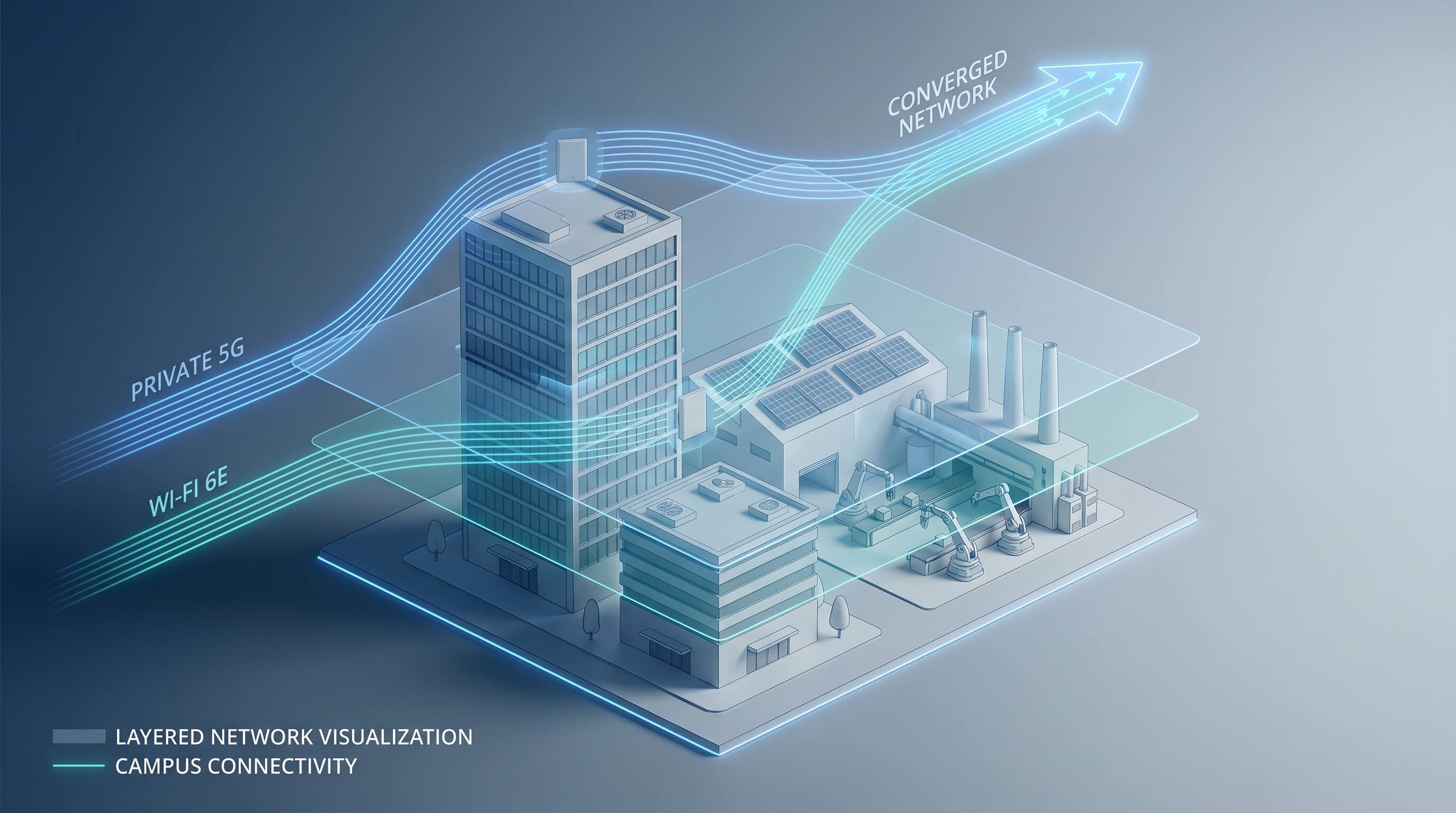
Enterprise wireless used to be framed as a binary choice. You built on Wi-Fi because it was cheap, familiar, and good enough, or you deployed private cellular because you needed deterministic coverage, tighter policy control, or support for large fleets of moving devices. That framing is starting to look dated.
The more interesting shift in 2026 is that serious enterprise networks are being designed around coexistence. Wi-Fi 7 is becoming the default for office, campus, and high-density indoor connectivity, while private 4G and 5G are being reserved for places where mobility, coverage consistency, device identity, or radio conditions justify the extra complexity. The point is not replacement. It is orchestration.
Why the old Wi-Fi versus 5G argument is breaking down
For years, vendors sold private 5G as if it would sweep away enterprise WLAN. In practice, that did not happen. Dell'Oro's 2026 enterprise networking outlook expects Wi-Fi 7 to become mainstream in enterprise wireless, while private cellular remains a niche but growing option for difficult environments and high-end operational use cases. That matches what most infrastructure teams already know from experience: offices, schools, hospitals, and retail sites still run on Wi-Fi because the economics, client support, and operational habits all favor it.
At the same time, private cellular is no longer a science project. Manufacturing plants, ports, warehouses, energy sites, and large venues now have enough off-the-shelf gear and integration partners to deploy private networks without inventing everything from scratch. Spectrum options such as CBRS in the US lowered the barrier, and neutral-host designs made indoor coverage conversations more practical for enterprises that do not want to rely entirely on public carrier build-outs.
What changed is that buyers became less ideological. Instead of asking which radio wins, they ask where each one belongs.
Wi-Fi still owns the general-purpose layer
Wi-Fi remains the best general-purpose access network for most enterprise users and devices. Laptops, tablets, phones, scanners, conferencing gear, and guest devices all assume it exists. Deployment skills are widespread, upgrade cycles are well understood, and the economics of dense indoor coverage are hard to beat.
Wi-Fi 7 strengthens that position. Wider channels, Multi-Link Operation, better scheduling, and cleaner use of 6 GHz give IT teams a credible upgrade story at exactly the moment enterprises want networks that can handle more video, more real-time collaboration, more sensors, and more AI-assisted operations. In many organizations, the next network refresh is not a debate about abandoning Wi-Fi. It is a debate about how quickly to move to a newer Wi-Fi baseline.
That matters because it keeps Wi-Fi as the default substrate for knowledge work. Even when private cellular enters the building, it rarely arrives to replace the office SSID. It arrives to solve a problem Wi-Fi was not designed to solve elegantly.
Where private 5G actually earns its keep
Private 5G becomes compelling when identity, coverage continuity, and mobility matter more than raw peak throughput. A robot crossing a yard between buildings, a fleet of autonomous carts in a factory, handhelds operating in RF-noisy spaces, or sensors spread across a large industrial site all benefit from cellular-style mobility and policy control.
This is where the Wireless Broadband Alliance's recent work on Wi-Fi and private 5G convergence matters. The goal is not just dual deployment. It is coordinated behavior across networks, including better onboarding, traffic steering, status sharing, and service-function integration. In plain English, enterprises want devices and applications to move across access types without forcing every team to build custom handoffs, duplicate security logic, or maintain separate operational silos forever.
Private 5G is also attractive where enterprises want more explicit SIM or eSIM-based identity, stronger isolation for operational technology, or a clearer path to service-level commitments for critical workflows. Those are not everyday office needs, but they are real business needs in logistics, energy, healthcare campuses, mining, and advanced manufacturing.
OpenRoaming, CBRS, and neutral host are the practical glue
The convergence story is less about grand telecom rhetoric and more about dull-sounding building blocks that remove friction. OpenRoaming is one of them. It turns Wi-Fi onboarding into something closer to cellular attachment, which matters for guest access, partner access, and large multi-tenant environments. The Wireless Broadband Alliance says a large majority of industry executives now plan OpenRoaming deployments over the next two years. That is a sign that identity and policy portability are becoming a real buying criterion.
CBRS is another important piece, especially in the US. It gave enterprises a more attainable route into private LTE and 5G, and it opened the door to neutral-host models that can improve indoor cellular coverage without the cost profile of legacy distributed antenna systems. For venues, campuses, and property owners, that changes the business case. They can think about cellular as infrastructure they can shape, not just coverage they wait for.
Neutral-host architecture also matters because it nudges enterprise teams toward a broader view of access. Once a building supports managed Wi-Fi, private cellular, and carrier integration in the same footprint, the conversation naturally shifts from technology preference to service design.
The real challenge is operational, not radio-level
The hardest part of convergence is not proving that packets can move. It is deciding who owns policy, observability, security, and automation across mixed environments. Enterprises do not want one stack for office IT, another for industrial operations, another for public cellular integration, and manual glue between all three.
That is why AIOps, identity federation, unified policy, and lifecycle management matter so much. If a device can authenticate cleanly but still disappears from the monitoring model when it roams between networks, convergence has failed at the level the business actually cares about. If a security team has to translate different telemetry models for every access technology, the complexity tax will cancel out much of the theoretical benefit.
In other words, the future enterprise network is not merely multi-radio. It has to be legible to operators.
What enterprises should do next
The smartest near-term move is not a grand private 5G rollout. It is a segmentation exercise. Map which users, devices, and workflows really need cellular-grade mobility or policy control, and which ones simply need a modern Wi-Fi upgrade. Many companies will discover that 80 percent of their estate belongs on better Wi-Fi, while a smaller high-value slice justifies private cellular.
They should also pressure vendors on interoperability instead of buying isolated promises. Ask how identity moves between Wi-Fi and cellular, how policy is expressed across both, how roaming and failover are handled, and whether operations teams get one coherent picture of device health and performance.
The best enterprise wireless strategy in 2026 is not choosing a winner. It is building a network where Wi-Fi stays the broad access layer, private 5G handles the demanding edge cases, and the seams between them get thinner every year. That is a more useful future than the old replacement narrative, and it is finally starting to look deployable.