Platform Engineering Is Replacing DevOps — Here's What That Actually Means in 2026
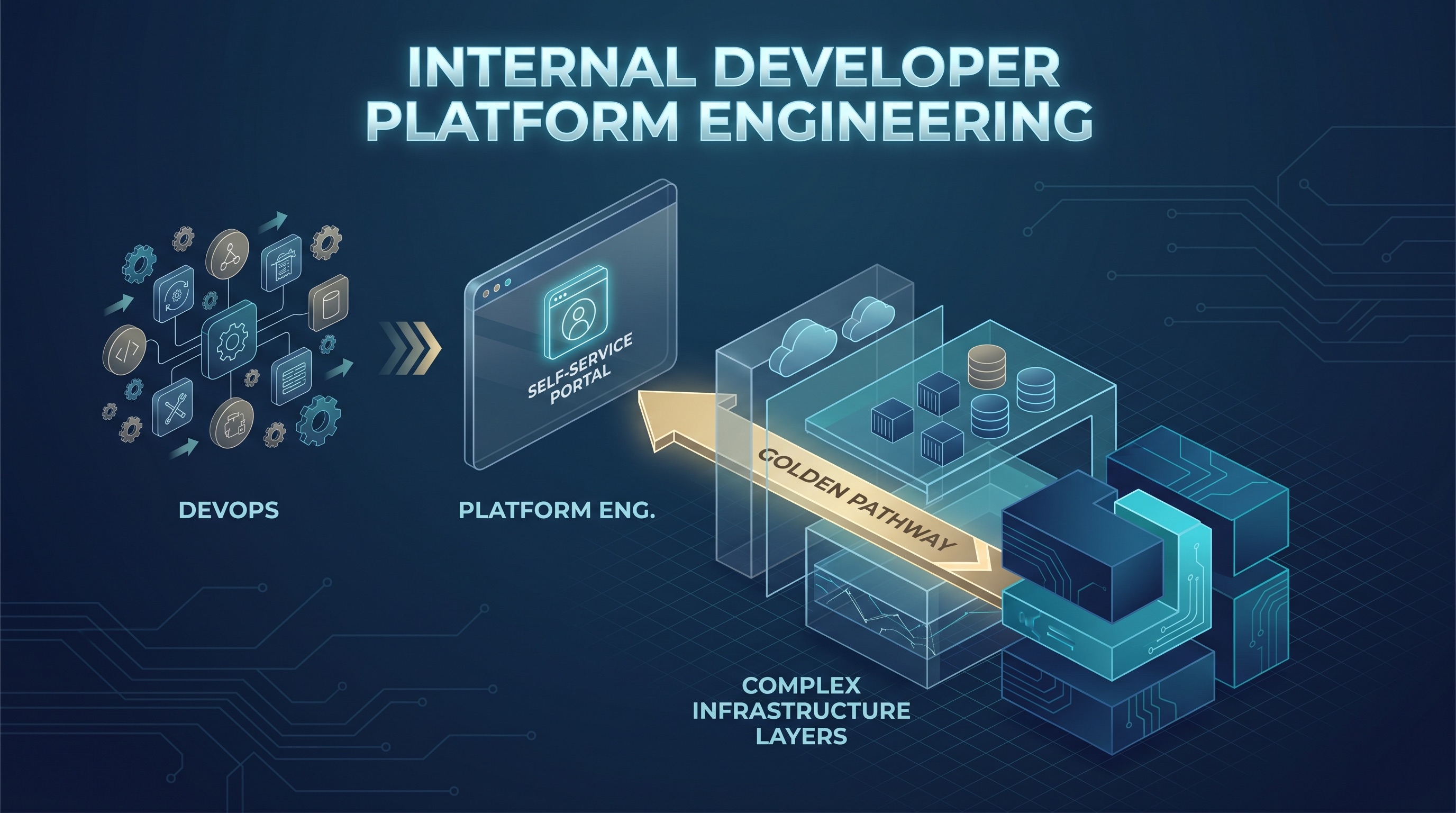
When companies adopted DevOps a decade ago, the promise was cultural: developers and operations engineers would work together, breaking down the wall between "we write it" and "you run it." What many organizations got instead was every developer becoming a part-time infrastructure engineer — on-call rotations, Kubernetes debugging at midnight, managing Terraform state drift when they wanted to ship features. The toil that DevOps promised to eliminate moved from ops teams to development teams.
Platform engineering is the correction. Rather than asking every developer to understand infrastructure, platform engineering builds a dedicated internal team whose sole job is creating the infrastructure abstractions, tools, and workflows that other developers consume as a service. The goal is a self-service system so well-designed that application developers can deploy, scale, and monitor their services without needing to understand what's running underneath. The distinction sounds subtle but the organizational consequences are significant.
What an Internal Developer Platform Actually Is
An Internal Developer Platform (IDP) is the product that platform engineering teams build. It's not a single tool — it's a curated layer of abstractions, automated workflows, and self-service interfaces that sit between developers and the underlying infrastructure (cloud providers, Kubernetes clusters, databases, security controls, monitoring systems).
A mature IDP typically provides:
- Service templates / scaffolding: Opinionated starting points for new services (microservice template, ML model serving template, data pipeline template) with sensible defaults for CI/CD, logging, monitoring, and security already wired in
- Self-service environments: Developers can provision dev/staging environments without filing tickets or waiting for ops approval — the platform enforces guardrails automatically
- Deployment workflows: A "deploy to production" button that runs automated tests, checks security policies, applies canary or blue/green traffic splitting, and rolls back if error rates spike — without the developer managing any of it
- Service catalog: A searchable inventory of all services, their owners, their dependencies, their SLAs, and their runbooks — reducing the tribal knowledge problem
- Observability out of the box: Every new service automatically emits standard metrics, logs, and traces; developers don't instrument from scratch
The critical concept is the golden path: the recommended way to do the common task (deploy a service, add a database, set up a cron job). The golden path is opinionated and automated. Developers who follow it don't need to understand the details — the platform handles them. Developers who need to deviate can, but they leave the automated safety net.
Backstage: The Open-Source Foundation
Spotify open-sourced Backstage in 2020 after using it internally to solve the service catalog and developer portal problem at scale. It's now a CNCF incubating project and has become the de facto foundation for IDPs at large companies: an estimated 80% of Fortune 100 companies have experimented with it, and several hundred companies have deployed production instances.
Backstage provides a plugin-based developer portal with a software catalog at its core. Out of the box, it catalogs services, APIs, documentation, teams, and infrastructure components. Plugins extend it to integrate with Kubernetes, CI/CD systems, cloud providers, incident management tools, and dozens of other systems. The result is a single pane of glass where a developer can find any service, understand its ownership, access its documentation, check its health, and trigger deployments — without switching between 12 different tools.
The weakness of Backstage is that it's fundamentally a frontend and catalog. It doesn't provision infrastructure or orchestrate deployments by itself — those capabilities require integrations with underlying systems (Terraform, Crossplane, Argo CD, GitHub Actions) and the expertise to wire them together. This is why a secondary market of Backstage-as-a-service providers has emerged: Roadie, Port, and Cortex all offer hosted or enhanced versions of the IDP concept aimed at teams that want the benefits without the Backstage maintenance burden.
Team Topologies and Why This Reorganization Matters
The organizational model behind platform engineering owes significant debt to the Team Topologies book by Matthew Skelton and Manuel Pais (2019), which introduced a framework for team structures in software organizations. The central insight relevant here is the distinction between stream-aligned teams (teams delivering value directly to users, organized around business domains) and platform teams (teams reducing cognitive load for stream-aligned teams by providing reliable internal services).
Traditional DevOps embedded infrastructure knowledge in every team. Platform engineering extracts that knowledge into a dedicated team that interfaces with others through well-defined APIs and self-service tools, not through ad-hoc requests and meetings. Stream-aligned teams get faster, more reliable infrastructure access. Platform teams build something with leverage — a capability one team builds that benefits ten others.
The organizational shift matters because it changes incentives. A platform team's success metric is developer experience and adoption, not ticket closure. They build for internal customers. This produces better-designed tools than operational teams whose incentive is uptime of specific systems.
What the Data Shows
The CNCF's 2025 Platform Engineering Survey found that 78% of organizations with more than 500 engineers had either adopted platform engineering or were actively implementing it. The DORA (DevOps Research and Assessment) metrics, which measure software delivery performance, consistently show that organizations with mature internal platforms outperform peers on deployment frequency (how often code ships), lead time for changes (how long from commit to production), change failure rate, and mean time to restore.
Specific case study data is harder to find at publication due to most organizations treating their platform as a competitive advantage, but Shopify, Lyft, Airbnb, and Stripe have all published public accounts of the productivity gains from investing in internal platforms. Shopify's platform engineering investment in 2022–2023 was cited as a key enabler of a 33% improvement in developer deployment throughput. Lyft reduced onboarding time for new services from weeks to under a day.
The Cloud Abstraction Layer
Modern IDPs increasingly abstract away cloud provider specifics. A developer deploying a new service shouldn't need to know which cloud region their company uses, how to configure VPCs, or what IAM role to attach. Platforms built on Crossplane (a Kubernetes-native tool for managing cloud resources declaratively) or Terraform abstractions can expose a simple interface — "give me a Postgres database with these specs" — while the platform provisions the actual cloud resource, applies security policies, adds monitoring, and records the dependency in the catalog.
This abstraction has a strategic benefit beyond developer experience: it reduces cloud lock-in at the application layer. When developers interact with an IDP interface rather than AWS APIs directly, migrating underlying infrastructure is a platform team problem rather than a company-wide rewrite. Organizations that built on platform abstractions found their pandemic-era cost-cutting cloud migrations significantly easier than those who hadn't.
When Platform Engineering Makes Sense — and When It Doesn't
Platform engineering has a setup cost. Building and maintaining an IDP is genuine product engineering work, and the return on investment requires enough teams consuming the platform to justify the investment. The inflection point where platform engineering starts making financial sense is generally cited at 50–100 engineers, though highly fragmented tech stacks can justify it earlier.
Below that threshold, the overhead of building and maintaining an IDP likely outweighs the productivity gains. A 10-person startup should use managed cloud services and off-the-shelf CI/CD tooling, not build internal abstractions. The mistake many growing companies make is waiting too long — trying to adopt platform engineering when they already have 300 engineers, a decade of accumulated heterogeneous tooling, and deeply entrenched "just ask the infra team" habits.
Actionable Takeaways
- Start with the service catalog, not the deployment pipeline: The fastest win for most organizations is giving developers a searchable, current inventory of what exists and who owns it. Backstage deployed with just the catalog plugin delivers immediate value and builds the foundation for everything else.
- Golden paths beat mandates: Forcing developers onto standardized workflows creates resentment. Making the standard path genuinely easier than alternatives creates adoption. Build the happy path first, then improve it based on where developers deviate.
- Measure developer experience explicitly: SPACE metrics (Satisfaction, Performance, Activity, Communication, Efficiency) or similar frameworks give platform teams a feedback loop. Don't just count ticket closures.
- Don't build what you can buy: The Backstage SaaS ecosystem (Roadie, Port, Cortex) has matured significantly. For teams without dedicated platform engineers, a managed solution is likely faster and cheaper than self-hosting Backstage and building plugins from scratch.
- The platform team needs product instincts: The most common failure mode is a platform team that builds what they think developers need rather than what developers actually want. Treat internal developers as customers. Run user research. Prioritize adoption metrics.