PCIe 6 Retimers Are Becoming a Design Constraint in AI Servers
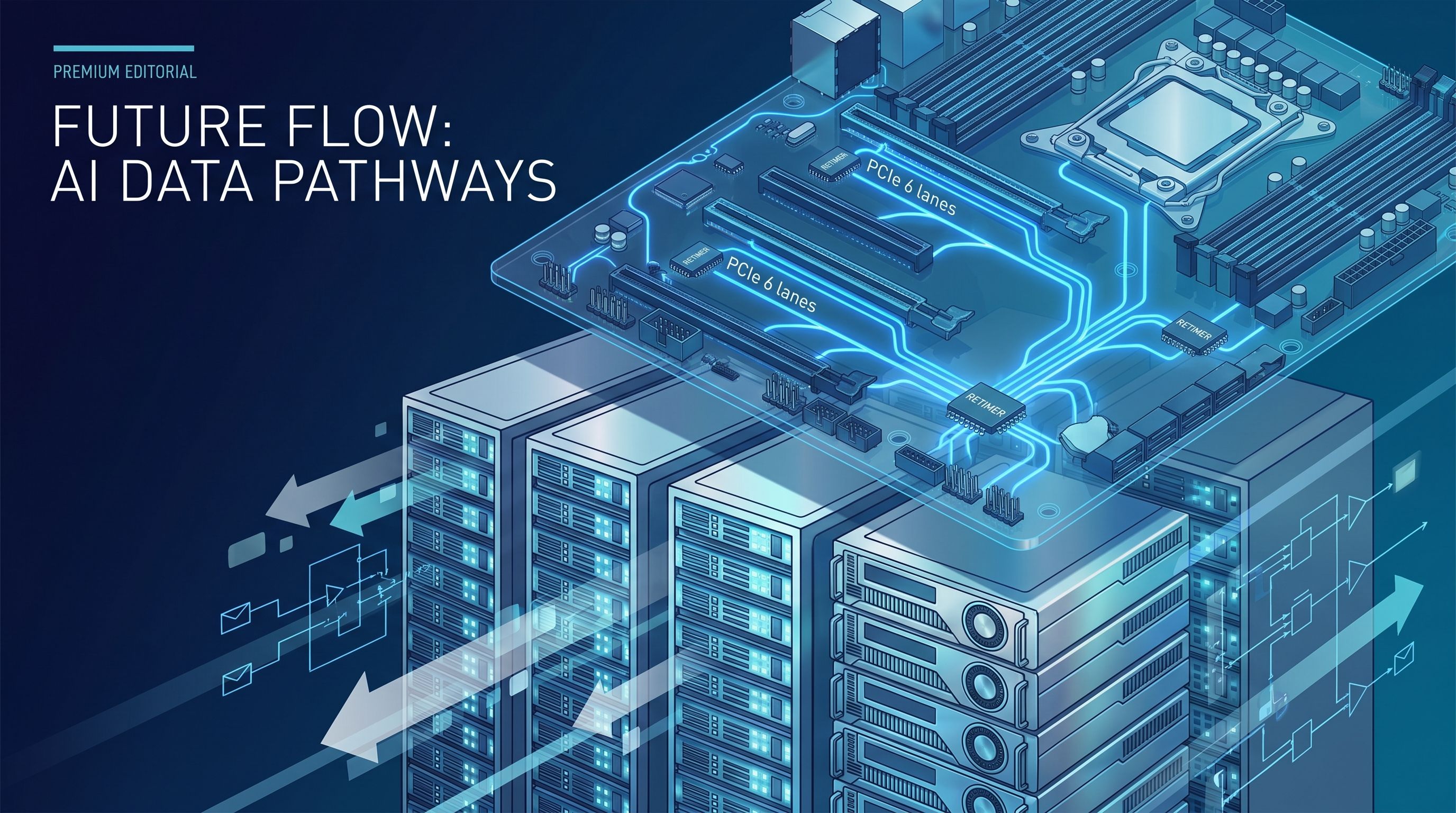
PCIe 6.0 is arriving with the kind of headline number infrastructure teams cannot ignore. It doubles per-lane throughput to 64 GT/s and can deliver up to 256 GB/s on an x16 link. For AI servers that need to move data between GPU, CPU, SSD, NIC, and accelerator domains, that leap matters. The catch is that the interface does not scale like earlier PCIe generations. The bandwidth gain comes with a much harsher signal environment, and that is pushing retimers from a supporting component into a board-level bottleneck.
This is not a consumer PC story, at least not yet. The immediate pressure is inside data center and hyperscale systems, where motherboard traces are long, topologies are dense, risers are common, and expansion plans increasingly include both high-performance networking and memory-coherent fabrics. In that environment, PCIe 6.0 is not just a faster interconnect. It is a signal integrity problem that shapes the physical architecture of the entire server.
PAM4 changes the cost of every inch on the board
The main reason is PAM4. Earlier PCIe generations used simpler signaling that gave platform designers more margin to work with. PCIe 6.0 reaches its higher transfer rate by using PAM4, which encodes more information in each symbol. That is essential for pushing throughput higher without an equally dramatic jump in frequency, but it also makes the link more sensitive to loss, noise, reflections, crosstalk, and layout imperfections.
In practical terms, every connector, via transition, cable assembly, and stretch of PCB routing becomes more consequential. The channel budget tightens. Designs that were merely demanding in PCIe 5.0 can become uncomfortable in PCIe 6.0, especially in multi-GPU servers where the board is already packed with high-speed interfaces competing for space and escape routing.
That is where retimers enter the conversation. A redriver can amplify and condition a weakening signal, but a retimer goes further. It regenerates and retimes the data stream, effectively rebuilding link quality at an intermediate point. At PCIe 6 speeds, that difference matters. Many server designs that might once have used simpler components now need retimers to preserve margin across realistic system distances and mechanical constraints.
Retimers are no longer optional plumbing
Retimers have been discussed for years as an enabling component for difficult links, but AI infrastructure is turning them into a mainstream architectural dependency. A modern AI server often combines multiple GPU cards or GPU modules, high-lane-count switches, fast NICs, and NVMe storage, sometimes across risers or modular trays. The logical diagram may look clean, yet the electrical reality is crowded and unforgiving.
Once retimers become necessary at several points in the topology, they stop being invisible plumbing. They affect board area, power delivery, thermal design, qualification effort, firmware validation, and bill of materials. They can also shape physical placement decisions. If the cleanest routing path still exceeds what the channel can tolerate, the retimer location begins to dictate where other subsystems can live.
That is why the bottleneck is not only about raw bandwidth. It is about the number of places where designers are forced to spend complexity just to keep the promised bandwidth usable. When a platform team wants more GPUs, more SSDs, or more flexible front-panel and rear-panel I/O, the limiting factor may no longer be lane count alone. It may be whether the system can preserve a healthy PCIe 6 channel without adding so many retimers that the design becomes harder to cool, validate, and manufacture.
FLIT mode and low-latency FEC improve reliability, not physics
PCIe 6.0 includes important mechanisms that help make the new signaling model viable. FLIT mode and low-latency FEC are part of the package that improves link reliability at these speeds. They are essential features, and they help the ecosystem move forward with a more demanding electrical layer.
But they do not erase the board-level problem. Reliability features help recover from the realities of a difficult link; they do not make loss, noise, or poor topology disappear. In other words, protocol advances reduce fragility, but they do not remove the need for careful channel engineering. Retimers remain one of the most practical tools for restoring signal quality when the physical path gets too ambitious.
This distinction matters because PCIe 6.0 marketing can sound like a straightforward generational upgrade. For software teams consuming the platform, it may feel that way. For hardware teams building dense AI systems, it does not. The protocol is smarter, but the board is still harder.
CXL raises the strategic value of clean PCIe 6 links
The retimer issue becomes even more important because PCIe 6.0 is also part of the foundation for newer CXL deployments. As server vendors think beyond basic peripheral attachment and toward more composable memory and accelerator architectures, the quality of the underlying PCIe 6 fabric matters more strategically.
CXL adoption raises the cost of instability. If the same high-speed physical layer is expected to support not only traditional I/O but also memory-coherent communication patterns, then margin problems are no longer just annoying validation bugs. They become blockers for broader platform roadmaps. That makes retimer selection, placement, interoperability testing, and thermal behavior more central to long-range server design.
This is one reason the early pain is concentrated in hyperscale and advanced data center hardware. Those buyers are the first to push lane density, board complexity, and expansion ambitions far enough to expose the tradeoffs. Consumer desktops can talk about PCIe 6 eventually, but they are not yet where the hardest electrical constraints are being felt.
Actionable takeaways for server designers and buyers
- Treat retimers as an architectural decision early. Do not leave them as a late-stage fix after routing gets difficult.
- Budget for signal integrity, not just bandwidth. A PCIe 6 lane map is incomplete without realistic channel assumptions.
- Differentiate retimers from redrivers clearly. At these speeds, the simpler component is often not enough for server-class reach and topology.
- Validate thermals and interoperability together. Retimers add both electrical resilience and system-level complexity.
- Plan PCIe 6 and CXL together. If CXL is on the roadmap, clean PCIe 6 implementation becomes more valuable, not less.
- Expect the first serious constraints in AI and hyperscale platforms. That is where dense GPU, NVMe, and fabric-heavy designs force the issue first.