NVIDIA's Blackwell Architecture Is Rewriting Data Center Economics
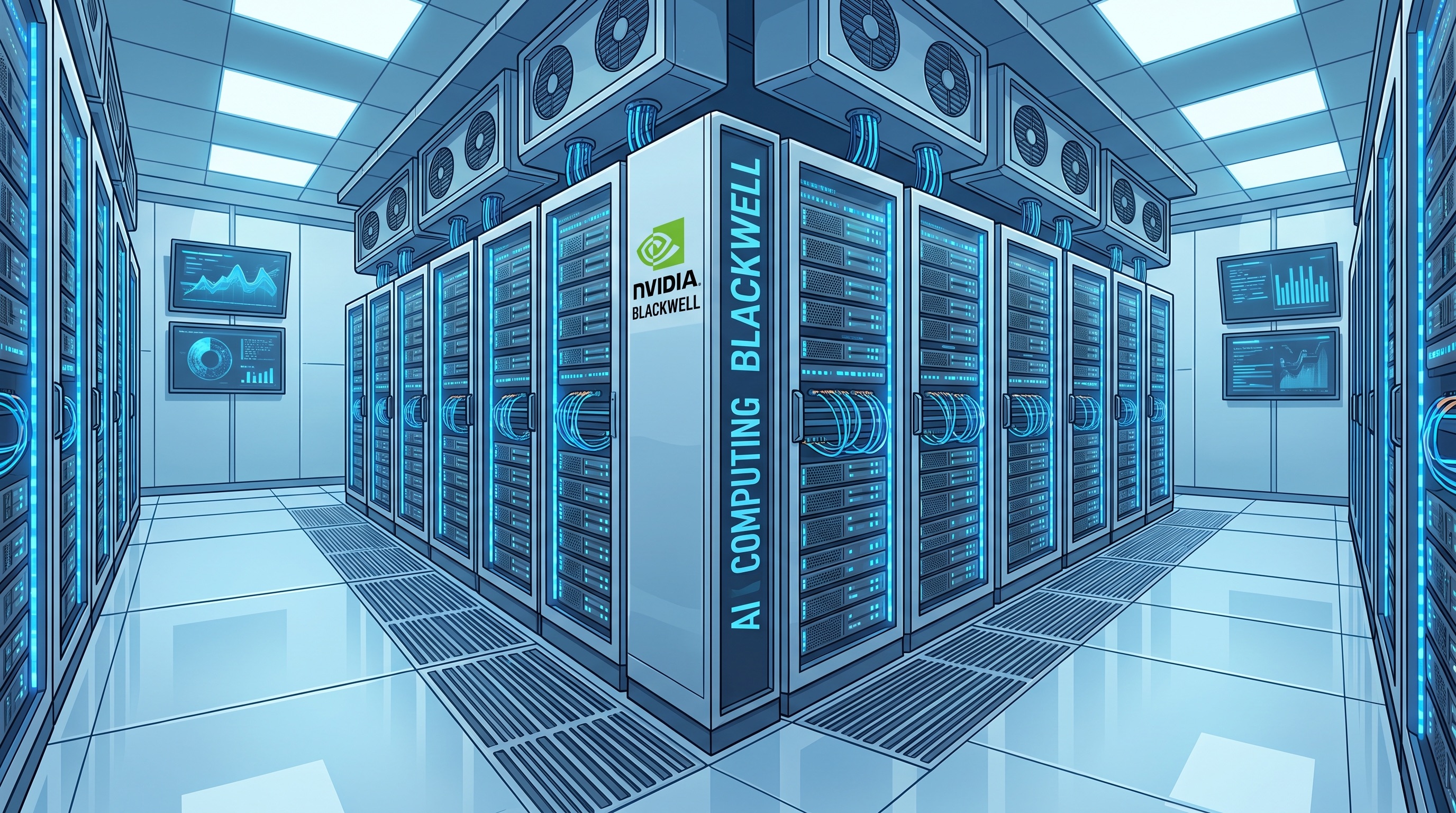
When NVIDIA introduced the Blackwell architecture in 2024 and began shipping at scale through 2025 and 2026, the conversation initially focused on benchmark numbers. That framing missed the more important story: Blackwell did not just push AI performance higher, it restructured the economics of AI compute so fundamentally that it is forcing changes at every layer of the stack — from how data centers are designed to how AI companies price their APIs.
This is not a product refresh. It is a renegotiation of who can afford to compete at the frontier of AI.
What Blackwell Actually Delivers
The B200 GPU delivers roughly 20 petaFLOPS of BF16 training throughput, approximately 2.5x the throughput of its H100 predecessor at comparable power envelopes. The more significant number is memory bandwidth: HBM3e on the GB200 delivers 8 terabytes per second across the NVLink interconnect — nearly twice the bandwidth of Hopper-generation systems.
The architectural shift that matters most for data center design is that NVIDIA has moved the fundamental unit of compute from the chip to the rack. The GB200 NVL72 is a 72-GPU rack system delivering 1.4 exaFLOPS of AI inference compute, linked via NVLink at a speed that makes the 72 GPUs behave like a single unified memory pool. Training a frontier model used to require stitching together thousands of discrete chips over InfiniBand. Blackwell-generation systems collapse much of that complexity into a rack-scale building block.
The Power Problem Nobody Is Advertising
The GB200 NVL72 rack draws approximately 120 kilowatts. A modest 10-rack deployment draws 1.2 megawatts. At scale, a facility with 1,000 such racks demands 120 megawatts — roughly equivalent to the power consumption of a small city.
Data centers built in the Hopper era were designed for 30-40 kW per rack. Retrofitting existing infrastructure for Blackwell power densities requires replacing cooling systems, upgrading power distribution, and in many cases rebuilding the facility from the ground up. This is why hyperscalers are not just buying GPUs — they are committing to multi-billion dollar infrastructure upgrades that take two to four years to complete.
The capital requirement is now so large that it functions as a structural barrier to entry. Building a competitive AI training cluster is no longer primarily a chip procurement question. It is a real estate, energy, and financing question.
What This Does to Economics
Training cost per token has fallen dramatically with each GPU generation. Estimates put the cost reduction from H100 to B200 at roughly 5-10x for equivalent model quality, depending on workload. This has driven API prices down substantially — OpenAI, Anthropic, and Google have each cut inference pricing by 80-90% since 2023.
But cheaper inference has not reduced total AI spending — it has increased it. Lower per-token costs enable new applications that were previously uneconomical, driving higher total volume and, ultimately, higher total infrastructure spend. This is the Jevons paradox applied to AI compute: efficiency gains increase demand, not just affordability.
For the hyperscalers — Microsoft Azure, Google Cloud, Amazon Web Services — this dynamic is favorable. They have the capital to buy Blackwell systems at scale, the existing data center footprints, and the customer relationships to fill the compute with demand. Microsoft and Google each guided over $80 billion in capital expenditure for 2025, with 2026 numbers expected to exceed that.
The Widening Gap Between Tiers
A company that was building competitive AI training infrastructure in 2022 with H100 clusters is now effectively falling behind without a Blackwell upgrade. And the upgrade is not incremental — it requires new power infrastructure, new cooling, new networking, and a substantially larger capital commitment. Smaller clouds that cannot afford the upgrade are increasingly pivoting to inference-only workloads and specialized niches rather than competing on general AI training.
Sovereign AI programs — national AI efforts in France, the UAE, Japan, Saudi Arabia, and India — face the same constraint. Governments that want domestic AI compute capability face infrastructure bills that were feasible with Hopper but require substantially more capital with Blackwell.
NVLink Fusion and the Ecosystem Play
Beyond raw hardware specs, NVIDIA is strengthening its ecosystem moat with NVLink Fusion, a platform that allows third-party chips — including Marvell's XPUs — to connect to NVIDIA GPUs as first-class peers rather than secondary accelerators. This makes NVIDIA the hub of hybrid AI infrastructure rather than a chip that can be displaced by a competing chip.
Actionable Takeaways
- Renting beats owning for inference at most scales. Unless you are running sustained, predictable inference at hyperscale, the economics of renting GPU compute from a cloud provider with Blackwell clusters are better than buying your own.
- Training clusters are a different calculation. If you are training frontier-scale models with sustained demand, owning dedicated infrastructure makes more sense — but the minimum viable cluster size is larger with Blackwell than with Hopper.
- Watch the pricing war between hyperscalers. AWS, Azure, and Google are all racing to deploy Blackwell and lower inference prices. The next 12 months will see continued price pressure that benefits API consumers.
- Power is the bottleneck, not chips. If you are in the data center business, power capacity and cooling infrastructure are now the critical constraint — not GPU availability.
The headline story of Blackwell is that it is faster than what came before. The real story is that it has made AI compute more capital-intensive, more concentrated, and more dependent on energy infrastructure than any previous generation. That reshapes competitive dynamics for years to come.