Neuro-Symbolic AI Is Returning as an Enterprise Efficiency Play
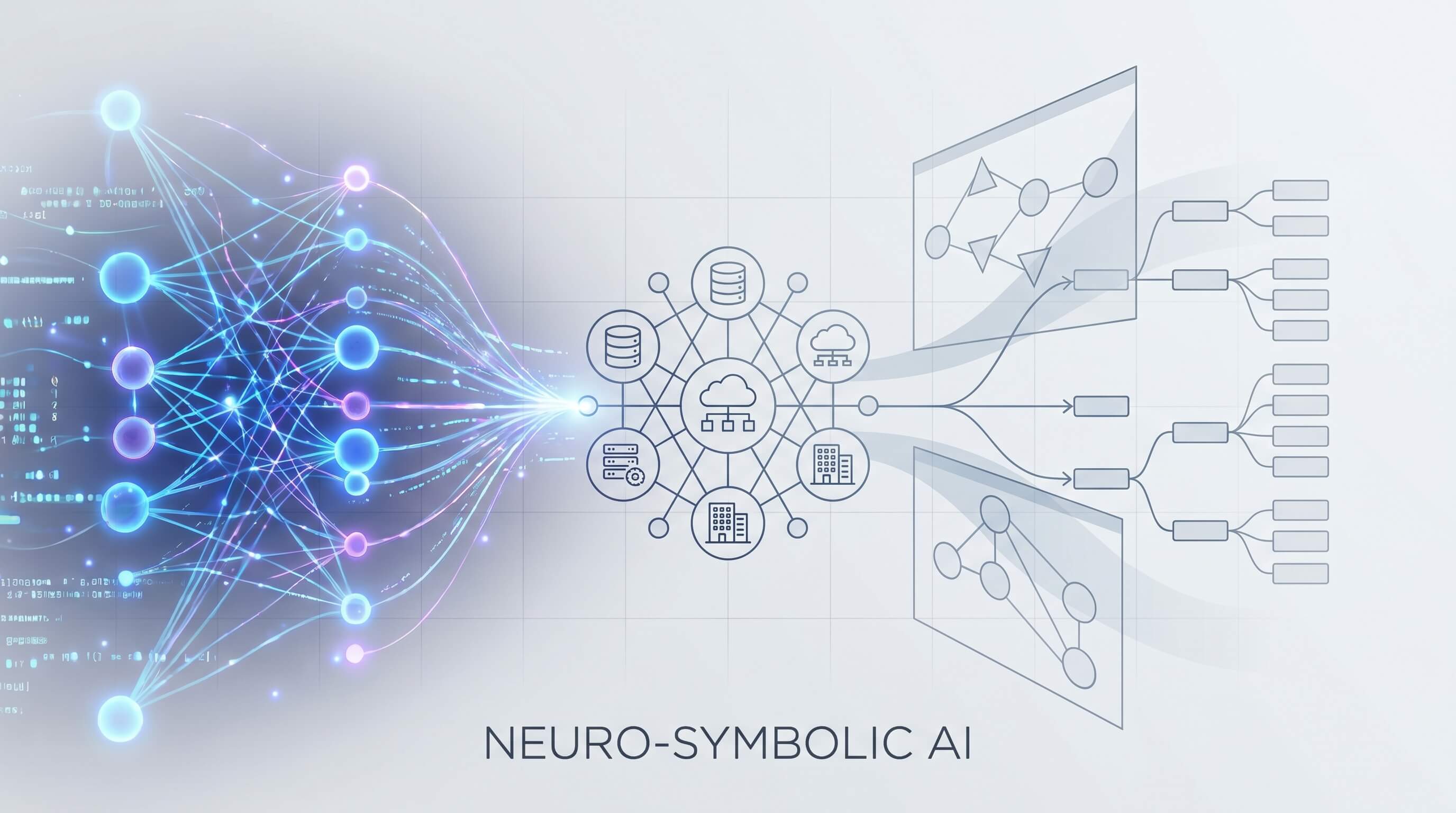
Neuro-symbolic AI is back in serious conversation, but not for the reason many people expected. A few years ago the phrase mostly surfaced in research circles, usually framed as a possible long-term bridge between statistical learning and formal reasoning. In 2026 the renewed interest is more pragmatic. Enterprises are revisiting neuro-symbolic approaches because the economics of large-scale inference, the need for traceable decisions, and the limits of brute-force prompting are pushing teams toward systems with more structure.
That shift matters because many real business workloads do not reward raw generative fluency alone. They reward consistency, controllable reasoning paths, lower compute cost, and outputs that can be checked against policy or domain rules. In those settings, neuro-symbolic design is no longer a curiosity sitting next to mainstream AI. It is becoming one of the more credible answers to a blunt question executives are now asking: how do we get useful reasoning without paying for endless tokens and endless risk?
Why the timing changed
The first reason for the comeback is cost pressure. The industry spent two years proving that giant models can do impressive work, then discovered that many enterprise tasks are too repetitive and too margin-sensitive to run as open-ended conversations forever. A support workflow, claims review, compliance screening process, or procurement assistant often needs bounded reasoning more than expansive creativity. When every step is handled by a large model with little structure, teams end up paying for over-generation, rechecking, retries, and prompt scaffolding that behaves like hidden operational debt.
Neuro-symbolic systems offer a different tradeoff. They use machine learning where perception, retrieval, ranking, or language flexibility matter, then rely on explicit representations such as rules, typed entities, knowledge graphs, planners, or constraint solvers where the problem benefits from structure. That can reduce the amount of expensive inference needed to reach a dependable result. Instead of asking a model to improvise an entire chain of reasoning every time, the system can route parts of the task through reusable logic.
The second reason is reliability. Enterprises are learning that a confident answer is not the same thing as an operationally safe answer. When a system touches finance, healthcare, law, industrial operations, or regulated customer workflows, teams need to understand why a decision was made and whether it violated any hard constraints. Purely neural systems can be powerful, but they are often awkward when a company needs strict rule handling, explicit exceptions, or defensible audit trails.
Where structure helps most
Neuro-symbolic design is especially useful when the task mixes ambiguity at the edges with precision in the middle. Document intake is a good example. A model may be excellent at reading messy human language, classifying intent, or extracting fields from semi-structured text. But once the system has identified the relevant entities, symbolic layers can validate relationships, enforce business logic, and flag contradictions. That hybrid design often produces a result that is both flexible and easier to trust.
Another strong fit is enterprise search and question answering over proprietary knowledge. A language model can interpret a user query and retrieve relevant materials, but a symbolic layer can help represent organizational relationships such as who owns a process, which policy supersedes another, or which product dependency blocks an action. That matters because many enterprise failures come from relationship errors rather than language errors. The model may understand the words while still missing the structure of the business.
This is also why interest in knowledge graphs has revived around AI programs. They are not returning as standalone magic databases. They are returning as scaffolding for systems that need grounded entities, durable links, and controlled reasoning paths. In practical terms, that can mean fewer hallucinated joins, cleaner source attribution, and better behavior when the same concepts appear across multiple systems with slightly different labels.
Efficiency is about more than smaller models
It is tempting to frame the trend as a simple cost-saving move away from giant models, but that is too narrow. The real efficiency gain often comes from deciding which parts of a workflow should not be solved by free-form generation at all. A symbolic planner can determine sequence. A rule engine can reject impossible outputs. A graph traversal can answer a relationship question directly. A constraint solver can narrow the search space before a model ever generates text. Each of those choices reduces waste because the model is used where it has comparative advantage, not where it is merely available.
That can make smaller models more useful as well. Once the surrounding system supplies structure, the model does not need to carry the whole cognitive burden alone. It may only need to map user language into a formal intent, summarize evidence, or produce a final explanation. This is one reason the neuro-symbolic conversation now aligns with enterprise AI budgets. Companies are not just asking how to buy more intelligence. They are asking how to engineer enough intelligence for the task.
Why auditors and operators like the idea
The operational appeal is straightforward. Symbolic components create surfaces that teams can inspect. They can review a rule set, compare graph relations, analyze planner steps, or test a constraint library against known edge cases. That does not eliminate risk, but it changes the debugging experience from pure behavioral observation to partial system inspection. For governance teams, that is a meaningful improvement.
It also helps with failure containment. When a hybrid system goes wrong, the error is sometimes easier to localize. Did extraction fail, did entity resolution merge the wrong records, did retrieval bring the wrong policy, or did a rule incorrectly fire? In a fully end-to-end setup, those failure modes often blur together. In a structured system, teams have a better chance of measuring where quality breaks and fixing that layer without retraining everything.
What the approach still does badly
None of this means neuro-symbolic AI is a universal upgrade. The biggest risk is complexity. Hybrid systems can turn into architecture diagrams that look rigorous but are brittle in practice. If the symbolic side is poorly maintained, overfit to outdated rules, or disconnected from how work actually happens, it becomes a bottleneck that users route around. If the neural side is weak, the structured layers simply formalize bad inputs.
There is also a talent problem. Building good neuro-symbolic systems requires teams that understand data, modeling, domain semantics, and software architecture together. That mix is harder to staff than a straightforward API integration. The winners are usually the organizations with a clear target use case and a reason to pay the design cost, not the ones adopting the label as a branding exercise.
What enterprises should do next
For enterprise teams, the practical move is not to announce a grand neuro-symbolic strategy. It is to find one workflow where free-form generation is expensive, hard to verify, or too inconsistent for production. Then ask which reasoning steps can be externalized into structure. Often the first wins come from modest interventions: entity schemas, explicit approval rules, graph-backed retrieval, or planners that constrain multi-step execution.
The broader lesson is that AI architecture is entering a more disciplined phase. The market is moving from admiration of raw capability toward scrutiny of cost, reliability, and operational fit. Neuro-symbolic AI fits that moment because it treats reasoning as something that can be designed, not just sampled. That is why it is returning now. Not as a romantic idea from an earlier research era, but as a practical way to make enterprise AI cheaper to run, easier to trust, and harder to break.