Multi-CDN architectures are becoming the new uptime baseline
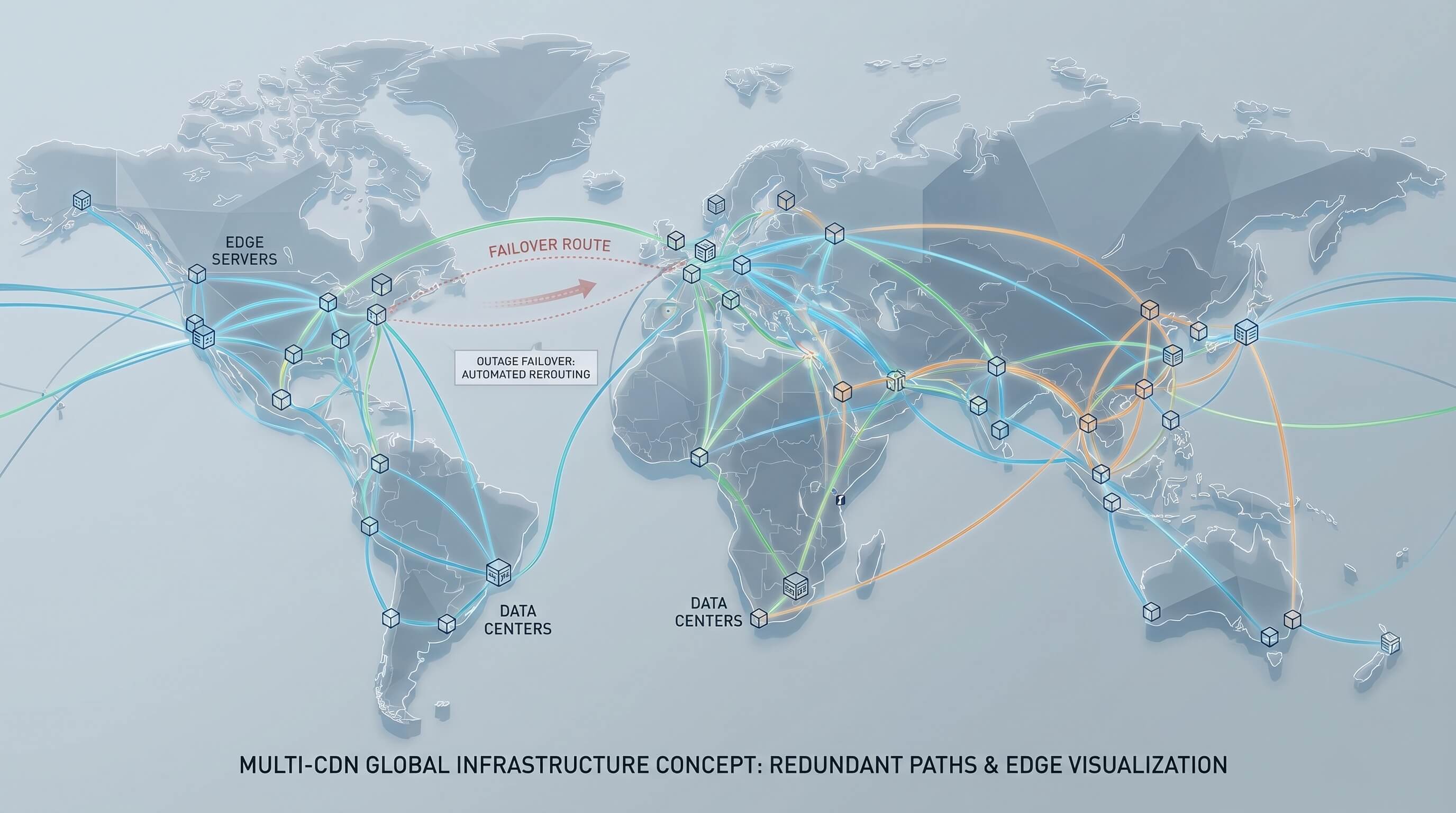
Multi-CDN used to be the sort of thing large media platforms bragged about in architecture talks. For most companies, a single CDN plus some hope felt good enough. That assumption is getting harder to defend. After a year packed with cloud disruptions, DNS mistakes, and stubborn regional performance problems, the bigger question is no longer whether multi-CDN is elegant. It is whether a modern internet business can justify not having it.
The case is getting stronger because website availability is no longer just about serving static assets quickly. AI features, personalized storefronts, streaming interfaces, SaaS dashboards, and API-heavy applications have made the edge far more important to product quality. If the delivery layer slows down or fails, the customer does not experience a partial outage. They experience a broken product.
Why one CDN is starting to look like a concentration risk
Fastly, in a recent architectural write-up, framed multi-CDN as a resilience decision rather than a performance luxury. That is an important shift. A single provider can still offer excellent global reach, DDoS mitigation, WAF controls, and caching performance. But even strong providers have bad days, and the internet has supplied plenty of reminders.
Cisco ThousandEyes, in its review of major 2025 outages, highlighted incidents across services including Slack, Zoom, Google Cloud, Cloudflare, Azure, and AWS DynamoDB. The specific root causes varied, from configuration errors to DNS failures to backend routing problems. The common lesson was simpler: dependency chains are fragile, and users do not care which vendor in the stack failed.
That fragility matters more when a single CDN sits in front of customer login flows, media delivery, API acceleration, bot filtering, and edge logic. A provider outage is one risk. A regional routing problem is another. So is a pricing change, a feature regression, or a compliance requirement that forces traffic policy changes. Multi-CDN does not remove operational complexity, but it can stop one vendor issue from becoming an all-hands customer incident.
Resilience is only half the story
The strongest argument for multi-CDN is failover, but performance is often the everyday reason teams stick with it. Different CDN networks are strong in different places, under different peering conditions, and for different traffic profiles. One provider may handle API-heavy traffic better in North America, another may deliver video more efficiently in parts of Europe, and another may have stronger economics for bursty traffic in Asia.
That makes traffic steering a product decision as much as an infrastructure decision. DNS-based steering is still the most common starting point because it is comparatively easy to implement. More advanced shops layer in health checks, weighted routing, real user monitoring, and application-level traffic management so they can steer based on real conditions instead of static assumptions.
The business effect is easy to miss if you look only at uptime percentages. A site can be technically available and still feel slow enough to lose conversions. A multi-CDN setup lets teams optimize for latency and regional consistency, not just disaster recovery. That matters more when AI features increase payload sizes, introduce more dynamic requests, and make interfaces more sensitive to network jitter.
The AI era is quietly making edge architecture harder
AI is often discussed as a model or GPU story, but it is also a traffic-shape story. AI summaries, image generation, retrieval layers, chat interfaces, and inference APIs create new request patterns at the application edge. They also make users less tolerant of waiting because the interface increasingly feels conversational and stateful.
That changes what "good enough" means for web delivery. A few extra seconds on an ecommerce category page is bad. A few extra seconds on an AI-assisted workflow can make the whole system feel unreliable. Human Security recently argued that automated and AI-related traffic is growing much faster than ordinary human traffic. Whether a company is dealing with helpful bots, scraping, agents, or model-connected workflows, its traffic mix is becoming less predictable and harder to secure with one-size-fits-all assumptions.
Multi-CDN helps here in two ways. First, it creates more room to match traffic classes to infrastructure characteristics. Second, it reduces the blast radius when one provider's edge logic, anti-bot tooling, or regional footprint behaves badly under unfamiliar workloads.
What companies get wrong when they adopt multi-CDN
The easiest mistake is treating multi-CDN as a box-ticking exercise. Simply pointing DNS at two providers is better than nothing, but it does not guarantee clean failover. Short TTLs, origin shielding, cache coherence, TLS configuration, observability, and runbooks matter. If the backup path has never been exercised under real load, it is not really a backup.
The second mistake is overengineering too early. Not every company needs client-side steering, multiple traffic managers, or a deeply customized routing brain on day one. A sensible path is to start with clear business requirements: which user journeys are revenue-critical, which regions need protection, what latency thresholds matter, and how much operational complexity the team can actually own.
A practical rollout often looks like this: begin with a second CDN for high-value properties, add health-aware steering, separate static and dynamic traffic policies, then use observability data to decide where more sophistication is justified. That gives teams a resilience gain without turning edge networking into its own full-time product.
Uptime is becoming a portfolio strategy
The broader shift is that reliability is increasingly managed like an investment portfolio. Companies are diversifying cloud providers, database replicas, model suppliers, and now delivery networks. That is not because every vendor is failing. It is because digital businesses have learned how expensive concentration risk becomes once customers depend on them continuously.
For media companies, SaaS vendors, retailers, and any platform building AI features into its front end, multi-CDN is moving from advanced optimization to baseline risk management. Not every company needs a globally tuned, four-provider edge strategy. But many more companies now need at least a credible second path.
The real lesson from the last year of outages is not that the internet is broken. It is that the internet is layered, interdependent, and economically unforgiving when one layer goes sideways. Multi-CDN is not glamorous, and it is not free. But in 2026, it increasingly looks like the price of building a product that stays up when customers expect it to.