Multi-Agent AI Systems Are Running Into a Coordination Tax Nobody Priced In
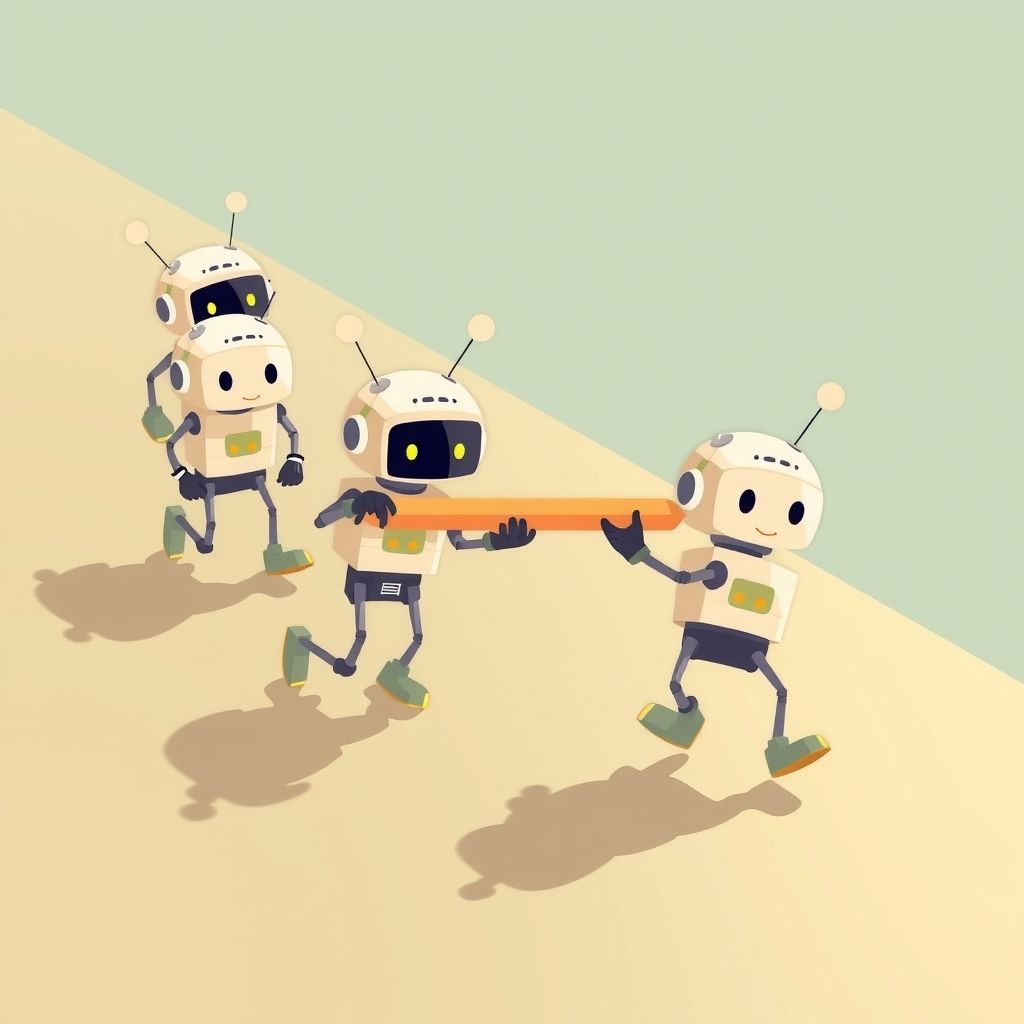
Enterprise teams building with AI agents have converged on an assumption borrowed from human org charts: more specialized workers, better outcomes. Split a task across a planner agent, a researcher agent, a coder agent, and a reviewer agent, and the thinking goes that each one, focused on a narrower job, will outperform a single generalist model doing everything. Recent research into production multi-agent systems says otherwise — and the gap between the pitch and the reality is becoming an expensive surprise for the teams finding out the hard way.
A widely circulated academic study on multi-agent coordination found that splitting work across agents does not scale the way org-chart intuition suggests. In environments with more than ten available tools, multi-agent setups showed sharply reduced efficiency compared to simpler architectures. The researchers traced the cause to context fragmentation: when a task is divided among agents, each one operates with a partial, independently-compressed view of the problem, and critical details get lost or distorted in the handoff. Communication overhead between agents doesn't grow linearly with team size — it grows super-linearly, meaning a five-agent pipeline isn't modestly more chatty than a two-agent one, it's disproportionately so.
The Tax Nobody Puts on a Line Item
Consultancies have started calling this the "multi-agent tax" or "orchestration tax," and the description is apt: it behaves like a tax because it's levied automatically, scales with activity, and rarely shows up as its own budget line. One widely cited estimate puts the overhead of an orchestrator layer at 30–50% more LLM calls than an equivalent single-pipeline design — calls that exist purely to pass state between agents, resolve disagreements, and re-request context that got dropped in a handoff.
That overhead is easy to miss because it doesn't arrive as a distinct invoice. It's distributed across every agent's token count, making a multi-agent system's true cost look like "the API bill went up" rather than "coordination is eating 35% of our spend." Teams that don't instrument coordination calls separately from task-execution calls are flying blind on exactly the metric most likely to blow their unit economics.
Where the Break-Even Point Actually Sits
Practitioner consensus — still more anecdotal than benchmarked, since no rigorous public benchmarks exist yet for 2026 production deployments — places the sweet spot at two to three well-defined agents for most workflows. Beyond three or four, the cost of handoffs (re-stating context, re-validating assumptions, resolving conflicting outputs) tends to outpace the marginal benefit of specialization. This mirrors a pattern familiar from distributed systems generally: splitting work across more nodes helps until coordination cost overtakes the parallelism gained, at which point adding nodes makes the system slower and more expensive, not faster and cheaper.
The failure mode is rarely dramatic. It shows up as agents that technically complete their assigned subtask correctly but produce a worse overall result than a single model would have, because the handoff lost nuance that mattered for the next stage. A researcher agent that correctly summarizes ten sources but drops the one caveat the writer agent needed is a textbook case — every individual agent "worked," and the system still failed.
What This Means for Teams Building Agent Systems Now
Three practical adjustments follow directly from this research:
- Instrument coordination separately from execution. Tag and track tokens spent on inter-agent messages, state-passing, and conflict resolution as their own cost category. If you can't see the number, you can't manage it.
- Default to fewer agents with wider scope, not more agents with narrower scope. Test whether a two-agent design with slightly less specialization beats a five-agent design before committing to the more elaborate architecture. The research suggests it often will.
- Treat tool count as a design constraint, not a feature count. The sharpest efficiency drop-off in the cited research appeared once systems crossed roughly ten available tools. If your agent swarm needs more than that, the fix is usually better tool curation per agent, not adding another agent to manage the sprawl.
None of this means multi-agent architectures are a dead end — plenty of workflows genuinely benefit from specialization, particularly ones with natural, low-overlap boundaries (a code-writing agent and a test-running agent rarely need to renegotiate shared context). The lesson is narrower and more useful than "agents don't work": coordination has a real, measurable cost that most teams are currently absorbing silently, and the architectures that win in 2026 will be the ones that treat that cost as a design variable from the start, not a surprise discovered in the first production invoice.