Model Context Protocol Is Turning AI Tooling Into a Real Developer Stack
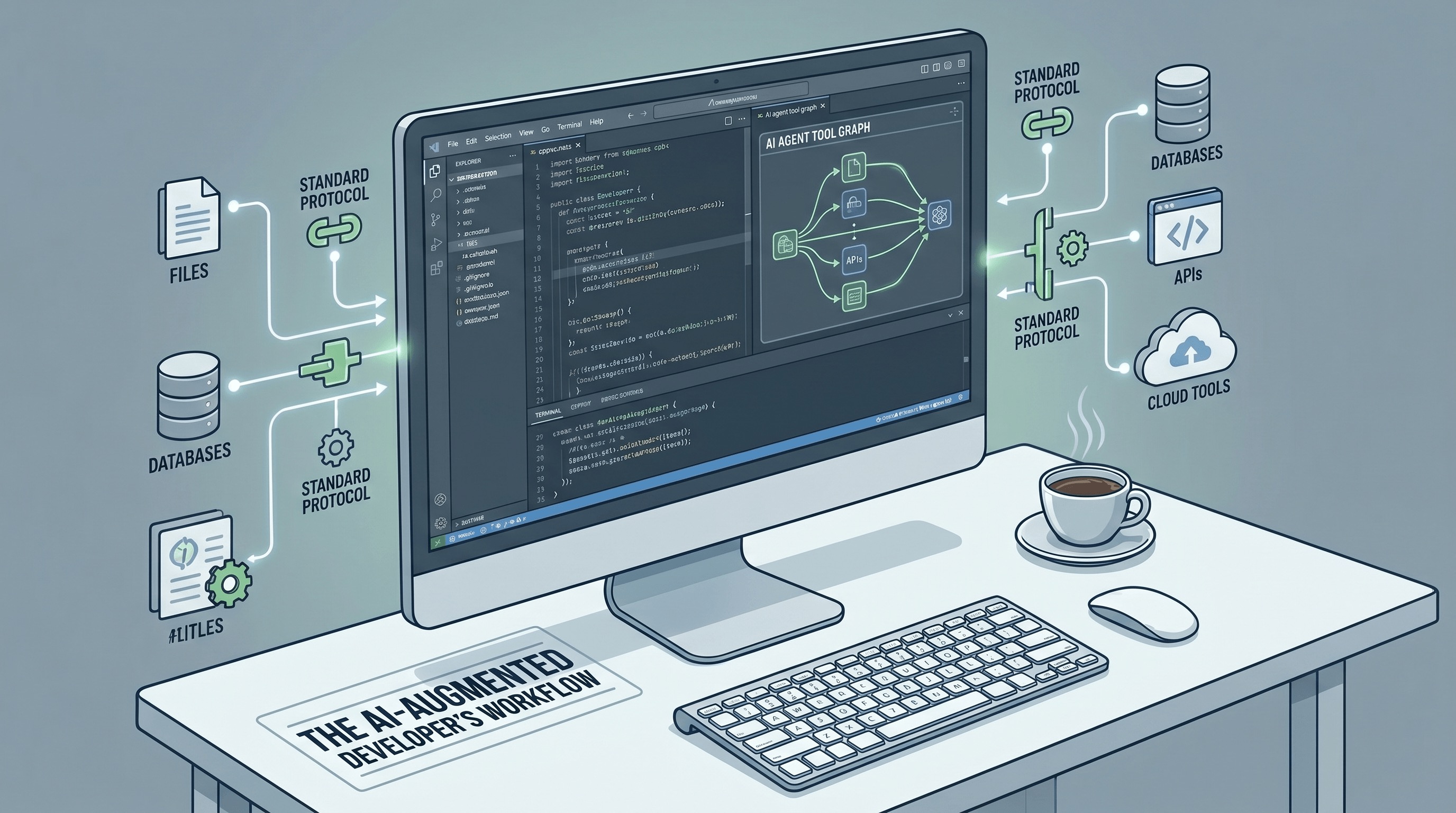
The proliferation of AI agents and specialized AI tools has brought immense potential, but also significant fragmentation. Developers building with AI have often found themselves mired in custom integrations, bespoke API calls, and a lack of interoperability that hinders scalability and reusability. This is precisely where the Model Context Protocol (MCP) emerges as a pivotal innovation. The real significance of MCP is not merely that it helps an AI use one more tool; it creates a shared, standardized integration layer that can transform fragmented agent experiences into a durable, composable, and portable developer platform.
MCP is rapidly becoming the foundational contract layer that makes AI developer tools truly composable, governable, and portable across diverse clients and environments. Often likened to a USB-C port for AI applications, MCP provides a universal specification for how AI models can discover, understand, and interact with external systems. This standardization is critical, moving AI integration beyond one-off glue code and into an ecosystem pattern, a shift that promises to do for agent tooling what robust APIs did for the broader cloud software industry.
The Challenge of Fragmented AI Tooling
Before MCP, integrating AI models with external tools was largely an ad-hoc process. Each AI application or agent required specific code to call different APIs, parse varied responses, and manage tool state. As the number of available tools grew, this approach became unsustainable. The 'tool problem' for AI agents is multifaceted: it involves not just connecting to a tool, but enabling the AI to dynamically select the right tool for a task, understand its capabilities and limitations, and execute complex sequences of operations. Without a common language, this became a bottleneck, limiting the sophistication and breadth of AI agent capabilities.
Furthermore, the scaling problem for large tool libraries is non-trivial. As Anthropic's research on advanced tool-use has highlighted, simply providing an AI with access to a massive list of tools can consume enormous context windows, leading to increased token overhead, slower inference, and reduced accuracy. The AI must not only process the task but also sift through a vast amount of tool documentation or API schemas to determine relevance. This inefficiency underscores the need for a more intelligent, on-demand approach to tool discovery and invocation.
MCP as a Standardized Interaction Contract
MCP addresses these challenges by providing an open-source standard that defines a common interface for AI applications to interact with external systems. It specifies how tools can describe themselves, how AI models can query for available tools based on intent, and how they can programmatically invoke those tools. This goes beyond simple API wrappers; MCP establishes a semantic layer, allowing AI agents to reason about tool capabilities and make more informed decisions about their use.
This standardized contract layer enables a paradigm shift. Instead of developers writing custom adapters for every tool and every AI model, tools can expose their capabilities via MCP, and AI models can learn to speak the MCP language. This dramatically reduces integration effort, accelerates development, and fosters an environment where tools are inherently interoperable. The protocol facilitates dynamic tool discovery, where an AI agent can, based on its current task and context, request and receive descriptions of relevant tools on demand, rather than having all tools pre-loaded into its context window.
Broad Ecosystem Adoption and Impact
The strength of any protocol lies in its adoption, and MCP has garnered significant support across the AI ecosystem. Major players like OpenAI, Anthropic, and various client-side applications such as Visual Studio Code, Cursor, and even direct integrations with models like Claude and ChatGPT are embracing MCP. This broad support is not coincidental; it reflects a shared industry understanding that a common integration layer is essential for the future of AI development.
OpenAI's 2025 developer recap, for instance, emphasized the importance of agent-native APIs, the evolution of Codex, and explicit support for MCP. This signals a clear strategic shift from merely prompting large language models towards delegating complex work to specialized tools and longer-horizon agents. MCP is foundational to this vision, providing the connective tissue that allows these agents to operate effectively within a rich, interconnected environment of services and applications.
Enabling Composability, Governability, and Portability
MCP's impact can be understood through three critical dimensions: composability, governability, and portability.
Composability
By providing a unified interface, MCP makes tools inherently composable. Developers can build modular tools that expose specific functionalities, knowing that any MCP-compliant AI agent can seamlessly integrate them. This allows for the creation of sophisticated, multi-step workflows where agents can chain together various tools to accomplish complex tasks, much like microservices are composed in modern software architectures. This modularity fosters innovation, as developers can focus on building specialized tools without worrying about the specifics of each AI model's integration requirements.
Governability
A standardized protocol also enhances the governability of AI agent interactions. With MCP, organizations can better monitor, audit, and control how their AI agents interact with external systems. The protocol can incorporate mechanisms for access control, permissions, and logging, providing a clear audit trail of tool invocations. This is crucial for security, compliance, and ensuring that AI agents operate within defined boundaries, especially in sensitive enterprise environments. It moves beyond opaque black-box interactions towards transparent and manageable agent behavior.
Portability
Perhaps one of the most significant benefits of MCP is the portability it offers. Tools built to the MCP standard can function across different AI clients, models, and development environments without requiring significant re-engineering. An agent developed in Visual Studio Code, leveraging MCP-compliant tools, can potentially run with similar efficacy when deployed via a cloud-based AI service or integrated into a custom application. This reduces vendor lock-in, encourages a diverse ecosystem of tools, and allows developers to choose the best AI models and platforms for their specific needs, knowing their tooling investments are protected.
MCP: The Foundation for an AI Developer Stack
The Model Context Protocol is more than just a technical specification; it is the nascent foundation for a true AI developer stack. It provides the missing contract layer that transforms disparate AI capabilities into a coherent, interconnected system. By standardizing how AI agents discover, understand, and interact with external tools, MCP unlocks a new era of intelligent automation and sophisticated AI applications.
As AI continues to evolve from simple conversational interfaces to complex, autonomous agents capable of performing multi-step tasks, the need for robust, interoperable tooling will only grow. MCP is not just facilitating this evolution; it is accelerating it, laying the groundwork for a future where AI development is as structured, scalable, and powerful as traditional software development. The era of the AI developer stack, built on protocols like MCP, has truly begun.