Model Context Protocol Is Becoming Enterprise AI’s Integration Layer
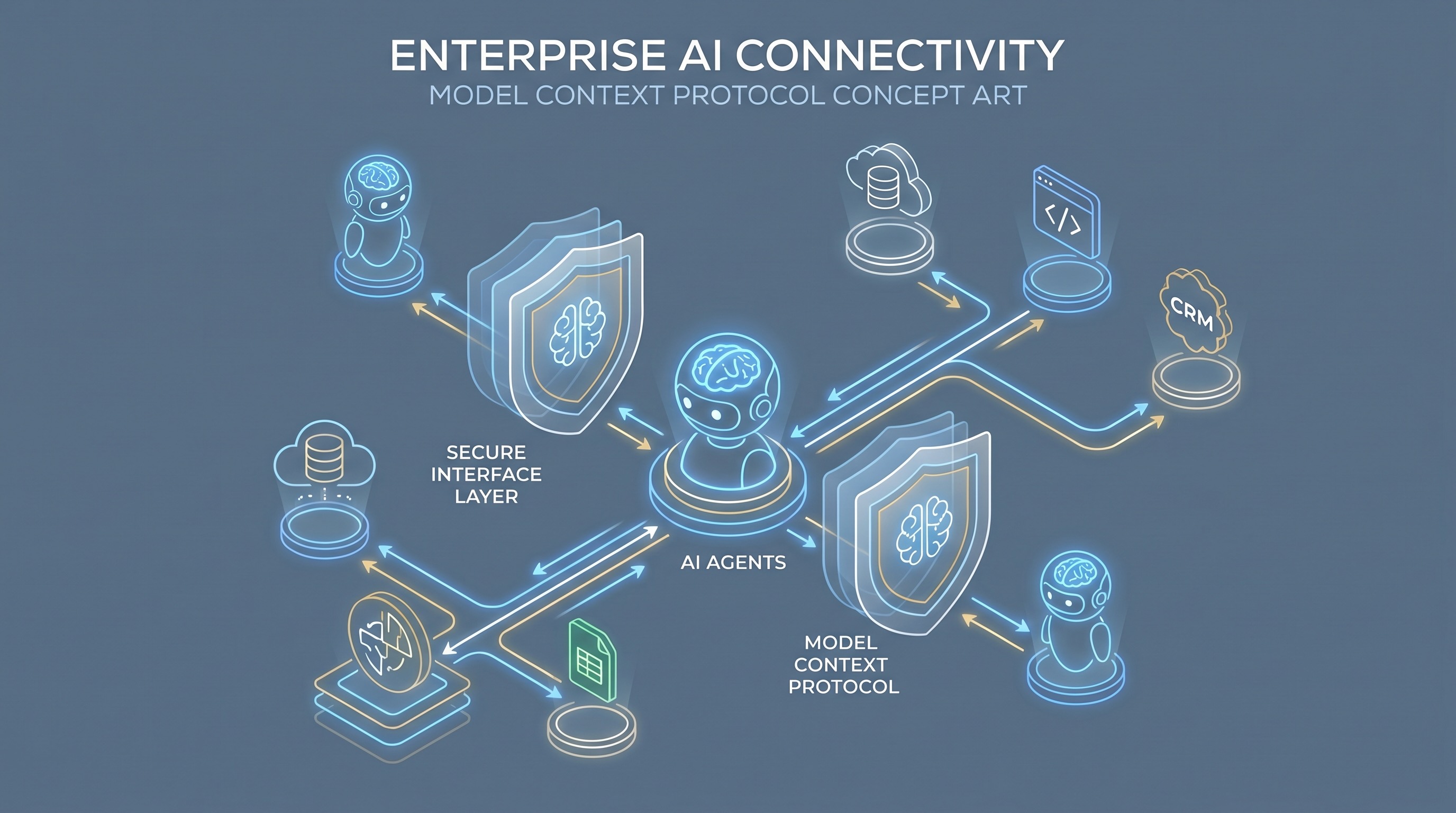
Enterprise AI teams spent the last two years proving that large models can write, summarize, classify, search, and reason well enough to matter. In 2026, the harder problem is no longer getting a model to say something intelligent. It is getting that model to do useful work across real systems without creating an integration mess. That is why Model Context Protocol, or MCP, is starting to matter far beyond developer demos. It is becoming the connective layer that turns isolated copilots into operational software.
The thesis is simple: enterprises do not need one more impressive chatbot that lives in a browser tab. They need AI systems that can reach documents, ticketing queues, CRM records, internal APIs, analytics dashboards, and workflow tools with predictable security and observability. Every custom connector built from scratch slows that down. A shared protocol for tool access does not solve every AI architecture problem, but it solves an increasingly expensive one: how to connect models to the rest of the stack without rebuilding the bridge every time.
MCP matters because integrations became the real deployment tax
Most enterprise AI projects do not fail because the base model is unusable. They stall because production environments are fragmented. A sales assistant needs Salesforce and call transcripts. A support agent needs the knowledge base, product telemetry, and refund tools. A coding assistant needs repository context, issue trackers, and deployment history. The model can be strong, but if each connection requires a bespoke adapter, authentication layer, permission model, retry strategy, and audit path, teams spend more effort on glue code than on product behavior.
That deployment tax gets worse as companies move from one assistant to many. A single internal chatbot can survive on a pile of one-off integrations. A broader agent strategy cannot. Once multiple teams want AI access to the same systems, protocol consistency starts to look less like developer elegance and more like cost control.
What MCP actually changes
At a practical level, MCP creates a standard way for models and agents to discover tools, request context, and invoke actions. That sounds narrow, but the effect is broad. Instead of teaching each model vendor and application team a different custom interface, enterprises can expose approved capabilities through a more uniform contract. In the best case, the model layer becomes less tightly coupled to the application layer.
That decoupling matters for three reasons. First, it improves portability. Teams can swap models or run multiple models for different workloads without rewriting every connector. Second, it improves governance. Security teams can reason about a smaller number of interfaces instead of auditing a growing sprawl of improvised API wrappers. Third, it improves speed. Product teams can assemble new workflows from existing capabilities rather than negotiating new integrations for every experiment.
Why the protocol conversation is really about control
There is a temptation to frame MCP as a convenience feature for agent builders. In enterprise settings, it is closer to a control plane discussion. The moment an AI system can read customer records, trigger refunds, modify documents, or open infrastructure tickets, the integration pattern becomes a security boundary. Who approved the action, what context was exposed, what scope the tool had, and what happened next all need to be inspectable.
This is where standardized access starts to beat ad hoc scripting. A protocol can enforce capability boundaries more cleanly than a rush of custom plug-ins built by different teams under deadline pressure. It also creates a better place to attach logging, policy checks, rate limits, human approval steps, and post-action audit trails. Enterprises are not standardizing tool access because standards are fashionable. They are doing it because agentic systems are making informal trust assumptions too expensive.
MCP will not replace architecture, and that is the point
Some of the hype around enterprise AI interoperability treats protocols as if they will magically make agents reliable. They will not. A protocol does not fix weak prompt design, poor retrieval, broken source data, or unrealistic product ambitions. It does not decide when a human should stay in the loop. It does not create business value by itself.
What it does is remove friction from the part of the stack that keeps getting rebuilt badly. That is often how durable infrastructure wins. Kubernetes did not eliminate application design, but it standardized enough deployment plumbing to change how software teams work. Identity protocols did not eliminate security engineering, but they made federated access manageable at scale. MCP is interesting for the same reason. It is not the product. It is the boring layer that product quality eventually depends on.
Why observability becomes the next battleground
As enterprises adopt more agent workflows, observability becomes as important as access. It is not enough to know that a model called a tool. Teams need to know which instruction triggered the call, what context was passed, whether the result was cached or transformed, whether the agent retried, and whether downstream data changed. Without that visibility, AI systems are hard to debug and even harder to trust.
MCP can help here because a common interaction layer creates a natural place to capture telemetry. That matters for performance, but it matters even more for governance. When an AI workflow produces a bad outcome, teams need to reconstruct the decision path fast. Standardized tool invocation gives them a better chance of doing that than scattered, app-specific integrations hidden behind helper functions.
The vendor angle is bigger than it looks
There is also a market dynamic underneath the technical one. Enterprises do not want to bet their entire AI strategy on a single model provider, single SaaS platform, or single orchestration framework. Even companies that love a current vendor assume the landscape will keep moving. A standard integration layer is attractive because it lowers switching costs and weakens lock-in at the exact point where lock-in tends to harden: data access and workflow execution.
That does not mean vendors will stop competing. It means competition shifts upward. If access to tools becomes more standardized, vendors have to win on reliability, security, latency, developer experience, and workflow quality instead of relying on proprietary connector gravity. That is healthier for buyers, and it is one reason protocol discussions are getting serious attention in boardrooms that would never care about developer standards on their own.
What smart teams should do now
Most companies do not need a sweeping platform rewrite to benefit from this shift. They need an inventory. Which systems are repeatedly requested by AI projects? Which actions are read-only, which are write-capable, and which need explicit approvals? Which integrations already have strong audit logging, and which are still fragile wrappers around internal APIs? Those answers will tell you whether MCP belongs in a pilot, a platform roadmap, or a security review.
The best near-term move is usually to standardize the highest-value, most frequently reused capabilities first. Think search across internal knowledge, ticket creation, CRM lookup, analytics queries, document actions, and controlled workflow triggers. Treat those as productized building blocks, not as one-team hacks. If the organization later expands from copilots to agents, the foundation will already be in place.
The real significance
Enterprise AI is entering the phase where architecture choices matter more than demos. Model quality still matters, but the winners will be the teams that can connect models to the business safely, repeatedly, and with enough visibility to operate them like real software. That is the opening for Model Context Protocol. It gives enterprises a way to make tool use less improvised and more infrastructural.
That may sound less exciting than a new frontier model, but it is probably more consequential. The companies that figure out integration discipline will ship more useful AI than the companies still chasing isolated moments of model magic. MCP is not valuable because it is new. It is valuable because enterprise AI finally has enough gravity to need plumbing.