LPCAMM2 Could Make Thin Laptops Upgradeable Again
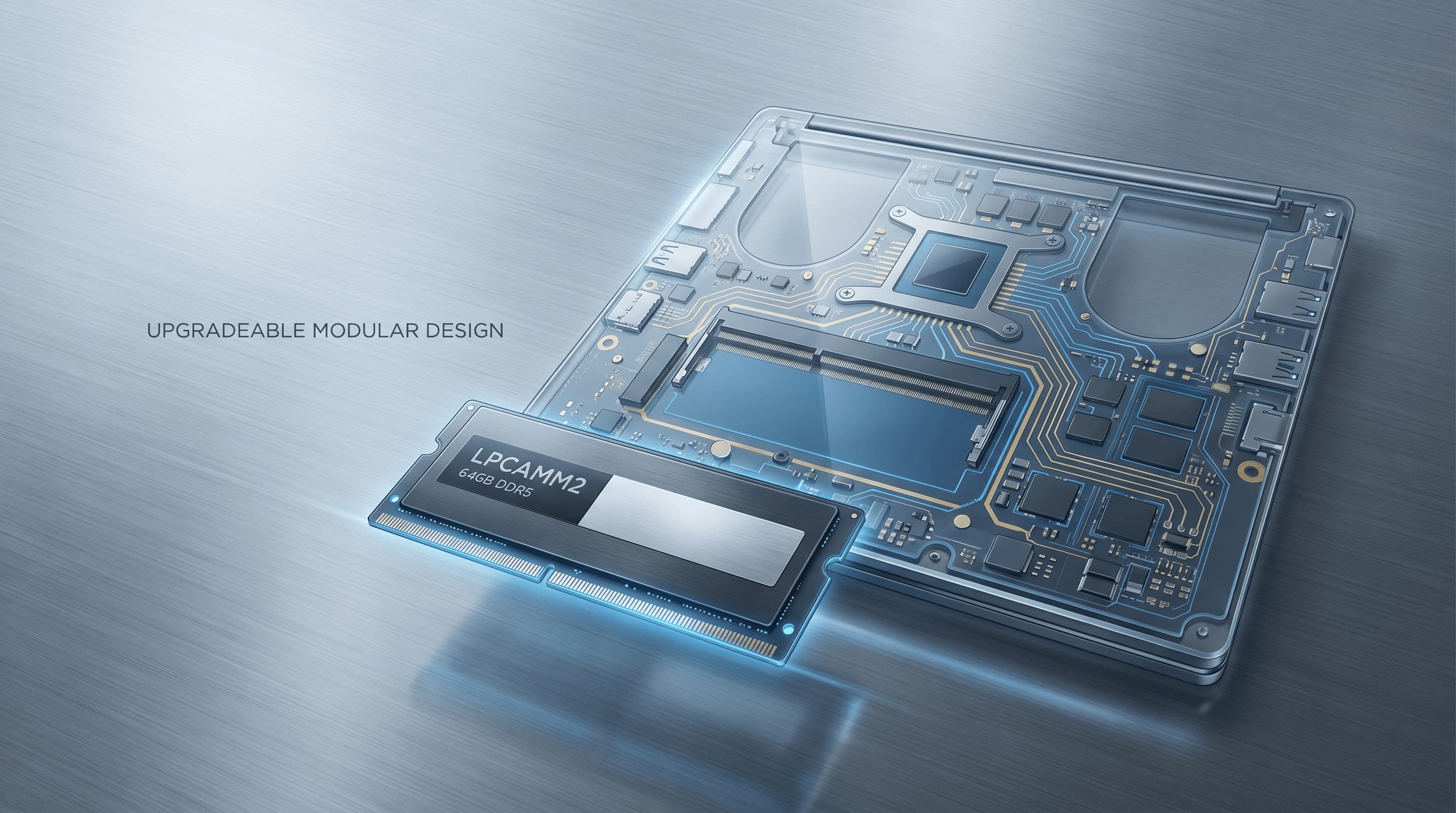
For more than a decade, thin laptops have been moving in one frustrating direction: less user-upgradeable memory, more soldered RAM. Buyers were told this was the unavoidable price of better battery life, slimmer designs, and faster performance. That explanation was not completely wrong. Modern LPDDR memory really does make more sense when board space is tight and every milliwatt matters. But it also created an ugly side effect: many of the nicest portable computers became disposable in the exact area that ages fastest.
LPCAMM2 matters because it offers a serious alternative to that compromise. It is not a nostalgic return to bulky upgrade doors or thick workstation chassis. Instead, it is a newer module format designed to bring LPDDR-style advantages into a removable, serviceable design that can fit modern thin laptops. If adoption expands, it could give buyers a rare combination that the industry has mostly treated as impossible: thinness, high bandwidth, and upgradeable RAM in the same machine.
Why thin laptops moved to soldered LPDDR in the first place
The move away from SO-DIMM slots was driven by physics as much as by fashion. Traditional SO-DIMM modules are relatively tall, use longer traces, and add connector complexity that makes very thin systems harder to design. As CPUs and integrated GPUs demanded more memory bandwidth, and as power efficiency became a competitive feature, laptop makers increasingly favored LPDDR. That memory standard was designed for lower power use and better signaling at high speeds, but it works best when it sits very close to the processor with carefully tuned routing.
Soldered LPDDR solved several problems at once. It reduced package height, helped signal integrity, simplified board layout around high-speed memory links, and often improved idle power behavior. Those are real gains. In ultraportables, even a small reduction in thickness or board area can free up room for a larger battery, better cooling, or extra SSD capacity. Manufacturers also like the manufacturing predictability of soldered memory because it removes a socket, reduces moving parts, and narrows the range of supported configurations.
The downside is familiar to anyone who has hit a memory ceiling too soon. When RAM is soldered, the purchase decision becomes permanent. If 16GB seemed generous in year one but feels cramped in year three, there is no easy fix. And year three now arrives faster than it used to. Browsers hold more tabs and heavier web apps. Local AI features are starting to reserve memory for inference, transcription, image tools, and search across personal data. Creative workflows in photo, audio, video, and 3D tools also scale quickly with more RAM. A laptop that is still fast enough at the CPU level can feel old simply because memory is fixed.
What LPCAMM2 changes
LPCAMM2, short for Low Power Compression Attached Memory Module 2, is designed to bridge the gap between soldered LPDDR and classic socketed memory. Instead of using a tall SO-DIMM slot, it uses a flatter compression connector and a low-profile module. That reduces z-height dramatically and makes the module far more suitable for slim laptops. More importantly, it is built around LPDDR-class memory behavior rather than trying to force older module assumptions into modern machines.
In practical terms, LPCAMM2 gives laptop designers a way to keep many of the benefits of LPDDR while regaining serviceability. A bad memory module can be replaced without replacing the whole motherboard. A buyer who underestimated future needs could move from 16GB to 32GB or higher later, assuming the vendor supports it. Enterprise fleets could service failed units faster. Repair shops could swap memory as a part instead of quoting a full logic-board replacement.
That sounds simple, but it addresses one of the worst trends in premium computing. For years, portability and repairability have been framed as enemies. LPCAMM2 suggests they do not have to be.
LPCAMM2 versus soldered memory
Thickness and board efficiency
Soldered memory still has the absolute edge in minimalism. Chips placed directly on the board can be optimized around the exact chassis design, and there is no removable module hardware at all. If a vendor wants the thinnest possible motherboard stack-up, soldered LPDDR remains the cleanest solution. LPCAMM2 does add a connector and a removable card, so it cannot be quite as pure.
But the gap is much smaller than the one between SO-DIMM and soldered memory. That is the whole point. LPCAMM2 can fit designs that would never tolerate a traditional memory slot, which makes it relevant to mainstream premium laptops rather than only bulky mobile workstations.
Signal integrity and performance
Soldered LPDDR remains the reference point for the shortest electrical path and the tightest control over signal routing. That can make validation easier at the edge of very high speeds. Even so, LPCAMM2 was created specifically to support modern high-speed memory requirements better than SO-DIMM can. In other words, it is not just removable memory, it is removable memory engineered for the signal demands that pushed vendors toward soldering in the first place.
For most real users, the important story is that LPCAMM2 is much closer to soldered LPDDR behavior than SO-DIMM is. That makes it far more credible in thin designs that also rely on integrated graphics or AI accelerators sharing system RAM.
Serviceability and lifespan
This is where LPCAMM2 clearly wins over soldered memory. If the module fails, replace the module. If your workload grows, replace the module. If you want to extend the life of a still-good laptop for a few more years of heavier software, replace the module. Soldered RAM offers none of that flexibility. Once it is chosen and shipped, it becomes a permanent limit and a frequent repair liability.
LPCAMM2 versus SO-DIMM
Thickness
SO-DIMM remains fine for thicker laptops, many mini PCs, and machines where chassis height is not under extreme pressure. But in thin premium laptops, it is usually too tall and too awkward. LPCAMM2 is substantially slimmer, which is why it has a real chance where SO-DIMM effectively lost the fight.
Capacity scaling and channel layout
LPCAMM2 can also simplify capacity scaling. One module can consolidate what otherwise might require multiple memory packages or more complex board decisions. Depending on platform design, that can help vendors offer broader RAM tiers without redesigning the motherboard as aggressively. For buyers, it can also make future upgrades more straightforward than hunting for matched SO-DIMM kits with the right timings, ranks, and limits.
Manufacturing complexity
SO-DIMM is mature, common, and cheap at scale. LPCAMM2 is newer, so there will be ecosystem friction. New connectors, validation paths, sourcing, thermal considerations, and inventory planning all add complexity. Manufacturers do not adopt a new memory form factor just because users like the idea. They adopt it when performance, platform simplification, product differentiation, and supply chain logic line up well enough.
That is why LPCAMM2 is promising, not guaranteed. It is technically elegant, but it still has to become boringly practical for OEMs.
Why this matters more in the AI era
The memory conversation is becoming more urgent because software is getting hungrier in ways users notice immediately. Local AI features are no longer lab demos. They are appearing in operating systems, browsers, note apps, image editors, coding tools, and creative suites. Many of these features work best when models, embeddings, caches, and active documents can stay resident in RAM. At the same time, integrated GPUs keep borrowing from system memory for graphics, video, and AI acceleration.
That means RAM pressure arrives from several directions at once. A browser with dozens of tabs, a design app, a video meeting, local transcription, and background AI helpers can overwhelm yesterday’s “enough” configuration. In that world, fixed soldered memory looks less like elegant engineering and more like an expiration date. LPCAMM2 cannot solve every laptop tradeoff, but it can make modern thin machines less brittle and less disposable.
The catch: adoption will decide everything
LPCAMM2 is not magic. It may cost more than soldered memory in some designs. It may be harder to package in the absolute thinnest flagship systems. Some vendors may prefer the margins and product segmentation that fixed RAM enables. And buyers should expect early adoption to appear first in premium or business-oriented machines, not instantly across the budget market.
Still, the direction is compelling. If the industry is serious about longevity, repairability, and AI-ready personal computing, removable high-performance memory needs a path back into thin laptops. LPCAMM2 is the first standard in a long time that looks genuinely built for that job. It does not erase the engineering reasons soldered LPDDR became dominant. It simply argues, convincingly, that those reasons no longer have to end the conversation.