Internet Exchange Points Are Becoming Strategic Regional Infrastructure
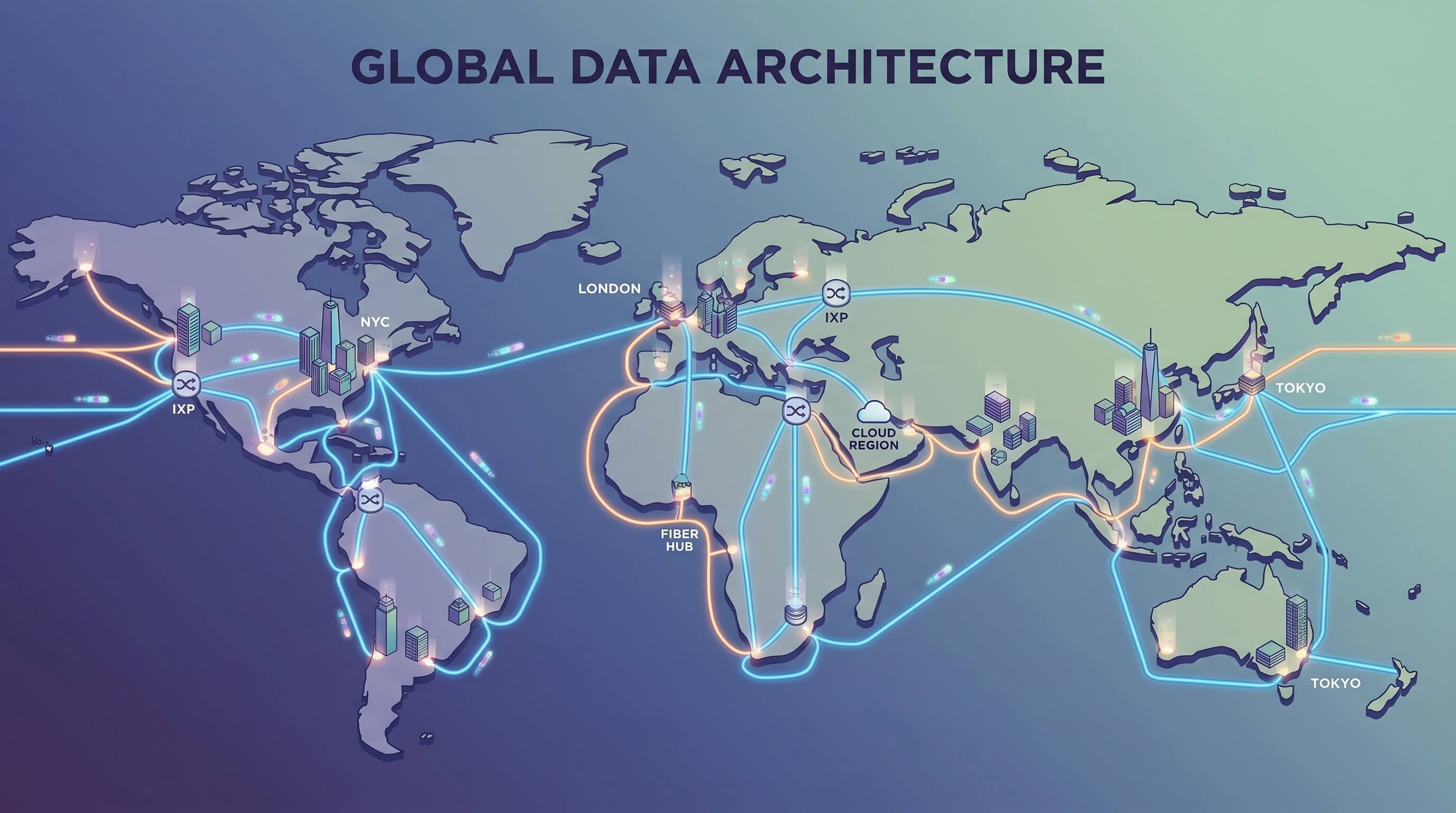
Internet exchange points used to sit in the background of network strategy. They were important to carriers, content delivery networks, and a relatively small circle of peering specialists, but they rarely appeared in broader conversations about economic development or digital policy. That has changed. In 2026, IXPs increasingly look less like niche telecom facilities and more like strategic regional infrastructure that can influence how fast, resilient, and locally grounded the internet feels for businesses and citizens.
The reason is straightforward. More of the modern internet now depends on keeping traffic local when possible. That includes cloud applications, streaming, payments, public services, gaming, collaboration software, and a growing wave of AI workloads that are highly sensitive to latency, bandwidth cost, and network reliability. Regions that can exchange more traffic locally reduce avoidable detours, improve performance, and create better conditions for cloud and platform investment. Regions that cannot often end up paying extra for longer paths, weaker resilience, and less control over how their digital economy scales.
IXPs matter because distance still matters
There is a persistent myth that the cloud made geography irrelevant. In practice, geography still matters a great deal. Even when services are delivered over global platforms, physical distance affects round-trip time, routing complexity, and failure domains. An IXP helps networks in the same market exchange traffic directly instead of sending it through expensive upstream transit or remote hubs. That can cut latency for end users, but it also reduces network waste that compounds at scale.
This matters more in regions that are trying to develop stronger local digital ecosystems. When traffic between two local networks has to leave the country or even the continent before returning, the result is not just slower performance. It also means more dependence on external carriers, more exposure to upstream outages, and weaker economics for local hosting. IXPs are one of the simplest ways to correct that imbalance.
Regional cloud growth depends on local interconnection
Cloud expansion is making the strategic value of IXPs easier to see. Hyperscalers, regional cloud providers, SaaS vendors, and CDN operators all care about efficient access to users. They may build availability zones, edge footprints, or caching nodes in a market, but those investments work better when the interconnection environment is mature. A healthy IXP lowers the friction of reaching many local networks through one neutral meeting point.
That changes the economics of where platforms deploy capacity. An IXP by itself does not create a cloud region, but it makes the market more legible and more efficient for infrastructure providers. It signals that there is enough coordination, traffic density, and network maturity to support local delivery. That can attract more caches, more cloud on-ramps, and eventually more reasons for enterprises to keep workloads closer to home.
In that sense, IXPs often function as enabling infrastructure. They do not replace fiber, data centers, or cloud investment, but they help those layers work together. Regions that want more local digital capacity increasingly need to treat neutral interconnection as part of the package, not as an optional extra.
AI-era traffic raises the stakes
The return of network strategy in the AI era gives IXPs a new relevance. AI services generate different traffic patterns from traditional web browsing. Model inference can involve large responses, retrieval pipelines, real-time interactions, and repeated access to cloud resources. Training traffic is concentrated in data centers, but user-facing AI products still depend on delivering low-latency experiences to distributed populations. That makes network efficiency valuable again in very practical ways.
As more AI features move into search, software, customer support, media tooling, and public services, regions will care more about where those requests are served and how much of that path stays local. Better local peering cannot solve every AI infrastructure problem, but it can reduce unnecessary backhaul and improve performance consistency. In markets with limited international capacity or high transit costs, that difference becomes even more important.
Resilience is now part of the IXP story
Latency is only part of the argument. Resilience matters just as much. When networks have richer local interconnection, they often gain more routing options during failures or congestion events. Outages are rarely eliminated, but an ecosystem with multiple local participants and exchange paths is generally less fragile than one that depends heavily on a small number of external transit links.
That resilience argument has become stronger as governments and enterprises rethink critical digital dependencies. Payments, public administration, healthcare systems, logistics, and communications increasingly run over internet-connected services. If core local traffic can continue to circulate efficiently during upstream disruption, that is a practical infrastructure advantage, not a theoretical one.
This is also why IXPs have started to appear in conversations about national digital resilience and continuity planning. They are not a complete answer, but they are part of the architecture that helps a regional internet keep working under stress.
Digital sovereignty is partly a routing question
Digital sovereignty is often discussed in terms of cloud contracts, data protection law, semiconductor policy, or platform dependence. Those are real issues, but the routing layer deserves more attention than it usually gets. If local traffic routinely exits the jurisdiction before coming back, then some sovereignty ambitions remain incomplete at the network level.
An IXP does not guarantee data sovereignty, and policymakers should avoid simplistic claims. Still, it improves the conditions for local handling of local traffic. That supports domestic hosting, regional services, and more predictable governance over critical network paths. For countries trying to strengthen their digital autonomy without building everything themselves, neutral interconnection is a practical lever.
What makes an IXP strategically successful
Not every exchange point automatically becomes strategic infrastructure. Success usually depends on governance, neutrality, technical reliability, and the ability to attract meaningful participation. Networks need to trust that the exchange is run fairly, priced sensibly, and connected to suitable facilities. Carriers, ISPs, mobile operators, cloud platforms, CDNs, and enterprise networks all need a reason to join.
The strongest IXPs also benefit from surrounding ecosystem choices. Carrier-neutral data centers, cross-connect simplicity, local technical communities, and supportive but non-intrusive policy can all help. The best public role is often to recognize the IXP as infrastructure and remove friction around power, facilities, permits, and regional connectivity, while letting the exchange remain operationally neutral.
The practical takeaway for regions
Regions that want better digital performance should stop treating IXPs as obscure telecom details. They are part of the economic plumbing that supports cloud growth, lower latency, stronger resilience, and more local value capture. In some markets, building or strengthening an IXP may deliver more practical internet improvement than another round of vague digital transformation language.
The broader point is simple. Internet exchange points matter again because the internet has become more strategic again. AI-era traffic, regional cloud competition, resilience planning, and digital sovereignty have all pushed interconnection back into view. The places that invest seriously in neutral, trusted local exchange will not just get tidier routing maps. They will be better positioned to host, serve, and govern the next phase of the internet.