Inference-Time Compute Is Reshaping How Researchers Measure AI Progress
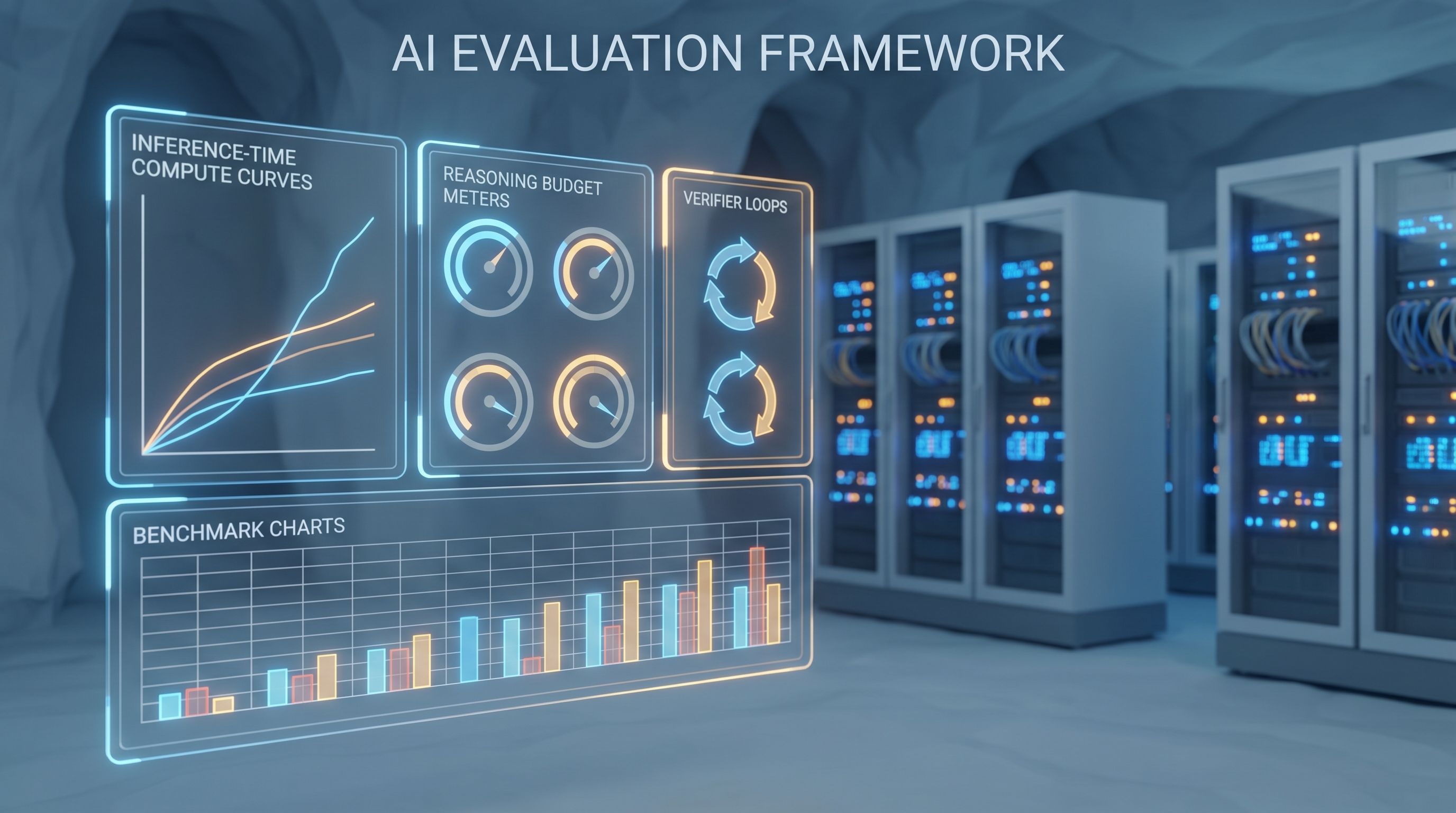
For years, the easiest way to summarize AI progress was to point to training scale. Bigger models, bigger datasets, bigger GPU clusters, and larger training runs appeared to produce a fairly direct story: capability rose when parameter counts and pretraining budgets rose. That framing was useful, but it is now visibly incomplete. Across reasoning-heavy tasks, researchers are paying closer attention to what happens after training, when a model is asked to solve a problem and can spend additional compute on search, reflection, decomposition, or verification.
The practical shift is important because it changes what a Benchmark result actually means. A model that answers a question in one pass is not operating under the same conditions as a system allowed to sample multiple chains of thought, call tools, run a verifier, or spend a much larger test-time budget on selection. As a result, many headline scores now combine base model capability with inference strategy. If readers do not separate those layers, they can easily misunderstand where progress is coming from.
Why parameter count stopped being enough
Parameter count still matters. Large models retain broader world knowledge, more latent skills, and stronger priors. But on many frontier evaluations, especially in mathematics, coding, agentic tasks, and scientific reasoning, raw one-shot performance no longer captures the ceiling. Researchers have repeatedly found that a model can do materially better if it is allowed to generate several candidate solutions, critique them, and choose among them with a verifier or reward model. In other words, capability depends not only on what was compressed during training, but also on how much extra thinking is purchased at inference time.
This matters because two models with similar training pedigrees can look very different once reasoning budgets are introduced. One model may improve dramatically when sampled repeatedly, while another may plateau quickly. One may benefit from tool use and external checking, while another mostly repeats the same failure mode. That means the old habit of reading a result table as a proxy for pretraining quality is getting weaker. Increasingly, the table reflects an interaction between the base model, the prompting scaffold, the search policy, and the verifier.
Inference-time compute is becoming a controllable resource
Researchers like this framing because inference-time compute is adjustable. Training runs are expensive and largely fixed once completed, but test-time budgets can be dialed up or down depending on the task. A system can spend more tokens on a hard Olympiad-style proof, less on routine summarization, and use selective compute only when uncertainty is high. This makes inference a scheduling problem rather than just a fixed pass through a network.
That change has strategic consequences. It encourages papers to report not just accuracy, but performance curves across different compute budgets. A model that looks average in a low-budget setting may become highly competitive once given room to branch and verify. Conversely, a flashy score achieved with heavy best-of-N sampling may say less about efficient reasoning than it first appears. As the community matures, readers should expect more plots showing capability versus latency, cost, and token usage, not just a single top-line number.
Reasoning budgets and verifier loops
The language of reasoning budgets is spreading because it gives a cleaner vocabulary for discussing these systems. A reasoning budget can include additional generated tokens, multiple sampled trajectories, external tool calls, or iterative self-correction. The key idea is that the model is not judged only on its first answer, but on what it can produce when allowed a bounded amount of extra search.
Verifier loops push that logic further. Instead of trusting the same generation process to both propose and evaluate an answer, researchers increasingly separate the roles. One model or process generates candidates, another checks them. In coding, the verifier may be unit tests. In math, it may be symbolic checking or a stronger model acting as a critic. In agentic workflows, it may be an environment that confirms whether the task was actually completed. These loops often produce large gains because many modern models fail less from having no useful intuition and more from failing to reliably select the right path on the first try.
This is why a paper that reports a dramatic new result deserves a second question: what was the verifier? If the verifier is extremely strong, domain-specific, or expensive, then the score reflects a full system design, not just a model improvement. That is not a flaw. It is often the real frontier. But it does change how the result should be interpreted and compared.
Evaluation methods are adapting, slowly
Benchmark design is now under pressure to catch up. Traditional leaderboards often flatten away the most important variables. They may fail to report the number of sampled attempts, the selection policy, the total token budget, or the latency tolerance. That makes comparisons messy. A model allowed to think for minutes and call tools is being placed beside a model restricted to a short direct answer. Both numbers can be true, yet they represent different products and different scientific claims.
Better evaluations are starting to specify constraints more clearly. Some papers report pass@k rather than pass@1, making the role of repeated sampling explicit. Others distinguish between base-model performance and scaffolded-system performance. A few evaluations now ask how much extra compute is needed to cross a threshold, which is often more informative than asking who has the single best maximum score. These are healthier habits because they reveal whether gains come from better priors, better search, or simply a larger willingness to spend tokens.
How to read benchmark claims more carefully
For practitioners, the immediate lesson is simple: when you see a state-of-the-art claim, look for the budget. Ask how many samples were drawn, whether a verifier filtered outputs, whether tools were used, and what latency or cost constraints were assumed. A benchmark result without those details increasingly describes only the tip of the system. The hidden part may be doing much of the work.
It is also worth checking whether the method scales smoothly. Some approaches improve only when compute is multiplied aggressively, which may be fine for research but impractical for production. Others gain steadily from modest extra reasoning, making them more relevant for real systems. The difference matters if you care about deployment rather than leaderboard theater.
There is a broader conceptual shift here. AI progress is being measured less like a static artifact and more like a policy for spending compute. The question is no longer only what the model knows after training. It is also how effectively the system can use additional time, tokens, and feedback to convert partial knowledge into reliable answers. That is closer to how humans assess difficult problem solving as well: not just raw recall, but the quality of search, checking, and correction.
Seen this way, inference-time compute does not replace model scale as a research axis. It complements it and, in some domains, exposes more of the real action. The strongest future evaluations will probably report both the capability of the underlying model and the efficiency with which a system turns extra compute into better outcomes. Until then, readers should treat benchmark numbers as system-level measurements with hidden assumptions, not as pure reflections of model size. That mindset leads to better comparisons, better product judgment, and a more realistic view of where AI progress is actually happening.