Inference-Time Compute Is Redrawing the Economics of Enterprise AI
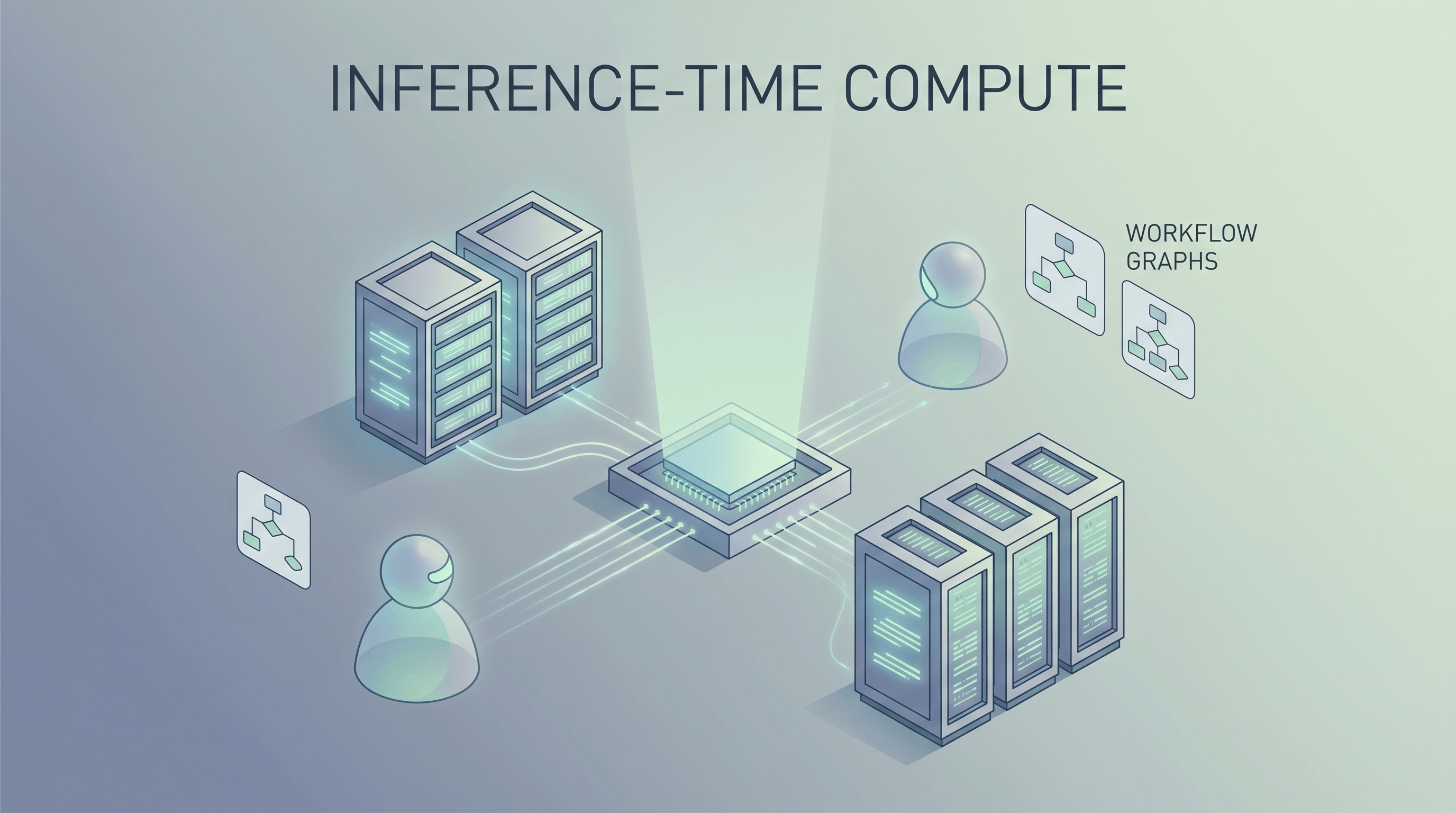
Enterprise AI used to be narrated as a training race. The hard part was assumed to be building or licensing a strong model, fine-tuning it on the right data, and then putting a clean interface on top. That framing is aging quickly. In 2026, the more consequential question for many companies is not what model they trained, but how much compute they burn every time the model actually does useful work.
That shift matters because the most valuable AI systems are no longer single-shot text generators. They are increasingly reasoning models, retrieval-heavy copilots, and multi-step agents that call tools, evaluate intermediate outputs, retry failed paths, and keep going until they finish a task. All of that happens at inference time. It means enterprise AI economics are being redrawn by the cost, latency, and reliability of live computation rather than by training alone.
The old AI cost model was too simple
For the first wave of generative AI adoption, companies mostly worried about access. Which provider had the strongest model? Would an API vendor remain stable? Should a team fine-tune a model or just write better prompts? Those questions still matter, but they do not fully explain why AI budgets are rising even as per-token prices fall.
The problem is that product behavior has changed faster than pricing headlines. A simple chatbot request might generate one answer and stop. A serious enterprise assistant often does far more. It may pull internal documents through RAG, reason over a long context window, call a search tool, produce a draft, critique that draft, rewrite it in a different format, and then route the result into another workflow. On paper, the final answer might look like one response. In compute terms, it can be the result of a small pipeline of decisions.
Deloitte argued in late 2025 that AI inference would account for roughly two-thirds of total AI compute in 2026, up from about one-third in 2023. That is not just a hardware forecast. It is a product forecast. It reflects the fact that companies are moving from model development toward large-scale usage, and usage is where real operating costs show up.
Reasoning changes the unit economics
Reasoning models are especially important here because they break the neat assumption that cheaper tokens automatically mean cheaper products. A model that spends more tokens thinking through a problem may deliver better accuracy, but it can also multiply runtime. Add verification steps or tool use and the cost expands again. For some workloads that is absolutely worth it. For others it quietly destroys margins.
This is why many AI teams are becoming obsessed with an idea borrowed from cloud engineering: not peak capability, but cost per successful task. A customer support workflow that resolves a case without escalation may justify a relatively expensive inference budget. A document summarizer that burns the same amount of compute to save someone 30 seconds probably does not. The enterprise buyer increasingly wants proof that inference spend maps to business outcome, not just to benchmark performance.
Infrastructure strategy is shifting upward and outward
Once inference becomes the dominant cost center, architecture decisions start to look different. Model choice still matters, but orchestration matters more than it did a year ago. Teams care about caching, prompt compression, routing low-risk tasks to smaller models, and reserving large reasoning models for cases where the extra thinking actually changes the answer. They care about observability: which prompts trigger long chains, which tools fail and force retries, which tenants create the worst cost spikes, and which workflows are accurate enough to automate fully.
This is also why the market is suddenly crowded with inference platforms, AI gateways, guardrail layers, and workflow runtimes. They are not just middleware looking for a problem. They exist because enterprise AI has become an operations discipline. If training defined the first competitive gap, then inference management is defining the next one.
Why smaller models keep getting stronger roles
The inference shift also helps explain the renewed interest in small and medium models. In many enterprise environments, the smartest available model is not automatically the best deployment choice. A smaller model that runs faster, costs less, and stays inside a predictable latency budget can be more valuable if it handles 80 percent of requests well enough. The large model becomes a specialist or escalation path rather than the universal default.
That pattern looks familiar because it resembles how mature software systems work. Not every request hits the most expensive database tier. Not every user action requires the deepest analytics pipeline. AI products are starting to adopt similar hierarchy. Fast models handle triage, classification, extraction, and drafting. Bigger reasoning systems intervene where ambiguity, legal risk, or revenue impact justify the spend.
The hidden budgeting fight
There is also an internal political consequence to all this. Training budgets are often approved as strategic bets. Inference budgets show up as recurring operational expense. Finance teams tolerate a one-time innovation push more easily than an open-ended monthly bill. That means AI leaders increasingly need to explain their systems the same way SaaS operators explain cloud spend: with utilization data, service tiers, and a clear argument about where the money goes.
Companies that ignore this will end up with an awkward mismatch. They will advertise AI across the product, then quietly rate-limit it, hide the best features behind premium plans, or discover that their most engaged customers are their least profitable ones. This is not a theoretical issue. It is the natural result of turning thought into metered infrastructure.
What enterprise teams should do next
The practical lesson is not to stop using advanced models. It is to design for selective intelligence. Measure task-level success instead of token volume alone. Profile the most expensive workflows. Split reasoning-heavy paths from routine ones. Instrument every tool call. Decide where latency matters more than perfect answers and where accuracy is worth deeper compute. Most of all, stop treating inference as a commodity line item.
That is the real turning point. Training made AI impressive. Inference is what makes it a business. The companies that understand this early will not just buy better models. They will build better cost structures, better product boundaries, and better operational discipline around AI systems that need to run all day, every day, at scale.