How AI Coding Agents Are Changing the Developer Toolchain
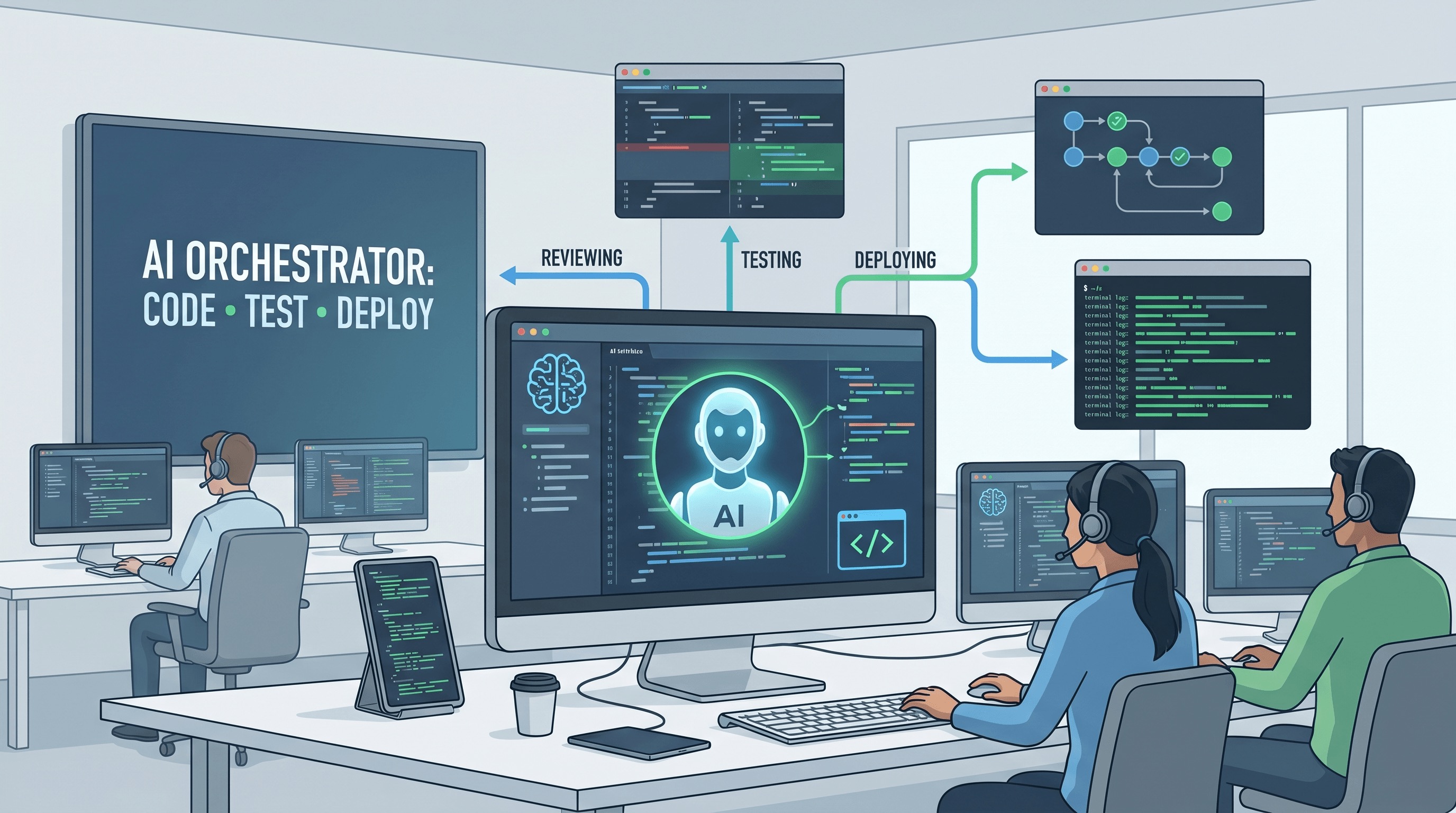
For years, AI in coding meant intelligent autocomplete or basic syntax suggestions. Tools like GitHub Copilot brought a significant leap, offering context-aware code snippets. But a new generation of AI coding agents is now emerging, moving beyond mere suggestions to actively participating in multi-step development workflows. This isn't about replacing developers; it's about fundamentally re-architecting the developer toolchain and redefining how we approach software engineering.
Beyond Autocomplete: What Are AI Coding Agents?
The distinction is crucial. While autocomplete predicts the next line of code, an AI coding agent is designed to understand a problem, inspect an entire repository, edit multiple files, run tests, debug errors, and even draft pull requests. Think of it less as a smart text editor and more as an autonomous assistant capable of executing a series of commands and interacting with various parts of your development environment.
These agents leverage large language models (LLMs) but augment them with tools and an execution environment. They can read documentation, interact with APIs, execute shell commands, and even browse the web to gather information. Benchmarks like SWE-bench, which evaluates agents on real-world software issues, demonstrate their growing ability to tackle complex problems. However, real-world utility isn't just about benchmark scores; it's heavily dependent on how these agents are scaffolded, what permissions they are granted, how well they integrate with existing tooling, and critically, how teams constrain and guide their behavior.
The Evolving SDLC: Where Agents Make an Impact
AI coding agents are poised to touch nearly every phase of the Software Development Life Cycle (SDLC):
Faster Prototyping and Scaffolding
Need to spin up a new microservice with a standard structure? An agent can generate boilerplate code, set up basic configurations, and integrate with existing project templates much faster than manual setup. This frees developers to focus on core business logic from the outset.
Broader Test Generation
Writing comprehensive tests is often a bottleneck. Agents can analyze existing code, identify potential edge cases, and generate unit, integration, and even end-to-end tests. This not only speeds up development but also potentially improves code coverage and reduces the likelihood of regressions.
CI/CD Triage and Debugging
When a CI build fails, an agent could be tasked with analyzing the logs, identifying the root cause, suggesting potential fixes, and even drafting a patch. This could significantly reduce the time developers spend on debugging build failures, allowing them to focus on new features.
Automated Documentation and Code Sync
Keeping documentation up-to-date with code changes is a perennial challenge. Agents can monitor code modifications, automatically update READMEs, generate API documentation, or even translate technical specifications into user-friendly guides, ensuring consistency and reducing documentation debt.
Intelligent Code Review Assistance
While human review remains indispensable, agents can act as a first pass. They can flag common anti-patterns, suggest performance improvements, ensure adherence to coding standards, identify potential security vulnerabilities, and even explain complex code sections to reviewers. This elevates the human review process, allowing developers to focus on architectural decisions and deeper logic.
The Tradeoffs: Navigating the New Landscape
While the benefits are compelling, adopting AI coding agents comes with significant considerations:
Larger, More Complex Pull Requests
An agent might generate a solution that spans multiple files and introduces a substantial number of changes. Reviewing such large pull requests (PRs) can be more time-consuming and error-prone for human developers, potentially negating some of the speed gains.
Hidden Errors and Subtle Bugs
Agents, despite their sophistication, can introduce subtle logical errors or edge-case bugs that are difficult for humans to spot during review. These "hidden errors" can manifest later in production, leading to costly fixes and eroding trust in the agent's output.
Compliance, Security, and Supply-Chain Risk
Sending proprietary code to external LLMs raises data privacy and compliance concerns. Agents might also inadvertently introduce insecure dependencies or suggest code patterns with known vulnerabilities, increasing supply-chain risks. Robust sandboxing and strict access controls are paramount.
Model Leakage and Data Privacy
There's a risk of proprietary code or sensitive information being inadvertently "learned" by a public model if not properly isolated, potentially leading to intellectual property leakage.
The Need for Human Architectural Judgment
Agents excel at tactical execution but lack strategic understanding. They cannot grasp the broader architectural implications, business context, or long-term vision of a project. Human developers remain crucial for high-level design, decision-making, and ensuring the overall coherence and maintainability of the system.
The Shift: Orchestration Over Automation
This evolution isn't about developers disappearing; it's about their role shifting. Developers are becoming orchestrators, defining the problems, setting the constraints, evaluating the outputs, and providing the critical human judgment that agents lack. The developer toolchain is becoming more orchestration-heavy, with a premium placed on robust guardrails, effective evaluation metrics, and, crucially, high-quality human review.
The focus moves from writing every line of code to designing the systems that write code, ensuring its quality, and integrating it seamlessly. The ability to effectively prompt, guide, and review agent-generated code will become a core competency for modern software engineers.
Where to Start: Actionable Guidance for Teams
Embracing AI coding agents requires a thoughtful, iterative approach:
- Start with Low-Risk Workflows: Begin by deploying agents for tasks that are well-defined, repetitive, and have minimal impact if errors occur. Examples include generating boilerplate, refactoring small code sections, writing unit tests for existing functions, or drafting documentation.
- Implement Explicit Permissions and Sandboxing: Treat agents like any new team member – give them only the access they need. Run them in sandboxed environments with limited network access and restricted file system permissions, especially when dealing with proprietary code.
- Develop Robust Evaluation Metrics: Don't just measure speed. Evaluate the quality, correctness, security, and maintainability of agent-generated code. Establish clear feedback loops to continuously improve agent performance and identify areas where human intervention is critical.
- Cultivate Tighter Review Habits: Never blindly trust agent output. Treat agent-generated code with the same scrutiny (or more) as code from a junior developer. Focus reviews on architectural soundness, potential side effects, and adherence to design principles, rather than just syntax.
- Focus on Augmentation, Not Full Automation: View agents as powerful assistants that augment human capabilities, not as replacements. The goal is to make developers more productive and allow them to tackle more complex, creative problems, not to remove them from the loop entirely.
The integration of AI coding agents into the developer toolchain is not a futuristic vision; it's happening now. By understanding their potential, acknowledging their limitations, and adopting them with a strategic, human-centric approach, teams can unlock significant productivity gains and reshape the future of software development.