Help Desk Social Engineering Is Becoming an Identity Security Failure Mode
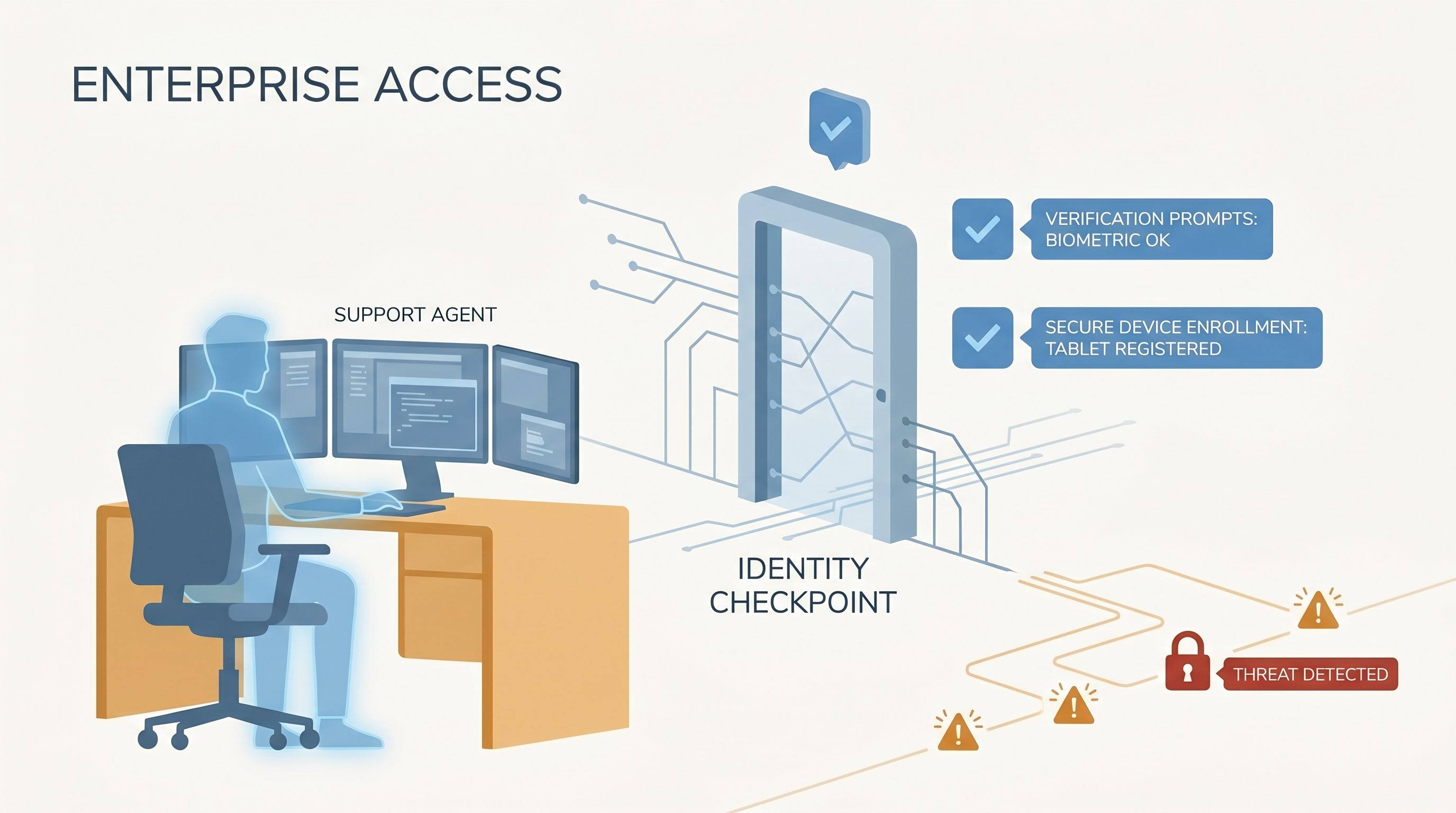
The enterprise help desk used to be treated as an operational function, measured by ticket volume, response time, and user satisfaction. That framing is now too narrow. In many organizations, the help desk can reset credentials, re-enroll devices, bypass friction for urgent users, and unblock access across a growing mix of SaaS, endpoints, contractors, and executives. Those are identity actions, not just support actions. As a result, help desk social engineering is becoming an identity security failure mode.
Attackers understand the leverage. Primary login flows often have better controls than recovery flows. MFA may protect sign-in, but an attacker who can convince support to reset a factor, enroll a new device, or override an account lock can route around those protections. The weakness is not always a broken authentication system. More often, it is a support process that is easier to exploit than the authentication path it is meant to back up.
The help desk is now part of the identity perimeter
Identity security discussions often focus on SSO, MFA, passwordless access, OAuth governance, and privileged access. Those controls matter, but they create a blind spot when organizations ignore the human workflows surrounding them. The help desk lives in that gap. It handles the edge cases, the urgent exceptions, and the account states that standard policy cannot resolve automatically.
That makes support teams attractive targets. An attacker does not need to defeat every layer of enterprise security if one persuasive interaction can trigger a reset or re-enrollment. The path may begin with a phishing email, then shift to a voice call, then continue in chat or SMS. Generative AI improves each stage by making impersonation more convincing, more scalable, and more adaptive. Voice cloning raises the pressure on agents who believe they are helping an executive. AI-assisted writing makes fraudulent requests look consistent with internal tone and process. Multi-channel impersonation helps attackers create the appearance of legitimacy across several touchpoints at once.
Identity sprawl expands the attack surface
This risk becomes more serious as identity sprawl grows. Modern organizations do not manage access only for full-time employees on standard laptops. They also support contractors with temporary access, executives who expect rapid exceptions, shared devices in frontline environments, and service accounts that connect systems behind the scenes. Every one of those cases adds complexity to verification.
Complexity is where social engineering thrives. Contractors may have incomplete records. Executives may demand urgency. Shared devices blur ownership. Service accounts often sit outside normal user lifecycle controls. Support teams are then asked to make judgment calls under time pressure. If the process depends too heavily on intuition, convenience, or visible confidence from the requester, attackers gain room to maneuver.
This is why the issue should not be treated as a training problem alone. Training helps, but it cannot compensate for workflows that rely on weak proof of identity. If an agent can be talked into taking a high-impact action with minimal independent validation, the organization has designed a bypass into its own identity perimeter.
High-risk support actions need stronger controls
Not every ticket is equal. Password resets, MFA changes, device re-enrollment, SIM or phone number updates, mailbox recovery, and privileged account unlocks should be handled as sensitive identity events. The operating assumption should be simple: if the action can restore or expand access, it deserves controls aligned with identity risk.
Several practices are especially important:
- Callback verification to known numbers, not numbers provided during the request. This reduces the chance that an attacker can control the verification channel during a live impersonation attempt.
- Phishing-resistant MFA for employees and administrators, especially for actions that alter enrollment state. Stronger MFA does not eliminate help desk abuse, but it raises the quality of identity assurance around recovery.
- Strict re-enrollment rules for devices and factors. Replacing an authenticator, enrolling a new endpoint, or changing recovery methods should require more than a single conversation.
- Step-up approval for sensitive actions. High-impact requests should require additional approval, ideally from a separate trusted workflow rather than from the same channel used by the requester.
- Audit trails that clearly record who requested what, which checks were performed, which exceptions were granted, and who approved them. Good logs improve investigations and also create accountability that shapes better behavior.
Operational speed cannot outrank identity assurance
Support leaders face a real tension. Users want fast resolution, and business operations do suffer when people are locked out. But speed without assurance creates a hidden transfer of risk from productivity metrics to identity compromise. In practice, attackers exploit that pressure. They create urgency, invoke seniority, and aim for the moments when a support agent is rewarded more for resolving friction than for resisting manipulation.
That tension should be resolved structurally, not emotionally. Agents need clear playbooks that normalize delay when identity proof is weak. Escalation should be easy. Refusal should be supported by policy. Exceptions should be visible and reviewable. The goal is not to make help desk staff suspicious of every user. The goal is to make high-risk identity changes difficult to perform without durable evidence.
Security teams should measure support workflows like authentication workflows
Many organizations test login security more rigorously than support security. They review MFA coverage, enforce conditional access, and monitor risky sign-ins, yet rarely apply the same discipline to account recovery or manual access restoration. That gap no longer makes sense.
Security teams should map which support actions can materially change identity state, document the proof required for each one, and test those workflows the way they test primary access controls. The question is not whether the help desk is part of identity security. It already is. The real question is whether the organization has accepted that reality in its controls, metrics, and ownership model.
Actionable takeaways:
- Treat password resets, MFA changes, and device re-enrollment as identity events, not routine support tasks.
- Require callback verification to known contact points for sensitive recovery requests.
- Use phishing-resistant MFA and stricter rules around factor and device replacement.
- Introduce step-up approval for high-impact support actions, especially for executives, contractors, and privileged accounts.
- Create auditable workflows so exceptions are documented, reviewable, and hard to abuse quietly.
- Review support processes anywhere identity sprawl exists, including shared devices and service accounts.